KAPDEC® | Elite STEM Learning Platform | https://kapdec.com
Unit : Cell structure and Function
Chapter: cell structure: subcellular components
Reference: Cell, Important discoveries, Types of cells, RER
SER, Spherosomes, Golgi bodies, Function of Golgi bodies, Lysosomes-Vacuoles, Chloroplast, Mitochondria, Endosymbiotic theory, Ribosomes
Learning objectives
- To understand the structure of subcellular components
Cell
- Basic unit of life
- structural unit of life
- Fundamental unit of life
- Functional unit of life
Important discoveries
- First cell was discovered by Robert Hooke in cork cells.
- First living cell was discovered by A.V Leeuwenhoek
- Cell theory was given by Schleiden (German botanist) and Schwann (British zoologist)
The following are the points of cell theory
- Organisms are formed from cells and their interactions
- Activity of an organism is a result of interactions
- All cells came from pre-existing cells -this was given by Rudolf Virchow “Omnis -cellula -e-cellula”
Types of cells
- Mycoplasma (PPLO)-smallest cell-0.3um
- Bacteria – 3-5um
- Human cell- 7um
- Largest cell-Ostrich egg(170x150mm)
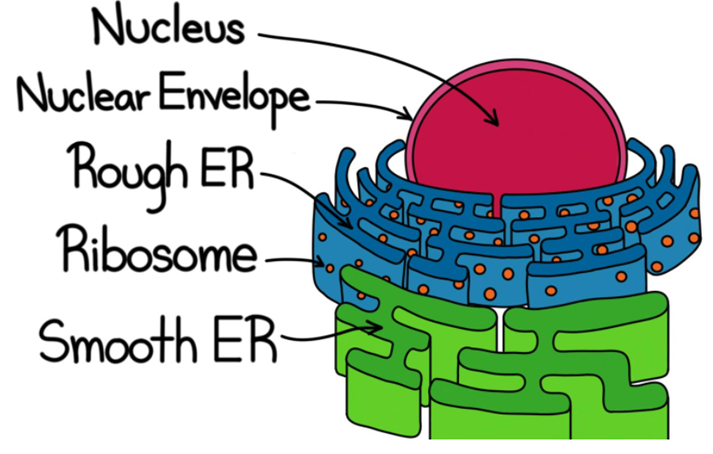
Endoplasmic reticulum which means inside cytoplasm network. It divides the cell into two parts luminal (cavity inside ER) and extra luminal. They are found in the form of cisternae, vesicles, and tubules. There are two types of E.R: smooth ER and rough Cristerna makes RER. Tubules makes SER
Source: Kapdec.com
RER– it is rough because of ribosomes. It is granular in nature and helps in protein synthesis. They are the precursor for lysosome enzymes. Ribosomes are attached via proteins Ribophorins 1 and 2. It is found in pancreatic and brain cells.
SER-it helps in detoxification of drugs in liver cells, synthesis of lipids and sterols
Spherosomes – vesicles which carry materials to Golgi from RER and SER
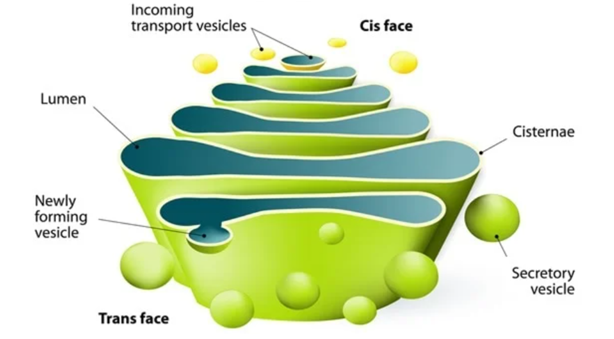
Golgi bodies-discovered by Camilo Golgi (1898). It is called dictyosomes in plants and Golgi bodies in animals. It is found in the form of cisternae, tubules, and vesicles.
Source: Kapdec.com
Function of Golgi bodies
- Secretion and transport of materials to outside
- Transport of substances within the cell as well
- helps in formation of acrosome present in head of sperms
- It helps in modification like in RER proteins and sugar are made glycoprotein (glycosylation) and in SER lipid and sugar made as glycolipids(glycoxidation).
- It creates some changes in plasma membrane.
- It helps in sugar synthesis like galactose and glycogen.
Lysosomes- shows polymorphism. These are vesicles released from Golgi apparatus and contains inactive hydrolytic enzymes. These enzymes can break lipids, carbohydrates, and proteins. These are called as primary lysosomes. These primary lysosomes fuse and becomes activated called as secondary lysosomes. The residual bodies are released in the form of waste called as exocytosis. They are called as suicidal bags. When lysosomes feel that the cell are metabolically inactive, they will burst and release their digestive enzymes which will digest the whole cell.
Vacuoles-single membrane organelle
- Sap vacuole-plant cell (90% volume). It stores mineral, anthocyanin(pigment) which is water soluble, water, gives support, structure. The outer membrane is called tonoplast.
- Contractile vacuole- it increases or reduces. It helps in osmoregulation
- Gas vacuole- it contains air bubble, no unit membrane, helps in buoyancy, found in bacteria.
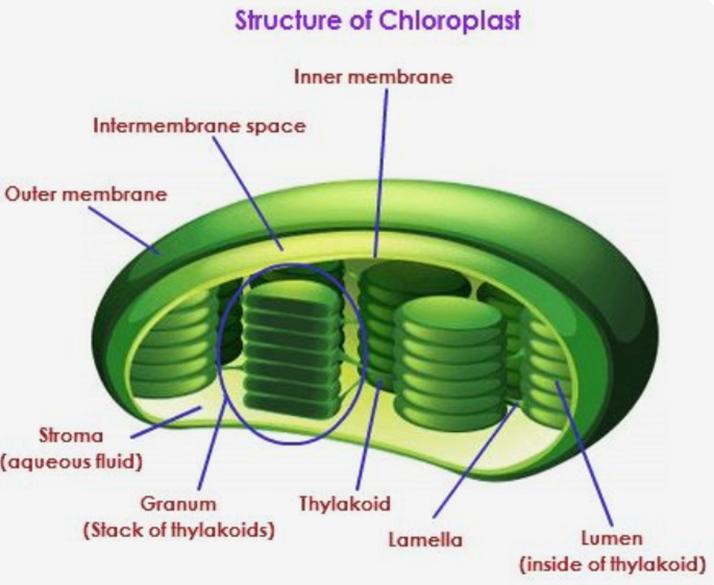
Chloroplast – it is the site of photosynthesis, double membrane organelle, thickness is 2.4um and length is 5-10um.There are one or many chloroplasts in a cell. It is filled with stroma and encloses thylakoids in it. Stacks of thylakoids are called grana which are attached by fret lamellae. Chloroplast is called semi-autonomous organelle which means self-dependent.
Source: Kapdec.com
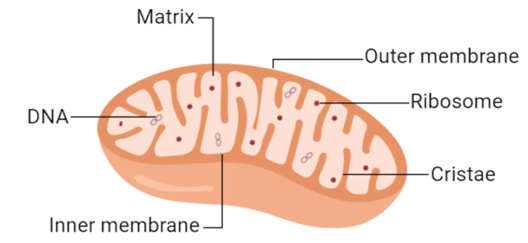
Mitochondria -it is called as powerhouse of cell which synthesizes ATP. It is double membrane organelle. The diameter is 0.2 um -1.0um and length is 1-4. 1um.A stain called Janus green is used to stain mitochondria, so cell never dies. The outer membrane is porous, the inner membrane is deeply folded called cristae. It is filled with matrix; all enzymes are present in matrix. F1-F0 particles or oxysomes or Fernandez and moranz particle One enzyme is present in inner mitochondrial membrane called succinyl dehydrogenase. It is semi -autonomous.
Source: Kapdec.com
Endosymbiotic theory-sometimes before mitochondria and chloroplast were prokaryotes. Then eukaryotic cell ate them up and started living symbiotically.
Similarities between mitochondria and chloroplast (due to these similarities they were called as prokaryotic in origin)
- circular ds DNA
- 70S Ribosomes
- High Guanine=Cytosine
- Both undergo binary fission
- Presence of porins in outer membrane
Ribosomes-membrane-less. They are protein factories-site of translation
Ribosomes are the granular structures composed of ribonucleic acid (RNA) and proteins. The eukaryotic ribosomes are 80S, while the prokaryotic ribosomes are 70S, made up of two subunits. ‘S’ stands for the sedimentation coefficient, which is indirectly is a measure of density and size.
Solved examples
Example 1. Which organelle uses digestive enzymes to break down old cellular components and/or invading bacteria/virus and recycles those components to other organelles for use in building new macromolecules?
a) Gap junction b) Nucleus
c) Golgi Body d) Lysosome
Solution 1: d) lysosome. It contains digestive enzymes which helps the cell to keep it clean.
Example 2. What is the role of ribosomes?
a) To store genetic information. b) To produce glycolipids.
c) To synthesize proteins. d) To hydrolyse waste materials.
Solution 2: c). Ribosome’s main function is to synthesize proteins.
Summary
- Cell is the structural and functional unit of life
- Mitochondria are important subcellular structures that make energy available to the cells. Their DNA is important in the endosymbiotic theory.
- Lysosomes are membrane-enclosed sacs that contain enzymes for the degradation of proteins, lipids, polysaccharides, and nucleic acid.
- The endoplasmic reticulum (ER) is a subcellular structure responsible for producing and transporting proteins and lipids.
- The Golgi apparatus is made of stacks of flattened membrane sacs.
- The central vacuole helps the plant cells stay rigid and contains water, salts, and enzymes.
- Chloroplast contain the green pigment chlorophyll that gives leaves their distinct color.
Scan to visit this resource online
https://kapdec.com/resources/cell-structure-subcellular-components
