KAPDEC® | Elite STEM Learning Platform | https://kapdec.com
Unit: Expressions and System of Equations
Chapter: Word Problems Involving Systems of Equations
Reference: – Interpreting real-life situations using algebraic equations, translating word problems into linear equations, identifying variables and setting up equations, solving systems using substitution method, solving systems using elimination method, Interpreting solutions in context of the problem, Identifying scenarios with no or infinite solutions, Applications in finance and budgeting, Applications in age-related problems
After studying this chapter, you should be able to understand:
- Interpreting real-life situations using algebraic equations
- Identifying variables and setting up equations
- Interpreting solutions in context of the problem
- Applications in age-related problems
Here is an elaboration on each of the topics under Word Problems Involving Systems of Equations:
- Interpreting real-life situations using algebraic equations: This involves analysing a real-world scenario and determining the mathematical relationships that exist between different variables. These relationships can then be modelled using algebraic equations.
- Translating word problems into linear equations: Word problems describe scenarios with quantitative information. This step involves translating the verbal information into one or more algebraic expressions or equations.
- Identifying variables and setting up equations: The first step in solving a word problem is identifying the unknowns (variables) and defining them clearly. After that, an equation is set up to represent the relationships between the variables.
- Solving systems using substitution method: This method involves solving one equation for one variable and then substituting that expression into another equation to find the value of the other variable. This helps to simplify complex problems.
- Solving systems using elimination method: The elimination method involves adding or subtracting equations to eliminate one of the variables, making it easier to solve for the remaining variable. This approach is often efficient for problems where variables can be easily cancelled out.
- Interpreting solutions in context of the problem: Once the system of equations is solved, the solution must be interpreted in the context of the original word problem. This involves ensuring that the solution makes sense and is meaningful in the real-world situation.
- Identifying scenarios with no or infinite solutions: Some word problems may not have a unique solution. In such cases, it’s important to recognize situations where there are no solutions (inconsistent system) or infinitely many solutions (dependent system).
- Applications in finance and budgeting: Systems of equations can be applied to financial problems, such as calculating income and expenses, determining profits, or solving problems involving investments and savings.
- Applications in age-related problems: Many word problems involve relationships between the ages of individuals at different points in time. Systems of equations are used to model such situations and determine unknown ages.
- Problems involving distance, speed, and time: These types of problems use the relationship between distance, speed, and time. Systems of equations are used to find missing information when given two or more variables related to these quantities.
- Comparison-based scenarios (prices, costs, quantities): Word problems may involve comparing quantities like the price of items, total costs, or quantities produced. Setting up systems of equations allows for determining the unknown quantities in these scenarios.
- Mixture or concentration-related problems: These problems often involve combining substances (such as chemicals, solutions, or ingredients) in certain proportions. Systems of equations help solve for unknown quantities in the mixtures based on given conditions.
Example: –
A school is organizing a charity event where they are selling two types of tickets: Adult Tickets (A) and Child Tickets (C). The tickets are sold at different prices:
- Adult Ticket: $15
- Child Ticket: $8
They sold a total of 250 tickets and raised $3,200. Additionally, they know that they sold 50 more adult tickets than child tickets.
Solution: –
Step 1: Define variables
Let:
A = number of adult tickets sold
C = number of child tickets sold
Step 2: Set up the system of equations
We are given two conditions in the problem:
- The total number of tickets sold:
A + C = 250
The total amount raised:
15A+8C=3200
- The relationship between the number of adult and child tickets:
A=C+50
Step 3: Substitute and solve the system using substitution
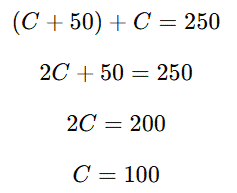
Using the third equation A=C+50, substitute this expression for A into the first two equations.
Substitute into A+C=250:
Source: Kapdec.com
Now that we know C=100, substitute this value into A=C+50 to find A:
A = 100 + 50 = 150
Step 4: Verify the solution with the second equation
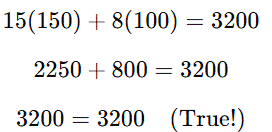
Now substitute A=150 and C=100 into the second equation
15A+8C=3200:
Source: Kapdec.com
Step 5: Interpret the solution
The solution to the system is:
- 150 adult tickets were sold, and
- 100 child tickets were sold.
Here are five conclusive points for Word Problems Involving Systems of Equations:
- Translation of real-world problems into algebraic equations helps in identifying relationships between variables.
- Solving using substitution and elimination methods offers strategies for finding unknowns in systems.
- Interpretation of solutions ensures that answers make sense in the context of the problem.
- Recognizing no or infinite solutions helps in identifying inconsistent or dependent systems.
- Applications in various fields like finance, age-related problems, and mixture scenarios showcase the versatility of systems of equations in real-world contexts.
Scan to visit this resource online
https://kapdec.com/resources/word-problems-involving-systems-of-equations
