KAPDEC® | Elite STEM Learning Platform | https://kapdec.com
Unit: Revisiting real numbers
Chapter: Precision & Accuracy
Reference: – Definition of Precision, Definition of Accuracy, Difference Between Precision and Accuracy, Significant Figures (Sig Figs), Rounding Off Numbers, Error in Measurement, Absolute Error, Relative Error, Propagation of Error in Calculations, Estimations and Approximations, Interval Notation for Precision, Truncation vs Rounding, Scientific Notation and Significant Digits
After studying this chapter, you should be able to understand:
- Definition of Precision & Definition of Accuracy
- Difference Between Precision and Accuracy
- Error in Measurement, Absolute Error & Relative Error
- Truncation vs Rounding & Scientific Notation and Significant Digits
1. Definition of Precision
Precision refers to the degree to which repeated measurements or calculations yield the same result. It reflects consistency or reproducibility, regardless of whether the result is correct.
2. Definition of Accuracy
Accuracy describes how close a measured or calculated value is to the actual, true, or accepted reference value. It reflects correctness or truthfulness of a result.
3. Difference Between Precision and Accuracy
While precision focuses on consistency across multiple attempts, accuracy focuses on how correct or close the result is to the true value. It is possible to be precise without being accurate, and vice versa.
4. Significant Figures (Sig Figs)
Significant figures are the digits in a number that convey meaningful information about its precision. They include all non-zero digits and certain zeros that indicate measurement accuracy.
5. Rounding Off Numbers
Rounding is the process of simplifying a number by reducing its digits while preserving its value to a certain level of precision. It helps maintain appropriate detail in calculations based on context.
6. Error in Measurement
Error in measurement refers to the unavoidable difference between a measured or calculated value and the actual value. It arises from limitations in tools, methods, or human estimation.
7. Absolute Error
Absolute error is the magnitude of the difference between the measured or estimated value and the actual value. It does not indicate the direction of the deviation—only its size.
8. Relative Error
Relative error is a comparative measure that expresses how large the absolute error is in relation to the true value. It gives a sense of the error’s significance in context.
9. Propagation of Error in Calculations
Propagation of error is the effect that errors in input values have on the result of a calculation. It explains how uncertainty in measurements carries through algebraic operations.
10. Estimations and Approximations
Estimation is the process of making a reasonable guess based on known information. Approximation is the act of using a value that is close to the actual number to simplify calculations.
11. Interval Notation for Precision
This refers to expressing a range within which the true value of a measurement lies, based on the degree of precision. It helps communicate uncertainty or tolerance around a value.
12. Truncation vs Rounding
Truncation removes digits beyond a certain point without adjusting the last retained digit, while rounding considers the next digit to decide how to adjust the retained value. Both affect how precision is presented.
13. Scientific Notation and Significant Digits
Scientific notation expresses very large or small numbers compactly using powers of ten, while preserving significant digits to reflect the precision of the value.
14. Tolerance in Algebraic Design
Tolerance is the acceptable range of variation in a measured or calculated value, especially in real-world applications like engineering or manufacturing, where exactness is not always possible.
15. Precision in Algebraic Formulas and Real Data
This involves using values with appropriate precision when substituting into formulas or analysing data, ensuring that results remain reliable and meaningful in applied problems.
Example: –
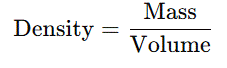
A formula used to calculate the density of a material is:
Source: Kapdec.com
A student measures mass and volume with the following precision:
- Mass is recorded to 4 significant figures
- Volume is recorded to 2 significant figures
When calculating the density, how many significant figures should the final answer have? Justify your answer theoretically based on the rules of precision and significant digits.
Solution: –
A student records:

Source: Kapdec.com
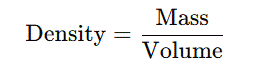
Use the formula:
Source: Kapdec.com
Step 1: Perform the Calculation

Source: Kapdec.com
Step 2: Identify Significant Figures in the Inputs
- Mass (125.6 g) has 4 significant figures
- Volume (46 cm³) has 2 significant figures
Step 3: Apply the Rule of Significant Figures for Division
- When dividing, the result must have the same number of significant figures as the input with the fewest.
- Here, volume limits the result to 2 significant figures.

Source: Kapdec.com
✅ Five Conclusive Points
- Precision and Accuracy Serve Different Purposes
Precision reflects consistency in repeated results, while accuracy indicates closeness to the true value. Both are essential for evaluating the reliability of mathematical and scientific work.
- Significant Figures Communicate Measurement Reliability
The use of significant figures in expressions and calculations conveys the level of precision, helping ensure that results do not falsely imply greater accuracy than the data allows.
- Error Analysis Is Crucial for Interpreting Results
Understanding and calculating absolute and relative error allows one to judge the credibility of a result, especially when dealing with measurements or estimates in real-world contexts.
- Approximation Must Balance Simplicity and Precision
Approximations simplify complex values but must be made carefully to preserve a meaningful level of accuracy appropriate to the problem or application.
- Proper Use of Precision Enhances Validity in Algebra
In algebraic problem-solving, especially with real data, maintaining appropriate precision ensures that solutions are not only mathematically correct but also practically useful and interpretable.
