KAPDEC® | Elite STEM Learning Platform | https://kapdec.com
Unit: Exponents & Powers
Chapter: Powers with Negative Exponents
Reference: – Understanding the meaning and interpretation of negative exponents, Rewriting expressions with negative exponents as reciprocals, simplifying algebraic expressions with negative exponents, Applying the laws of exponents with both positive and negative powers, evaluating expressions involving negative exponents, solving real-life problems using negative exponents, Identifying patterns and rules in exponent behavior
After studying this chapter, you should be able to understand:
- Understanding the meaning and interpretation of negative exponents
- Rewriting expressions with negative exponents as reciprocals
- Applying the laws of exponents with both positive and negative powers
- Identifying patterns and rules in exponent behavior
Here is the theoretical elaboration of each topic under “Powers with Negative Exponents”: –
- Understanding the meaning and interpretation of negative exponents
A negative exponent indicates the reciprocal of a base raised to the corresponding positive exponent. This concept helps shift expressions from the numerator to the denominator or vice versa in fractional terms. - Rewriting expressions with negative exponents as reciprocals
Negative exponents can be expressed as the reciprocal of the base raised to a positive exponent, which provides a method for simplifying and comparing expressions in rational form. - Simplifying algebraic expressions with negative exponents
Algebraic terms containing negative exponents are simplified by applying the rules of exponents to combine like bases and convert them into a form with positive exponents. - Applying the laws of exponents with both positive and negative powers
The standard laws of exponents—such as product of powers, quotient of powers, and power of a power—remain valid and are used with both positive and negative exponents to transform and reduce expressions. - Converting between standard form and exponential form with negative exponents
Expressions written in standard numerical form can be rewritten using exponential notation with negative exponents, particularly when representing small decimal values. - Evaluating expressions involving negative exponents
Expressions with variables or numbers raised to negative powers are evaluated by rewriting them in reciprocal form and then applying arithmetic or substitution techniques. - Solving real-life problems using negative exponents
Negative exponents often appear in scientific and engineering contexts to denote very small quantities, and are used in modeling phenomena such as decay, friction, or diminishing returns. - Identifying patterns and rules in exponent behavior
Recognizing how exponents behave in consistent patterns helps in generalizing and predicting outcomes when working with more complex algebraic expressions. - Understanding and avoiding common misconceptions in applying negative exponents
Learners are guided to avoid errors such as treating negative exponents as negative numbers or failing to apply reciprocal logic, thus ensuring accuracy in simplification and computation.
- Example: –
Given the expression:
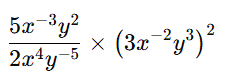
Source: Kapdec.com
Simplify the given expression using the laws of exponents.
- Express the final answer in terms of positive exponents only.
- Interpret the result and explain how negative exponents are used in the simplification.
Solution: –
Step 1: Apply the laws of exponents
Start with the given expression:
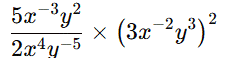
Source: Kapdec.com
First, simplify the fraction:
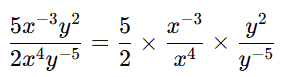
Source: Kapdec.com
Use the quotient of powers rule

Source: Kapdec.com
Thus, we get:
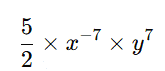
Source: Kapdec.com
Now, simplify the second part

Source: Kapdec.com
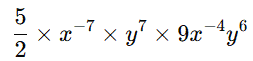
Step 2: Multiply the terms
Now, multiply the simplified parts together:
Source: Kapdec.com
Multiply the constants and combine the exponents for x and y:

Source: Kapdec.com
Step 3: Convert negative exponents to positive

Source: Kapdec.com
Final Answer:

Source: Kapdec.com
Here are 5 conclusive points for the topic “Powers with Negative Exponents”:
- Negative exponents indicate the reciprocal of the base raised to a positive exponent, helping to simplify complex expressions.
- Algebraic expressions with negative exponents can be rewritten as fractions, with the base moving to the denominator.
- The laws of exponents apply universally, even with negative exponents, allowing for simplification and combining terms.
- Negative exponents are commonly used in scientific notation to express small numbers or values close to zero.
- Understanding negative exponents is essential for solving real-world problems involving rates of decay, growth, and other phenomena.
