KAPDEC® | Elite STEM Learning Platform | https://kapdec.com
Unit: Similarity
Chapter: Area of Similar Triangles
Reference: – Similarity and Area Ratio, Proportionality of Corresponding Sides, Scaling Factor and Area, Area of Right Triangles, Application of the Area Ratio Formula, Area of Triangles with Known Sides, Applications in Geometric Problems, Relationship between Side Lengths and Areas, Perimeter and Area Ratios
After studying this chapter, you should be able to understand:
- Similarity and Area Ratio
- Proportionality of Corresponding Sides & Scaling Factor and Area
- Area of Right Triangles & Application of the Area Ratio Formula
- Relationship between Side Lengths and Areas & Perimeter and Area Ratio
Geometry: Triangles
AREA OF SIMILAR TRIANGLES
Source: Kapdec.com
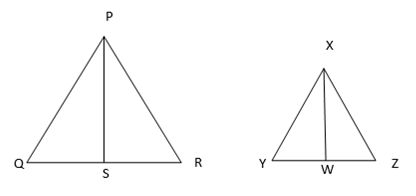
In similarity the ratio of the area of the similar triangles is equal to the square of corresponding sides or altitudes or median.
Similarity and Area Ratio – When two triangles are similar, the ratio of their areas is equal to the square of the ratio of their corresponding sides. This means that if the ratio of the sides of two similar triangles is k. This concept helps to understand how geometric figures scale in two dimensions.
Proportionality of Corresponding Sides – In similar triangles, the corresponding sides are proportional. This means that the ratio of the lengths of one pair of corresponding sides is the same as the ratio of the lengths of another pair of corresponding sides. The proportionality of sides is a fundamental property that helps in calculating the areas of similar triangles.
Scaling Factor and Area – The scaling factor (also known as the side ratio) is the ratio of the corresponding sides of two similar triangles. The area of one triangle will be scaled by the square of the scaling factor. For example, if the ratio of the corresponding sides of two triangles is
Area of Right Triangles – In similar right triangles, the area can be calculated using the ratio of the squares of the corresponding sides. Since the areas of similar triangles are proportional to the square of the side lengths, this property simplifies the calculation of the area when one of the triangles is a right triangle.
Application of the Area Ratio Formula – The formula for the area ratio of two similar triangles are the corresponding sides. This formula is used to solve geometric problems where the areas of similar triangles are involved, and either the area or the side lengths are unknown.
Area of Triangles with Known Sides – The area of a triangle can be determined using the base and height formula, or in the case of similar triangles, by using the known side lengths. For similar triangles, the area is proportional to the square of the ratio of the corresponding sides, helping to calculate unknown areas when given side lengths.
Applications in Geometric Problems – The area properties of similar triangles are applied in various geometric problems, including finding the area of objects in real-world scenarios such as determining the area of shadows, scaling objects in models or maps, and analyzing proportions in design and construction.
Relationship between Side Lengths and Areas – In similar triangles, if the side lengths of one triangle are multiplied by a factor, the area is affected by the square of that factor. For example, if all sides of a triangle are doubled, the area will increase by a factor. This relationship shows how changes in linear dimensions impact the area of similar triangles.
Perimeter and Area Ratios – While the ratio of the corresponding sides in similar triangles is the same for both perimeter and area, the effects on perimeter and area differ. The perimeter of similar triangles is proportional to the ratio of the corresponding sides (linearly), while the area is proportional to the square of the ratio of corresponding sides.
Comparing Areas of Multiple Similar Triangles – When dealing with multiple similar triangles, their areas can be compared by using the area ratio formula. If more than two similar triangles are involved, their areas can be calculated and compared based on their side length ratios, helping in solving complex geometric problems involving multiple triangles.
GIVEN: ∆PQR ~ ∆XYZ.
TO PROVE:

Source: Kapdec.com
CONSTRUCTION: Draw PS as perpendicular bisector of QR and XW as perpendicular bisector of YZ.
PROOF: In

Source: Kapdec.com
,
∠Q= ∠Y (∆PQR ~ ∆XYZ
∠PSQ= ∠XWY (Both are perpendicular bisector with 90°

Source: Kapdec.com
each)
∴ ∆PQS ~ ∆XYW
PSXW= PQXY (Corresponding sides are proportional as ∆PQS ~ ∆XYW )
PQXY= QRYZ= RPZX (Corresponding sides are proportional)
We can write, PSXW= QRYZ
The ratio: area of ∆PQRarea of ∆XYZ= 12×QR ×PS12 ×YZ ×XW
QRYZ × PSXW
QRYZ × QRYZ (PSXW= PQXY= QRYZ= RPZX)
QR2YZ2= RP2ZX2= PQ2XY2 (Square will also remain same as PQXY= QRYZ= RPZX
PYTHAGORAS THEOREM
Pythagoras theorem only works on right angled triangle. When a line is drawn from vertex opposite to hypotenuse, it divides the triangle into two similar ones.
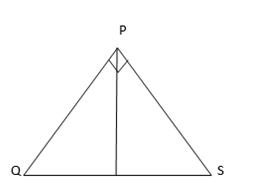
THEOREM 1: The Square of the hypotenuse is equal to the sum of squares of the other two sides in right angled triangle.
Source: Kapdec.com
GIVEN: PQS is a triangle whose ∠P = 90°

Source: Kapdec.com
.
TO PROVE:

Source: Kapdec.com
CONSTRUCTION: Draw a perpendicular PR on QS.
PROOF: In

Source: Kapdec.com
,
∠PQR= ∠PQS (Common Angle)
∠PRQ= ∠QPS (Both angles are 90°

Source: Kapdec.com
)
By A.A. axiom of similarity,
∆RQP ~ ∆PQS
Then, PQQS= QRPQ → PQ2=QR ×QS
In ∆RPS and ∆PQS,
∠PSR= ∠PSQ (Common angle)
∠PRS= ∠QPS (Both angles 90°

Source: Kapdec.com
)
By A.A. axiom of similarity,
∆RPS ~ ∆PQS
∴ PSQS= RSPS → PS2=RS ×QS
On adding PQ2 and PS2
PQ2+ PS2=QR ×QS+RS ×QS
QR+RS ×QS
QS2= PQ2+ PS2
The converse of this theorem is also true.
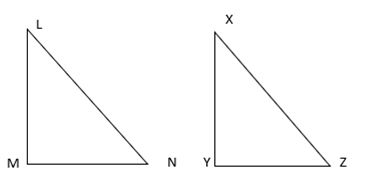
THEOREM 2: If square of one side is equal to the sum of the squares of the other two sides. The triangle has the angle opposite the first side is a right angle.
Source: Kapdec.com
Five-point conclusion summarizing the Area of Similar Triangles chapter in HS Geometry:
- Area Ratio and Side Ratio Connection – The key concept is that the ratio of the areas of two similar triangles is the square of the ratio of their corresponding sides, highlighting the relationship between linear and area scaling.
- Proportionality in Similar Triangles – The proportionality of corresponding sides in similar triangles allows for the straightforward calculation of areas using known side lengths, providing a practical tool for geometric problem-solving.
- Impact of Scaling – The scaling factor directly affects the area of similar triangles, and the area scales by the square of the scaling factor. This principle is critical in real-world applications such as map scaling, architectural design, and modelling.
- Applications in Real-World Problems – The area properties of similar triangles are extensively applied in real-world problems, such as determining areas in topography, architecture, and design, where indirect measurements are used to calculate areas based on proportional relationships.
- Distinct Difference Between Perimeter and Area – While perimeter and area are both proportional in similar triangles, the relationship differs: perimeter scales linearly, while area scales with the square of the side ratio, emphasizing the different ways these geometric properties are affected by scaling.
