KAPDEC® | Elite STEM Learning Platform | https://kapdec.com
Unit: Transformations
Chapter: Transforming Non-Polygonal Figures
Reference: – Definition of Non-Polygonal Figures, Transformations on Non-Polygonal Figures, Translation of Non-Polygonal Figures, Rotation of Non-Polygonal Figures, Reflection of Non-Polygonal Figures, Dilation of Non-Polygonal Figures, Composition of Transformations on Non-Polygonal Figures, Effect of Transformations on Curves and Circles, Applications of Transformations to Non-Polygonal Figures, Mapping and Transformation of Non-Polygonal Figures
After studying this chapter, you should be able to understand:
- Definition & Transformations on and of Non-Polygonal Figures
- Translation, Rotation & Reflection of Non-Polygonal Figures
- Effect of Transformations on Curves and Circles
- Mapping and Transformation of Non-Polygonal Figures
Definition of Non-Polygonal Figures – Non-polygonal figures refer to shapes that do not meet the formal definition of a polygon (a figure with straight sides). These include curved shapes like circles, ellipses, parabolas, and other irregular curves or surfaces. Unlike polygons, these figures do not have a finite number of straight edges, but they can still undergo geometric transformations.
Transformations on Non-Polygonal Figures – Transformations applied to non-polygonal figures are operations that change the position, orientation, or size of the figure in some way. These transformations can be similar to those applied to polygons, such as translations, rotations, reflections, and dilations, but they often involve specific methods tailored to the continuous nature of curves and non-polygonal shapes.
Translation of Non-Polygonal Figures – A translation is a transformation that slides a non-polygonal figure a fixed distance in a specific direction. Each point of the figure is moved the same distance and in the same direction. In the case of non-polygonal figures, this movement preserves the shape, size, and orientation, but only changes the position of the figure in the plane.
Rotation of Non-Polygonal Figures – Rotation involves turning a non-polygonal figure around a fixed point (the center of rotation) by a specified angle. This transformation keeps the figure’s shape and size unchanged but alters its orientation in the plane. When applied to curves or circular shapes, a rotation does not distort the figure but repositions it within the plane, often around a central point.
Reflection of Non-Polygonal Figures – A reflection is a transformation that flips a non-polygonal figure over a line of symmetry (the mirror line). Each point of the figure is mapped to a corresponding point on the opposite side of the line, maintaining the distance from the line of reflection. The shape and size of the figure remain unchanged, but the figure is reversed or reflected. For circular figures, reflections maintain the circularity but alter their orientation.
Dilation of Non-Polygonal Figures – Dilation is a transformation that changes the size of a non-polygonal figure, either enlarging or reducing it, while maintaining its shape. The dilation is controlled by a scale factor, which is the ratio of the size of the image to the size of the original figure. If the scale factor is greater than 1, the figure is enlarged; if less than 1, the figure is reduced. This transformation preserves the proportion and shape, but alters the size of the figure uniformly.
Composition of Transformations on Non-Polygonal Figures – The composition of transformations involves applying two or more transformations in sequence to a non-polygonal figure. The result of applying multiple transformations can lead to a final figure that is altered in position, orientation, or size based on the combination of each transformation. The order of transformations is important, as different compositions can result in different outcomes (e.g., a rotation followed by a translation may give a different result than a translation followed by a rotation).
Effect of Transformations on Curves and Circles – Transformations like rotation, reflection, and translation preserve the properties of curves and circles, such as their smoothness and roundness. However, dilation affects the size of the circle or curve. A rotation, for instance, keeps a circle in its original shape and position relative to its center, while a reflection mirrors it across a line. Dilation changes the radius of a circle, proportionally enlarging or shrinking it while maintaining its circular nature.
Applications of Transformations to Non-Polygonal Figures – In the real world, transformations of non-polygonal figures are commonly used in fields like computer graphics, architecture, engineering, and physics. For example, curves and circles in design may be rotated, translated, or scaled to fit different patterns. In physics, transformations help model and predict motion or force distributions. Computer graphics use these transformations to animate curved objects or shapes on screens.
Mapping and Transformation of Non-Polygonal Figures – Mapping in this context refers to the process of transferring one non-polygonal figure to another through a transformation. Mapping can involve simple transformations, such as translating a circle along a plane, or more complex ones, such as scaling or rotating curves. Transformations preserve certain properties of the figure (e.g., symmetry) while altering its position, size, or orientation. This concept is vital in fields like cartography (for mapping shapes and objects) and in computer graphics (for rendering and modifying curves).
Transforming Non-Polygonal Figures
Most of our transformation work has been with polygons so far. In this lesson, we will look at some of the properties of transforming the figures we have worked with that aren’t polygons, such as line segments, angles, circles, perpendicular lines, and parallel lines.
Line Segments
We will proceed with this lesson by going through the transformations we know performed on line segments.
Translations: There are no new special properties of a translation that occur when performing a line segment. Just like with polygons, the length of the line segment remains the same because a translation is a rigid motion.
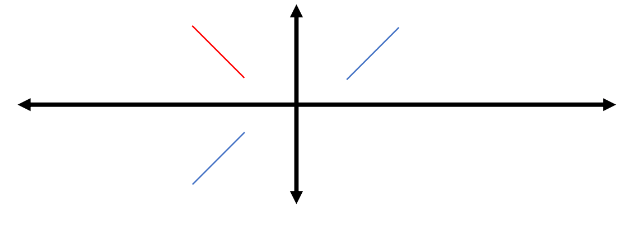
Reflections: Reflecting a line segment across a line of reflection perpendicular or parallel to a line segment will create a parallel line segment.
Reflecting a line segment across a line of reflection at a 45o or 135o angle to the line segment will create a perpendicular line segment.
Source: Kapdec.com
Rotations: All multiples of 180o create a parallel line, and 180o rotations about the center of the line segment are reflexive.
All other multiples of 90o form perpendicular line segments.
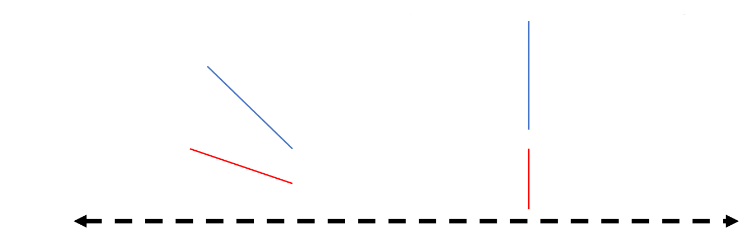
Dilations and Stretches: A dilation of a line segment will increase the length of a line segment by exactly the factor of dilation and will increase the distance of the line segment from the center of dilation by that factor as well. In the coordinate plane, this center of dilation is usually the origin.
A stretch always has an axis from which the figure is stretching. For example, in the coordinate plane, horizontal stretches are moving away from the vertical y-axis and vertical stretches are moving away from the horizontal x-axis.
If the line segment is centered at or on its stretch axis, it will not move any farther away from the stretch axis. Otherwise, its distance from the axis in the direction perpendicular to that axis will increase by the same factor as the factor of stretching. If the stretch direction is perpendicular to the line segment, only the distance will change. Thus, a stretch that is perpendicular to a line segment whose center lies on the stretch axis is reflexive.
A stretch will only create a line segment parallel to the pre-image if the direction of the stretch is parallel to the line segment. A stretch will never create a perpendicular line.
Source: Kapdec.com
Five-point conclusion summarizing the Transforming Non-Polygonal Figures chapter in HS Geometry:
- Transformations Can Be Applied to Non-Polygonal Figures – Non-polygonal figures, including curves and circles, can undergo various geometric transformations such as translations, rotations, reflections, and dilations. These transformations maintain specific properties like shape and size while changing other aspects like position and orientation.
- Preservation of Shape and Size – Many transformations, such as rotation, reflection, and translation, preserve the size and shape of non-polygonal figures. For example, a reflection or rotation of a circle retains its round shape, while translation only shifts its position.
- Dilation Alters Size – Dilation is the transformation that changes the size of non-polygonal figures. By using a scale factor, dilation can enlarge or reduce the figure, but it preserves the shape and proportion, making it useful for resizing objects while maintaining their characteristics.
- Compositions of Transformations Yield Complex Results – When multiple transformations are applied sequentially, the result can be more complex than individual transformations. Compositions can lead to new types of movements, such as combined translations and rotations, which affect the figure’s final position and orientation.
- Real-World Applications Are Extensive – Transformations of non-polygonal figures play a significant role in real-world applications, especially in computer graphics, architecture, and engineering. These transformations help model movement, design objects, and create visual effects by manipulating curves, circles, and other irregular shapes.
