KAPDEC® | Elite STEM Learning Platform | https://kapdec.com
Unit: Linear Graphs
Chapter: Introduction to Graphs
Reference: – Understanding Graphs and Their Importance, Cartesian Coordinate System, Types of Graphs, Plotting Points on a Graph, Understanding Graphical Representation of Equations, Identifying Patterns and Trends in Graphs, Applications of Graphs in Real Life, Interpreting Graphs and Their Key Features
After studying this chapter, you should be able to understand:
- Understanding Graphs and Their Importance
- Types of Graphs & Plotting Points on a Graph
- Applications of Graphs in Real Life
- Interpreting Graphs and Their Key Features
1. Understanding Graphs and Their Importance
- Graphs are powerful tools used to represent relationships between different sets of data visually.
- They help in understanding trends, identifying patterns, and making predictions based on available information.
- Graphs are commonly used in fields such as science, economics, business, and engineering to simplify complex information.
2. Cartesian Coordinate System
- The Cartesian coordinate system is a two-dimensional plane used to plot points and represent relationships between variables.
- It consists of a horizontal axis (x-axis) and a vertical axis (y-axis), which divide the plane into four quadrants.
- Each point on the graph is identified using an ordered pair, which specifies its position relative to the axes.
3. Types of Graphs
- Different types of graphs serve various purposes in data representation and analysis.
- Line graphs depict continuous data and trends over time.
- Bar graphs display categorical comparisons by using rectangular bars.
- Histograms represent frequency distributions and help in statistical analysis.
- Scatter plots show the relationship between two variables, helping to identify correlations.
4. Plotting Points on a Graph
- Graphs rely on accurately placing points based on their corresponding values.
- Each point is positioned according to its x-value and y-value, determining its exact location on the graph.
- Proper plotting of points is essential in creating accurate graphs for analysis and interpretation.
5. Understanding Graphical Representation of Equations
- Equations can be represented visually on a graph to illustrate mathematical relationships.
- The shape and direction of the graph depend on the type of equation used.
- Linear equations form straight-line graphs, while other equations can produce curves, parabolas, or other complex shapes.
6. Identifying Patterns and Trends in Graphs
- Observing a graph helps in identifying consistent patterns that indicate specific trends.
- Increasing trends indicate growth, while decreasing trends suggest a decline in values.
- Recognizing these patterns is useful in predicting future behavior based on past data.
7. Applications of Graphs in Real Life
- Graphs are extensively used in various real-world situations, from financial planning to scientific research.
- Businesses use graphs to track sales performance, while meteorologists rely on them to study climate changes.
- They provide a structured way to analyse data, making it easier to derive meaningful conclusions.
8. Interpreting Graphs and Their Key Features
- Graphs contain essential components such as slope, intercepts, and axes that provide critical information.
- The slope of a graph indicates the rate of change between variables.
- Intercepts represent the points where the graph crosses the axes, offering insight into initial conditions or zero values.
Example: –
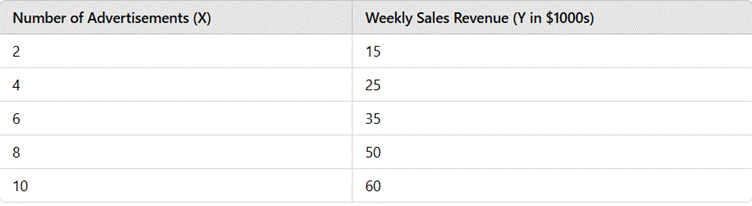
A company analyses the relationship between the number of advertisements displayed (X) per week and their weekly sales revenue (Y in $1000s). The collected data is shown below:
Source: Kapdec.com
(a) Plot the data points on a Cartesian plane.
(b) Identify the type of correlation.
(c) Find the equation of the trend line (line of best fit).
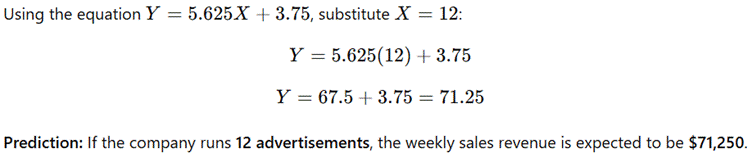
(d) Predict the sales revenue if the company runs 12 advertisements.
Solution: –
(a) Plotting the Data Points:
- The X-axis represents the number of advertisements.
- The Y-axis represents the weekly sales revenue in $1000s.
- The given data points are: (2,15), (4,25), (6,35), (8,50), (10,60).
- When plotted, the points show an increasing trend.
(b) Identifying the Correlation:
- As the number of advertisements increases, the sales revenue also increases.
- Since the data points form an upward-sloping pattern, this is a positive correlation.
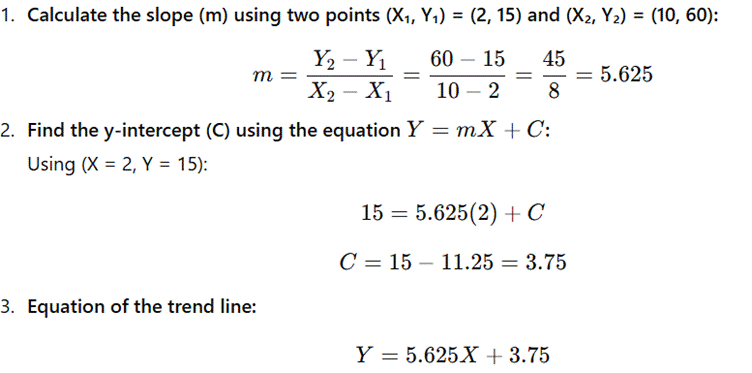
(c) Finding the Equation of the Trend Line (Y = mX + C):
Source: Kapdec.com
(d) Predicting Sales Revenue for 12 Advertisements:
Source: Kapdec.com
Here are five conclusive points for the topic “Introduction to Graphs” under Linear Graphs:
1. Graphs Simplify Complex Data Representation
- Graphs provide a visual method to understand relationships between different sets of data, making complex information easier to interpret.
- They allow for quick analysis of trends, comparisons, and patterns across various fields, including science, business, and economics.
2. The Cartesian Coordinate System Forms the Basis of Graphing
- The x-axis and y-axis help in accurately positioning data points and identifying relationships between two variables.
- Understanding the coordinate plane is fundamental to graphing equations, plotting points, and analysing linear relationships.
3. Different Types of Graphs Serve Unique Purposes
- Line graphs show trends over time, bar graphs compare categorical data, and scatter plots reveal correlations between variables.
- Choosing the appropriate type of graph is essential for correctly representing and interpreting data.
4. Graphs Help in Identifying and Predicting Trends
- Observing the direction and shape of graphs enables us to recognize increasing, decreasing, or constant patterns in data.
- By analysing past trends on graphs, predictions about future behavior or outcomes can be made with better accuracy.
5. Interpreting Graphs Enhances Decision-Making
- Understanding key graphical components such as slope, intercepts, and data points aids in making informed conclusions.
- Graphs support logical reasoning and evidence-based decision-making in various disciplines, from economics to scientific research.
