KAPDEC® | Elite STEM Learning Platform | https://kapdec.com
Unit: Factorization of Expressions
Chapter: Division of Algebraic Expressions -1
Reference: – Basic Division of Algebraic Expressions, Dividing Monomials, Dividing Polynomials by Monomials, Dividing Polynomials by Polynomials, Algebraic Fractions and Division, Remainder and Factor Theorem
After studying this chapter, you should be able to understand:
- Basic Division of Algebraic Expressions
- Dividing Polynomials by Monomials & Polynomials
- Algebraic Fractions and Division
- Remainder and Factor Theorem
- Fundamental Concept of Division in Algebraic Expressions
- The process of division in algebra follows similar principles as arithmetic division but applies to variables and coefficients.
- Each term in an algebraic expression can be divided individually or collectively using appropriate rules.
- Understanding division helps in simplifying expressions and solving equations effectively.
- Division of Monomials
- When dividing single-term algebraic expressions, the quotient rule of exponents is applied.
- The coefficients are divided normally, while the variables follow exponent rules for simplification.
- This method is essential for understanding polynomial division and algebraic fraction simplifications.
- Division of Polynomials by Monomials
- A polynomial divided by a single-term expression is separated into individual terms to simplify separately.
- This approach ensures that each term of the polynomial is divided correctly while maintaining algebraic consistency.
- Factorization may be used before division to simplify expressions further.
- Division of Polynomials by Polynomials
- When a polynomial is divided by another polynomial, structured techniques like long division are used.
- This division process involves repeated subtraction and simplification of terms until the remainder is obtained.
- Understanding this concept is crucial for advanced algebraic operations and solving equations efficiently.
- Algebraic Fractions and Their Division
- Division of algebraic fractions involves reciprocating the divisor and applying multiplication rules.
- Factoring is an important step before performing division to cancel common factors.
- Simplifying algebraic fractions aids in solving complex algebraic equations with rational expressions.
- Application of Remainder and Factor Theorems
- The remainder theorem helps determine the remainder when a polynomial is divided by a linear expression.
- The factor theorem provides insights into the roots of polynomials by testing divisibility.
- These theorems are widely used in algebraic problem-solving and polynomial analysis.
- Significance of Division in Algebraic Manipulations
- Division is an essential algebraic operation used in equation solving, calculus, and function analysis.
- Mastery of division techniques enhances mathematical problem-solving skills and conceptual understanding.
- This concept is extensively applied in real-world scenarios, including scientific computations and financial modeling.
Example: –
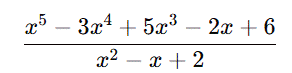
Simplify the following expression using appropriate division techniques:
Source: Kapdec.com
Solution: –
We will divide the polynomial using long division
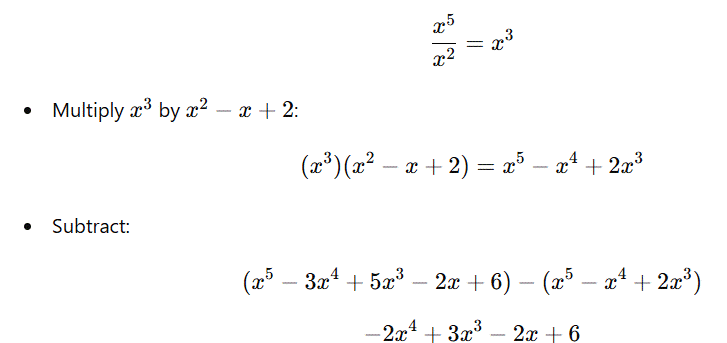
Step 1: Divide the first term
- The first term in the dividend is x5, and the first term in the divisor is x2
- Divide:
Source: Kapdec.com
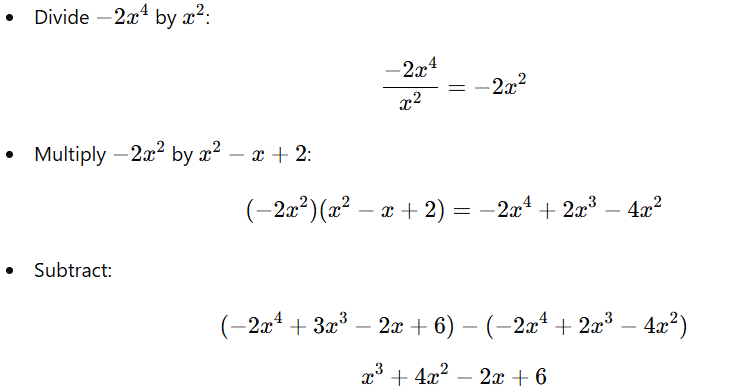
Step 2: Divide the next term
Source: Kapdec.com
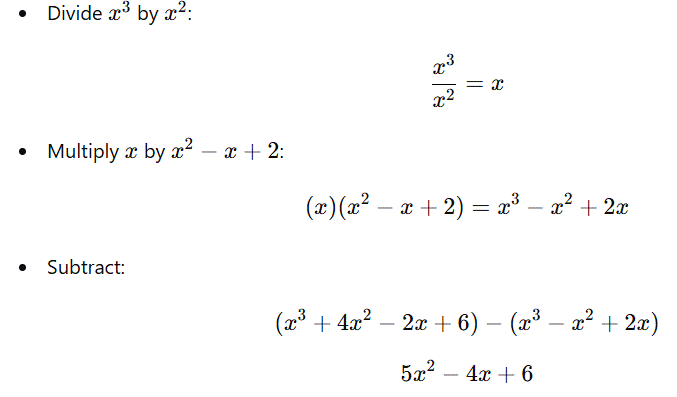
Step 3: Divide the next term
Source: Kapdec.com
Step 4: Divide the next term
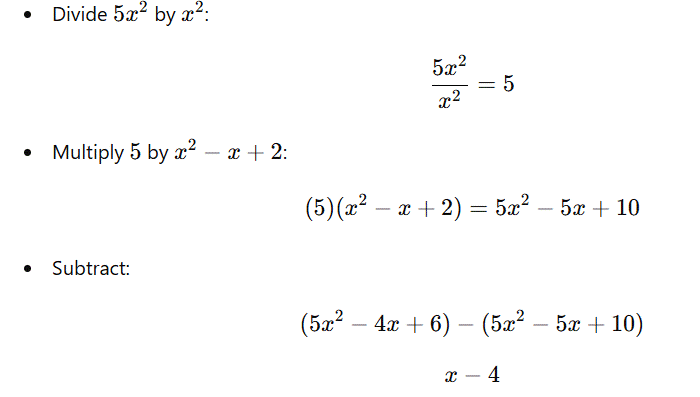
Source: Kapdec.com
Final Answer:

Source: Kapdec.com
Here are five conclusive points related to the Division of Algebraic Expressions:
- Division as an Essential Algebraic Operation
- The division of algebraic expressions is a fundamental skill in algebra, allowing for the simplification of complex expressions and solving equations.
- It helps break down larger expressions into manageable components, making it easier to work with algebraic fractions and polynomial equations.
- Application of Exponent Rules in Division
- When dividing algebraic expressions, exponent laws play a crucial role in simplifying terms.
- Understanding the quotient rule of exponents is essential for dividing expressions with variables efficiently.
- Long Division in Polynomial Expressions
- Polynomial division, especially when dividing a polynomial by another polynomial, follows a structured process similar to numerical long division.
- This method is useful in various algebraic applications, including factorization and function analysis.
- Factorization as a Simplification Tool
- Before dividing algebraic expressions, factorization can help break down terms to identify common factors.
- This approach ensures that the division process is efficient and results in simplified expressions.
- Real-World Relevance of Algebraic Division
- The division of algebraic expressions is widely used in scientific calculations, engineering, and data analysis.
- Mastering this concept enhances problem-solving skills and prepares students for more advanced mathematical applications.
