KAPDEC® | Elite STEM Learning Platform | https://kapdec.com
Unit: Measurement System
Chapter: Perimeter and Area of Circle
Reference: – Introduction to Circles, Circumference (Perimeter) of a Circle, Area of a Circle, Derivation of Area and Circumference Formulas, Area of Sector and Segment of a Circle, Length of an Arc, Applications and Word Problems, Combined Figures involving Circles
After studying this chapter, you should be able to understand:
- The fundamental concepts of the circumference and area of a circle.
- The formulas for the perimeter and area and their derivations.
- How to calculate the area of sectors and segments, and the length of arcs.
- How to apply these concepts to solve real-world problems.
Introduction to Circles
Definition
A circle is a closed curve in a plane where every point on the curve is equidistant from a fixed point called the center. The distance from the center to any point on the circle is the radius.
The perimeter of a circle is called its circumference. The region enclosed by the circumference is the area of the circle.
[Importance of Circles]
- Circles are one of the most fundamental shapes in geometry and nature.
- Understanding circles is essential for studying advanced mathematics, physics, and engineering.
- Calculations involving circles are used in daily life, such as in designing wheels, plates, and clocks.
- Forms the basis for understanding circular motion and waves.
Example
A circular park has a radius of 14 m. Find its circumference and area.
[Subtopics]
1. Basic Elements
- Center (O): The fixed point inside the circle.
- Radius (r): The distance from the center to any point on the circle.
- Diameter (d): Twice the radius; the longest chord passing through the center. d=2r
- Circumference (C): The perimeter or the total distance around the circle.
Key Points:
- The ratio of the circumference to the diameter of any circle is constant, denoted by the Greek letter π (pi). π≈3.14159
- π is an irrational number, meaning its decimal representation is non-terminating and non-repeating.
Circumference (Perimeter) of a Circle
[Definition]
The circumference of a circle is the total length of its boundary. It is the distance one would travel if they walked around the circle once.
The formula for the circumference (C) is:
C=2πr
or
C=πd
where r is the radius and d is the diameter.
[Importance of Circumference]
- Used to find the perimeter of circular objects.
- Essential in calculating distances in circular motion.
- Applied in problems involving fencing, binding, or framing circular regions.
Examples
- Find the circumference of a circle with a radius of 7 cm.
[Subtopics]
1. Derivation of the Formula
The value of π is defined as the ratio of the circumference (C) to the diameter (d) of any circle:

Source: Kapdec.com
. Rearranging gives

Source: Kapdec.com
. Since d=2r, we get C=2πr.
2. Application
Substitute the known value (radius or diameter) into the formula.
Example Solution:
Radius r = 7 cm
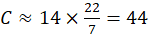
Circumference C=2×π×7=14π cm.
Using

Source: Kapdec.com
,
Source: Kapdec.com
cm.
Area of a Circle
[Definition]
The area of a circle is the amount of space enclosed within its circumference. It is measured in square units.
The formula for the area (A) is:

Source: Kapdec.com
where r is the radius.
[Importance of Area]
- Used to determine the space covered by circular objects.
- Essential in material estimation, like paint required for a circular surface.
- Applied in various scientific and engineering calculations.
Examples
- Find the area of a circle with a diameter of 10 cm.
[Subtopics]
1. Derivation of the Area Formula
The area can be derived by dividing the circle into many small sectors and rearranging them to form a parallelogram-like shape, which leads to the formula

Source: Kapdec.com
.
2. Application
Substitute the known value of the radius into the formula. If the diameter is given, first find the radius

Source: Kapdec.com
.
Example Solution:
Diameter d = 10 cm, so radius r=5 cm.
Area

Source: Kapdec.com
cm².
Using π≈3.14,

Source: Kapdec.com
cm².
Area of Sector and Segment of a Circle
[Definition]
- A sector of a circle is the region bounded by two radii and the corresponding arc. It resembles a ‘slice’ of the circle.
- A segment of a circle is the region bounded by a chord and the corresponding arc.
[Importance of Sector and Segment]
- Used in calculating areas of pie charts, clock faces, and circular fields.
- Essential for understanding portions of circles in design and architecture.
- Helps in solving problems involving partial areas of circles.
Examples
- Find the area of a sector with a central angle of 60° in a circle of radius 7 cm.
[Subtopics]
1. Area of a Sector
The area of a sector is a fraction of the area of the whole circle, based on the central angle θ (in degrees).

Source: Kapdec.com
If the angle is in radians,

Source: Kapdec.com
.
2. Area of a Segment
The area of a segment is found by subtracting the area of the corresponding triangle from the area of the sector.
Area of Segment=Area of Sector–Area of Triangle
For a segment with central angle θ (in degrees):

Source: Kapdec.com
Length of an Arc
[Definition]
An arc is a part of the circumference of a circle. The length of an arc depends on the radius of the circle and the central angle subtended by the arc.
[Importance of Arc Length]
- Used in calculating distances along curved paths.
- Essential in manufacturing, such as cutting materials for circular segments.
- Applied in trigonometry and calculus.
Examples
- Find the length of an arc of a circle with radius 14 cm and central angle 90°.
[Subtopics]
1. Formula for Arc Length
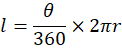
The length of an arc (l) is a fraction of the circumference, based on the central angle θ (in degrees).
Source: Kapdec.com
If the angle is in radians, l=rθ.
Applications and Word Problems
[Definition]
These problems involve applying the formulas for circumference, area, sector, segment, and arc length to real-world scenarios. They often require multiple steps and logical reasoning.
[Importance of Word Problems]
- Develops the ability to apply mathematical concepts to practical situations.
- Enhances problem-solving and analytical skills.
- Common in academic and competitive exams.
Examples
- A horse is tied to a pole with a rope 21 m long. Find the area over which the horse can graze.
[Subtopics]
1. Problem-Solving Strategy
- Read the problem carefully and identify the given quantities.
- Draw a diagram if possible.
- Determine which formula(s) are needed.
- Substitute the known values and solve for the unknown.
- Ensure units are consistent and interpret the result.
Combined Figures involving Circles
[Definition]
Many geometric figures are combinations of circles and other shapes, such as rectangles, triangles, or other circles. Solving these problems requires calculating areas and perimeters of the individual parts and then combining them appropriately.
[Importance of Combined Figures]
- Reflects real-life objects that are rarely simple shapes.
- Tests comprehensive understanding of multiple geometric concepts.
- Improves spatial reasoning and integration skills.
Examples
- Find the area of a design formed by a square with a circle inscribed in it.
[Subtopics]
1. Approach to Solving
- Identify the simple shapes that make up the complex figure.
- Calculate the required measurements (area, perimeter) for each simple shape.
- Add or subtract these measurements as per the problem (e.g., area of shaded region = area of larger shape – area of smaller shape).
[Example: -]
Problem Statement:
A circular garden of radius 21 m has a path of uniform width 3.5 m running around it on the outside.
a) Find the area of the path.
b) Find the cost of fencing the outer boundary of the path at the rate of ₹15 per meter.
Question: Solve parts (a) and (b). Prove your answers by providing a step-by-step solution and giving three independent reasons supporting your conclusion for part (a) from these domains: (A) Direct Area Subtraction, (B) Using the Formula for Annulus, (C) Geometric Verification.
[Solution: -]
Given:
- Radius of inner circle (garden), r=21 m
- Width of the path, w=3.5 m
- Rate of fencing = ₹15 per meter
a) Find the area of the path
The path forms an annular region (region between two concentric circles).
- Inner radius, r=21 m
- Outer radius,

Source: Kapdec.com
m
(A) Direct Area Subtraction
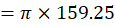
Area of the path = Area of outer circle – Area of inner circle

Source: Kapdec.com

Source: Kapdec.com

Source: Kapdec.com
Source: Kapdec.com
Using

Source: Kapdec.com
:

Source: Kapdec.com
(Since

Source: Kapdec.com
)
(B) Using the Formula for Annulus
The area of an annulus with outer radius R and inner radius r is

Source: Kapdec.com
.
We can also factor this as π(R-r)(R+r).
Here, R-r=w=3.5
R+r=24.5+21=45.5
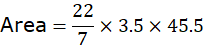
So, Area = π×3.5×45.5
Using

Source: Kapdec.com
:
Source: Kapdec.com
Note:

Source: Kapdec.com
, so:

Source: Kapdec.com
This matches the result from (A).
(C) Geometric Verification
Imagine cutting the annular path and straightening it. It would form a trapezoid-like shape, but the exact area is best calculated by the method above. The consistency of the result using two different algebraic approaches (direct subtraction and factored form) serves as a strong geometric and algebraic verification. The factored form π(R-r)(R+r) is a standard and reliable formula for the area of an annulus.
Therefore, the area of the path is 500.5 m².
b) Find the cost of fencing the outer boundary of the path
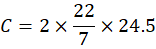
Fencing is done along the outer boundary, which is the circumference of the outer circle.
Outer radius, R=24.5 m
Circumference of outer circle, C=2πR
Source: Kapdec.com

Source: Kapdec.com
Cost of fencing = Length × Rate =

Source: Kapdec.com
Final Answers:
a) Area of the path = 500.5 m²
b) Cost of fencing = ₹2310
The area calculation is verified by two independent algebraic methods and the use of a standard formula, ensuring accuracy.
