KAPDEC® | Elite STEM Learning Platform | https://kapdec.com
Unit: Polynomials
Chapter: Adding and Subtracting Polynomials
Reference: – Understanding polynomial terms and structures, identifying like terms in polynomials, grouping like terms for simplification, adding polynomials using horizontal method, adding polynomials using vertical method, subtracting polynomials using sign change, subtracting polynomials using horizontal method, subtracting polynomials using vertical method, identifying degrees after operations, Applying operations in word problems
After studying this chapter, you should be able to understand:
- Understanding polynomial terms and structures
- Grouping like terms for simplification
- Subtracting polynomials using sign change
- Identifying degrees after operations
Here’s a theoretical elaboration for each topic under “Adding and Subtracting Polynomials”: –
- Understanding polynomial terms and structures
A polynomial is an algebraic expression made up of variables and constants combined through operations such as addition, subtraction, and multiplication. Each part separated by a plus or minus sign is called a term. Recognizing variables, coefficients, and exponents helps in understanding how the expression is constructed. - Identifying like terms in polynomials
Like terms are those that share identical variables raised to the same powers. Grouping like terms is essential for simplifying expressions, as only these terms can be added or subtracted from each other meaningfully. - Grouping like terms for simplification
This step involves rearranging the expression to bring similar terms together. Grouping helps in organizing the expression clearly before performing any operations. It ensures accuracy and efficiency in simplification. - Adding polynomials using horizontal method
In this approach, the expressions are written side by side in a single line. Like terms are then directly combined by applying the operation across them. This method emphasizes mental computation and line-by-line simplification. - Adding polynomials using vertical method
This method aligns the polynomials vertically, matching like terms in rows. It mimics traditional addition, making it easier for visual learners to track terms and operations systematically. - Subtracting polynomials using sign change
Subtraction of polynomials can be approached by changing the signs of the terms in the expression being subtracted and then following the addition rules. This reinforces the concept that subtraction is the addition of opposites. - Subtracting polynomials using horizontal method
Similar to the horizontal addition method, this involves writing both expressions in one line and applying subtraction operations term by term, paying attention to sign changes and variable alignment. - Subtracting polynomials using vertical method
This format stacks polynomials one below the other, aligning like terms. Subtraction is carried out column-wise, providing clarity and reducing error in multi-step expressions. - Simplifying polynomial expressions after addition or subtraction
Once like terms are combined, the expression is rewritten in its simplest form. Simplification involves ensuring all possible combinations are made and no redundant terms are left. - Identifying degrees after operations
The degree of a polynomial is based on the highest power of the variable in the simplified expression. Understanding how operations affect the degree is important for analysing the behavior of the expression. - Applying operations in word problems
Real-life situations often involve quantities that change or combine. Translating these into polynomial expressions and applying addition or subtraction helps in problem-solving and interpreting results in context. - Common errors and checking solutions
Mistakes in sign handling or misidentifying like terms can lead to incorrect simplification. Reviewing each step carefully and cross-verifying with the original problem helps maintain accuracy and reinforces understanding.
Example: –
Add the polynomials:

Source: Kapdec.com
Solution: –
Group like terms:

Source: Kapdec.com
Simplify:
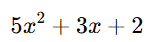
Source: Kapdec.com
The sum is 5x2+3x+2
Here are five conclusive points for the topic “Adding and Subtracting Polynomials”:
- Adding and subtracting polynomials involves combining like terms, which are terms that have identical variable parts.
- Operations can be performed using horizontal or vertical alignment, both requiring careful attention to signs and term arrangement.
- Subtraction is executed by adding the opposite of the second polynomial, reinforcing conceptual understanding of negative values.
- Proper simplification requires accurate grouping and ordering of terms, often from highest to lowest degree.
- These operations are foundational for understanding polynomial functions, solving equations, and modeling real-world relationships.
