KAPDEC® | Elite STEM Learning Platform | https://kapdec.com
Unit: Polynomials
Chapter: Factoring polynomial – Manipulation of Polynomials
Reference: – Understanding the structure of polynomials, identifying common factors in polynomial terms, Factoring using the distributive property, Factoring trinomials with multiple terms, Factoring by grouping, Difference of squares in polynomials, Perfect square trinomials, Recognizing special factoring patterns, Simplifying expressions through factoring
After studying this chapter, you should be able to understand:
- Understanding the structure of polynomials
- Identifying common factors in polynomial terms
- Factoring using the distributive property
- Simplifying expressions through factoring
Here is a theoretical elaboration for each topic under the chapter “Factoring Polynomial – Manipulation of Polynomials”: –
- Understanding the structure of polynomials
Polynomials are algebraic expressions made up of terms which include variables raised to whole number powers. Understanding how these terms are arranged helps in recognizing patterns and simplifying complex expressions. - Identifying common factors in polynomial terms
This process involves examining the terms of a polynomial to determine any variables or constants that are shared across all terms. These shared elements can be factored out to simplify the expression. - Factoring using the distributive property
The distributive property allows expressions to be rewritten by taking out a common factor. This technique simplifies the polynomial by reversing multiplication and expressing the terms in a compact, factored form. - Factoring trinomials with multiple terms
Trinomials, which are polynomials consisting of three terms, can often be broken into a product of binomials. Recognizing the pattern of these trinomials helps in rewriting them in a factored structure. - Factoring by grouping
When a polynomial has multiple terms, they can be divided into smaller groups that have common factors. These groups are then individually factored and recombined to form a fully factored expression. - Difference of squares in polynomials
Some polynomials are structured as the subtraction of two square terms. These follow a specific factoring identity that rewrites the expression as a product of a sum and a difference. - Perfect square trinomials
These are trinomials that result from squaring a binomial. Recognizing this pattern helps in expressing the trinomial as the square of a binomial, which is a compact and simplified form. - Recognizing special factoring patterns
Polynomials sometimes follow patterns like cubes, squares, or repeated identities. Understanding these patterns allows for quick and accurate factoring without trial and error.
- Simplifying expressions through factoring
Factoring is a method used to rewrite expressions in a simpler form. Simplified expressions are easier to interpret, evaluate, and apply to real-world situations or further algebraic operations. - Solving polynomial equations using factoring
When a polynomial is factored, each factor can be set to zero to find the possible values of the variable. This method helps in solving equations efficiently and accurately. - Applications in word problems
Factoring techniques are applied to solve practical problems involving area, motion, and finance where polynomial equations represent real-world relationships. - Rewriting expressions in factored form for analysis
Factored expressions help in understanding the behavior of the polynomial, such as its roots and turning points, which are critical for graphing and interpretation.
Example: –
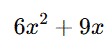
Factor the polynomial:
Source: Kapdec.com
Solution: –
Identify the common factor:
- Both terms have a common factor of 3x.
Factor out the common factor:

Source: Kapdec.com
Final Answer: 3x(2x+3)
Here are five conclusive points for the topic “Factoring Polynomial – Manipulation of Polynomials”:
- Factoring polynomials simplifies complex algebraic expressions by identifying and extracting common factors from terms.
- Recognizing patterns like the difference of squares or perfect square trinomials streamlines factoring.
- Grouping terms based on shared factors allows polynomials to be factored efficiently, enhancing problem-solving capabilities.
- Factoring helps solve polynomial equations by setting each factor to zero and finding the variable values.
- Properly factored expressions make it easier to analyze polynomial behavior, including roots and graph features.
Scan to visit this resource online
https://kapdec.com/resources/factoring-polynomial-manipulation-of-polynomials
