KAPDEC® | Elite STEM Learning Platform | https://kapdec.com
Unit: Real world equations
Chapter: Rearranging Equations, Identifying Constraints, and Building Equations
Reference: – Understanding Literal Equations, Techniques for Rearranging Equations, Building Equations from Word Problems, Identifying Mathematical Constraints, Domain Constraints in Real-World Contexts, Range Constraints in Real-World Problems, Handling Inequalities While Rearranging, Function Form from Rearranged Equations, Application of Inverse Operations, Dealing with Nonlinear Equations, Variable Isolation and Its Impact on Domain, Modeling Situations with Piecewise Equations
After studying this chapter, you should be able to understand:
- Understanding Literal Equations & Techniques for Rearranging Equations
- Domain Constraints in Real-World Contexts
- Function Form from Rearranged Equations
- Modeling Situations with Piecewise Equations
- Understanding Literal Equations
Literal equations are mathematical equations that contain multiple variables. They are typically solved or rearranged to isolate one variable in terms of the others without substituting numerical values.
- Techniques for Rearranging Equations
This involves using algebraic operations such as addition, subtraction, multiplication, division, factoring, and distributing to manipulate and solve for a specific variable within an equation.
- Building Equations from Word Problems
This is the process of translating real-life situations, scenarios, or word problems into algebraic equations that model the relationships between different quantities.
- Identifying Mathematical Constraints
Mathematical constraints refer to restrictions or conditions that limit the possible values a variable can take in an equation, often based on the logical or physical context of the problem.
- Domain Constraints in Real-World Contexts
Domain constraints define which input values (independent variables) are possible or meaningful in a real-world scenario. For example, time or distance can only take non-negative values in many contexts.
- Range Constraints in Real-World Problems
Range constraints focus on limiting output values (dependent variables) based on what is realistic, possible, or allowed by the problem context.
- Handling Inequalities While Rearranging
This refers to solving and manipulating inequalities (instead of equalities), taking care to reverse inequality signs when multiplying or dividing both sides by a negative number, and considering how this affects the domain.
- Function Form from Rearranged Equations
This involves expressing one variable explicitly in terms of another, usually solving an equation for the dependent variable so that the relationship fits a recognizable function format like y=f(x).
- Application of Inverse Operations
Inverse operations are used to undo mathematical operations during the rearrangement process. For example, subtraction is the inverse of addition, and division is the inverse of multiplication.
- Dealing with Nonlinear Equations
Nonlinear equations contain variables raised to powers other than one or involve roots, exponents, or other non-linear operations. Rearranging such equations requires special attention to how domain and range might be restricted.
- Variable Isolation and Its Impact on Domain
When isolating a variable, certain operations (like division by a variable or taking square roots) may introduce new restrictions on the domain to avoid undefined expressions.
- Modeling Situations with Piecewise Equations
Piecewise equations use different algebraic expressions for different segments of the domain, allowing more complex modeling of real-world scenarios where conditions change over ranges of input values.
- Understanding Extraneous Solutions
Extraneous solutions are results that emerge during the solving process but do not satisfy the original equation or lie outside the permissible domain. These must be identified and excluded.
- Dimensional Analysis and Units in Equations
This involves ensuring that the units of measure used in an equation remain consistent and logical across all terms, helping to avoid errors and making sure the domain and range reflect the correct units.
- Graphical Interpretation of Rearranged Equations
This refers to plotting rearranged equations on a graph to visually examine how changes in the domain affect the range and to understand the real-world meaning of the graph.
Example: –
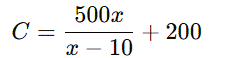
A company’s total cost C (in dollars) to produce x units of a product is modelled by the equation:
Source: Kapdec.com
Solution: –
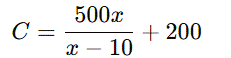
Given:
Source: Kapdec.com
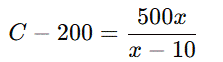
First, isolate the fractional term:
Source: Kapdec.com
Now, cross-multiply:

Source: Kapdec.com
Move all terms involving x to one side:

Source: Kapdec.com
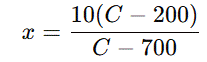
Finally, solve for x:
Source: Kapdec.com
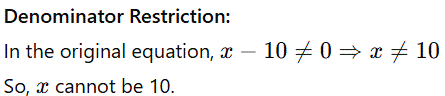
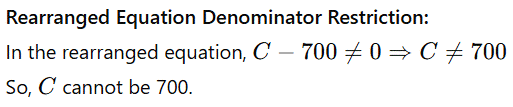
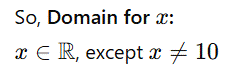
Domain restrictions come from two points:
Source: Kapdec.com
Source: Kapdec.com
Source: Kapdec.com
Here are five conclusive points for “Linear Functions in a Coordinate Plane”:
- Rearranging Equations Enhances Flexibility in Problem Solving
Mastering equation rearrangement allows students to express variables in different forms, making it easier to solve for unknowns and analyse relationships between variables.
- Identifying Constraints Prevents Mathematical Errors
By recognizing domain and range restrictions and mathematical constraints, students can avoid undefined operations (like division by zero or square roots of negatives) and ensure that solutions remain valid within real-world contexts.
- Building Equations from Word Problems Connects Algebra to Real Life
Converting real-world situations into algebraic equations helps students understand how math models practical scenarios, from physics and finance to geometry and everyday problem-solving.
- Domain and Range Considerations Ensure Meaningful Solutions
Not all mathematically possible solutions make sense in real-world problems. Considering domain and range constraints ensures that students select only meaningful, context-appropriate solutions.
- Graphical and Analytical Approaches Work Together
Understanding how rearranged equations translate into graphs helps students visualize domain and range, offering both symbolic and graphical perspectives for interpreting solutions.
Scan to visit this resource online
https://kapdec.com/resources/rearranging-equations-identifying-constraints-and-building-equations
