KAPDEC® | Elite STEM Learning Platform | https://kapdec.com
Unit: Algebra
Chapter: Concept of Polynomials
Reference: – Introduction to Polynomials, Terms and Coefficients, Degree of a Polynomial, Types of Polynomials, Zeroes of a Polynomial, Remainder Theorem, Factor Theorem, Factorization of Polynomials, Algebraic Identities
After studying this chapter, you should be able to understand:
- The fundamental definition and components of a polynomial.
- How to classify polynomials based on degree and number of terms.
- The relationship between zeroes and factors of a polynomial.
- The application of the Remainder Theorem and Factor Theorem.
Introduction to Polynomials
Definition
A polynomial is an algebraic expression consisting of variables (also called indeterminates), coefficients, and non-negative integer exponents, combined using addition, subtraction, and multiplication operations. A polynomial in one variable, x, is generally written as:

Source: Kapdec.com
where

Source: Kapdec.com
are constants (coefficients), and

Source: Kapdec.com
is a non-negative integer.
[Importance of Polynomials]
- Polynomials are the most basic and widely used algebraic expressions.
- They form the foundation for higher mathematics, including calculus and linear algebra.
- Used in various real-world applications, such as physics, engineering, and economics.
- Essential for solving equations and modeling situations.
Example
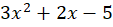
Expression:
Source: Kapdec.com
This is a polynomial in x with three terms. The coefficients are 3, 2, and -5. The exponents are 2, 1, and 0.
[Subtopics]
1. Components of a Polynomial
- Terms: Parts of the polynomial separated by + or – signs. E.g.,

Source: Kapdec.com
,

Source: Kapdec.com
, and

Source: Kapdec.com
are terms.
- Coefficients: The numerical part of each term. E.g., 3, 2, and -5.
- Variable: The symbol whose value can change. Commonly x, y, z.
- Exponent: The power to which the variable is raised. Must be a non-negative integer.
Key Points:
- Expressions with variables in the denominator (e.g.,

Source: Kapdec.com
) or under a radical (e.g.,

Source: Kapdec.com
) are not polynomials.
- The coefficient of the term with the highest exponent is called the leading coefficient.
2. Standard Form
A polynomial is written in standard form when its terms are arranged in descending order of their exponents.
Terms and Coefficients
[Definition]
This section delves deeper into the building blocks of polynomials. Understanding terms and coefficients is crucial for performing operations like addition, subtraction, and factorization.
Importance of Terms and Coefficients
- Necessary for identifying like terms during simplification.
- Helps in determining the degree and leading term.
- Fundamental for evaluating polynomials for given values of the variable.
Examples
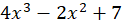
- In the polynomial
Source: Kapdec.com
:
- Terms:

Source: Kapdec.com
,

Source: Kapdec.com
,

Source: Kapdec.com
- Coefficients: 4, -2, 7
- Constant term: 7 (the term with

Source: Kapdec.com
)
- Terms:
[Subtopics]
1. Like and Unlike Terms
- Like Terms: Terms that have the same variable raised to the same power. E.g.,

Source: Kapdec.com
and

Source: Kapdec.com
are like terms.
- Unlike Terms: Terms with different variables or different exponents. E.g.,

Source: Kapdec.com
and

Source: Kapdec.com
are unlike;

Source: Kapdec.com
and

Source: Kapdec.com
are unlike.
2. Constant Polynomial
A polynomial of degree 0. It has no variable part and is just a constant number. E.g.,

Source: Kapdec.com
.
Degree of a Polynomial
[Definition]
The degree of a polynomial is the highest exponent of the variable in any of its terms when the polynomial is expressed in its standard form.
[Importance of Degree]
- Determines the general shape and behavior of the polynomial’s graph.
- Indicates the maximum number of zeroes (or roots) the polynomial can have.
- Used to classify polynomials (linear, quadratic, cubic, etc.).
Examples
-

Source: Kapdec.com
has a degree of 4.
-

Source: Kapdec.com
has a degree of 0.
[Subtopics]
1. Finding the Degree
Identify the term with the largest exponent. The value of that exponent is the degree.
2. Degree of a Zero Polynomial
The polynomial

Source: Kapdec.com
is called the zero polynomial. Its degree is not defined.
Types of Polynomials
[Definition]
Polynomials can be classified based on the number of terms they contain or based on their degree.
Importance of Classification
- Helps in quickly identifying the properties of the polynomial.
- Different types have standard methods for solving and factoring.
- Aids in communication and problem-solving.
Examples
- Based on number of terms:
- Monomial: One term (e.g.,

Source: Kapdec.com
)
- Binomial: Two terms (e.g.,

Source: Kapdec.com
)
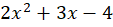
- Trinomial: Three terms (e.g.,
Source: Kapdec.com
)
- Monomial: One term (e.g.,
- Based on degree:
- Linear Polynomial: Degree 1 (e.g.,

Source: Kapdec.com
)
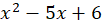
- Quadratic Polynomial: Degree 2 (e.g.,
Source: Kapdec.com
)
- Cubic Polynomial: Degree 3 (e.g.,

Source: Kapdec.com
)
- Linear Polynomial: Degree 1 (e.g.,
[Subtopics]
1. Based on Number of Terms
- Monomial, Binomial, Trinomial, Polynomial (for four or more terms).
2. Based on Degree
- Constant (Degree 0), Linear (Degree 1), Quadratic (Degree 2), Cubic (Degree 3), Quartic (Degree 4), and so on.
Zeroes of a Polynomial
[Definition]
A zero (or root) of a polynomial

Source: Kapdec.com
is a number

Source: Kapdec.com
such that when it is substituted for the variable, the value of the polynomial becomes zero, i.e.,

Source: Kapdec.com
.
[Importance of Zeroes]
- Finding zeroes is equivalent to solving the equation

Source: Kapdec.com
.
- Zeroes represent the x-intercepts of the polynomial’s graph.
- Directly related to the factors of the polynomial.
Examples
- For

Source: Kapdec.com
, find

Source: Kapdec.com
. So, 2 is a zero.
[Subtopics]
1. Finding Zeroes
Set the polynomial equal to zero and solve for the variable. For linear and quadratic polynomials, this can be done directly.
2. Relationship with Factors
If

Source: Kapdec.com
is a zero of

Source: Kapdec.com
, then

Source: Kapdec.com
is a factor of

Source: Kapdec.com
.
Remainder Theorem
[Definition]
The Remainder Theorem states that when a polynomial

Source: Kapdec.com
is divided by a linear divisor of the form

Source: Kapdec.com
, the remainder is equal to

Source: Kapdec.com
.
[Importance of Remainder Theorem]
- Provides a quick way to find the remainder without performing long division.
- Useful for verifying factors.
- Helps in evaluating polynomials at specific points.
Examples
- Find the remainder when p(x)=

Source: Kapdec.com
is divided by

Source: Kapdec.com
.
- By Remainder Theorem, remainder =

Source: Kapdec.com
.
[Subtopics]
1. Statement and Proof
If p(x) is divided by (x-a), then p(x)=(x-a)q(x)+r, where r is the remainder. Substituting x=a gives p(a)=r.
2. Application
Used to check if (x-a) is a factor. If p(a)=0, then it is a factor.
Factor Theorem
[Definition]
The Factor Theorem is a special case of the Remainder Theorem. It states that (x-a) is a factor of the polynomial p(x) if and only if p(a)=0.
[Importance of Factor Theorem]
- A powerful tool for factorizing polynomials.
- Simplifies the process of finding all factors and zeroes.
- Essential for solving polynomial equations.
Examples
- Check if (x-1) is a factor of

Source: Kapdec.com
.
- p(1)=1-3+3-1=0. Yes, it is a factor.
[Subtopics]
1. Statement and Proof
Direct consequence of the Remainder Theorem. If p(a)=0, then remainder is 0, so (x-a) divides p(x) exactly.
2. Finding Factors
Use the Factor Theorem to test possible values of ‘a’ (often factors of the constant term) to find zeroes and thus factors.
Factorization of Polynomials
[Definition]
Factorization is the process of expressing a polynomial as a product of its linear or irreducible factors. This is often done by finding the zeroes of the polynomial.
[Importance of Factorization]
- Simplifies polynomial expressions.
- Essential for solving polynomial equations.
- Used in calculus for integration and finding limits.
Examples
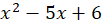
- Factorize
Source: Kapdec.com
.
- The zeroes are 2 and 3, so factors are (x-2) and (x-3). Thus,

Source: Kapdec.com
.
[Subtopics]
1. By Splitting the Middle Term
A common method for quadratic polynomials.
2. Using Factor Theorem
For higher-degree polynomials, use the Factor Theorem to find one factor, then perform polynomial division to reduce the degree.
Algebraic Identities
[Definition]
Algebraic identities are standard equations that are true for all values of the variables involved. They are useful shortcuts for expanding and factorizing polynomials.
[Importance of Algebraic Identities]
- Speed up calculations and simplifications.
- Provide standard forms for factorization.
- Frequently used in problem-solving.
Examples
-

Source: Kapdec.com
-

Source: Kapdec.com
-

Source: Kapdec.com
-

Source: Kapdec.com
[Subtopics]
1. Common Identities
Memorizing key identities is crucial for efficient problem-solving.
2. Application in Factorization
Recognizing patterns that match these identities allows for quick factorization.
[Example: -]
Consider the polynomial p(x)=

Source: Kapdec.com
.
Question:
a) Find the degree of the polynomial and identify its type based on the number of terms.
b) Verify whether (x-2) is a factor of p(x) using the Factor Theorem.
c) If it is a factor, factorize p(x) completely.
d) Find all the zeroes of p(x).
Prove your answer by providing a step-by-step solution and giving three independent reasons supporting your conclusion for part (b) from these domains: (A) Direct Substitution, (B) Remainder Theorem Application, (C) Polynomial Long Division Verification.
[Solution: -]
a) Degree and Type
- The highest power of x is 3. So, the degree is 3.
- The polynomial has 4 terms:

Source: Kapdec.com
. Therefore, it is simply called a polynomial (or specifically, a cubic polynomial).
b) Verify if (x-2) is a factor using the Factor Theorem.
The Factor Theorem states that (x-a) is a factor of p(x) if and only if p(a)=0. Here, a=2.
(A) Direct Substitution
Compute p(2):
=

Source: Kapdec.com

Source: Kapdec.com

Source: Kapdec.com

Source: Kapdec.com

Source: Kapdec.com
Since p(2)=-12≠0, by the Factor Theorem, (x-2) is not a factor.
(B) Remainder Theorem Application
The Remainder Theorem states that the remainder when p(x) is divided by (x-2) is p(2). We calculated p(2)=-12. A non-zero remainder means that (x-2) does not divide p(x) exactly. Therefore, it is not a factor. This is a direct application of the theorem and is consistent with (A).
