KAPDEC® | Elite STEM Learning Platform | https://kapdec.com
Unit: Polynomials
Chapter: Multiplying and Dividing Polynomials
Reference: – Understanding polynomial multiplication, Distributive property with polynomials, using area models for multiplication, Box method for binomial expansion, FOIL method for binomial products, multiplying monomial and polynomial, Multiplying binomials and trinomials, Patterns in polynomial multiplication, Polynomial long division, Synthetic division basics, Division by binomials
After studying this chapter, you should be able to understand:
- Understanding polynomial multiplication & Distributive property with polynomials
- FOIL method for binomial products
- Multiplying binomials and trinomials & Patterns in polynomial multiplication
- Polynomial long division, Synthetic division basics & Division by binomials
Here is a theoretical elaboration of each topic under the chapter “Multiplying and Dividing Polynomials”: –
- Understanding polynomial multiplication
Polynomial multiplication involves combining each term from one expression with every term from another, following the distributive property and applying rules of exponents during simplification. - Distributive property with polynomials
This concept applies the idea of distributing one term across all terms inside a parenthesis, forming the basis of polynomial multiplication and ensuring that all terms are accounted for. - Using area models for multiplication
Area models visually represent the product of polynomials by placing terms in a grid, helping to systematically organize and combine like terms for accurate results. - Box method for binomial expansion
A structured grid, or box, is used to arrange terms of two expressions, making it easier to perform multiplication and observe patterns in expansion. - FOIL method for binomial products
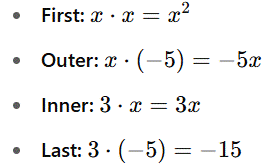
This method is a mnemonic for multiplying two binomials by combining the first terms, outer terms, inner terms, and last terms, leading to a complete expansion. - Multiplying monomial and polynomial
In this case, each term of the polynomial is individually multiplied by the monomial, ensuring that each product respects the laws of multiplication and exponents. - Multiplying binomials and trinomials
This process involves combining each term of the binomial with each term of the trinomial, followed by simplifying the resulting expression by combining like terms. - Patterns in polynomial multiplication
Specific patterns, such as square of a binomial or product of conjugates, help recognize and apply shortcuts that simplify multiplication of standard polynomial forms. - Polynomial long division
This technique resembles arithmetic long division, where terms are divided step-by-step, with focus on matching leading terms and subtracting partial products iteratively. - Synthetic division basics
A simplified method of dividing polynomials when the divisor is linear, this process avoids variable notation and relies on coefficients to efficiently perform division. - Division by binomials
Dividing by binomials requires aligning terms in descending order and systematically eliminating terms through multiplication and subtraction techniques. - Interpreting quotient and remainder
After division, the resulting expression may have a quotient and a remainder, which together represent the original polynomial in a new, simplified form.
Example: –
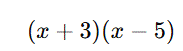
Multiply the binomials:
Source: Kapdec.com
Solution: –
Solution (Using FOIL method):
Source: Kapdec.com
Combine like terms:

Source: Kapdec.com
Final Answer:
X2−2x−15
Here are five conclusive points for the topic “Multiplying and Dividing Polynomials”:
- Polynomial operations require a strong grasp of distributive properties and exponent rules to simplify and restructure expressions accurately.
- Visual tools like box and area methods enhance conceptual understanding, especially for multiplying binomials and trinomials.
- Recognizing standard patterns, such as special products, helps streamline polynomial multiplication.
- Long and synthetic division are essential for breaking down complex expressions and identifying quotient-remainder relationships.
- Mastery of these operations lays the groundwork for advanced algebra topics like factoring, solving polynomial equations, and analyzing graphs.
Scan to visit this resource online
https://kapdec.com/resources/multiplying-and-dividing-polynomials
