KAPDEC® | Elite STEM Learning Platform | https://kapdec.com
Unit: Understanding Functions
Chapter: Introduction to Functions
Reference: – Understanding the Concept of a Function, Function Notation, determining if a Relation is a Function, Domain and Range, Representing Functions, Interpreting Real-World Functions, Building Functions, Comparing Different Types of Functions, Mathematical Practices in Functions
After studying this chapter, you should be able to understand:
- Understanding the Concept of a Function
- Domain and Range
- Interpreting Real-World Functions
- Mathematical Practices in Functions
- Understanding the Concept of a Function
A function is a special type of relationship between two sets, where each element in the first set (called the domain) is paired with exactly one element in the second set (called the range). Functions help in defining dependencies between variables and are fundamental in mathematical modeling and problem-solving. - Function Notation
Functions are represented using notation that clearly defines their input-output relationship. A function is often written in the form of an equation where the dependent variable is expressed in terms of the independent variable. This notation provides a structured way to analyse and compute values efficiently. - Determining if a Relation is a Function
Not every relation between two sets is a function. To be classified as a function, each input must be linked to only one output. Various tests, such as the vertical line test on graphs, help in determining whether a given relation qualifies as a function. - Domain and Range
The domain of a function consists of all possible input values, while the range comprises the resulting outputs. Understanding domain and range is crucial as it defines the extent to which a function operates and helps in analysing constraints within mathematical models. - Representing Functions
Functions can be expressed in different forms, including equations, tables, graphs, and verbal descriptions. Each representation provides unique insights into how a function behaves and can be used to interpret and predict patterns effectively. - Interpreting Real-World Functions
Functions are widely used to model real-world scenarios, such as tracking population growth, predicting economic trends, and analysing physical phenomena. Recognizing how functions apply to practical situations enhances problem-solving skills and mathematical reasoning. - Building Functions
Constructing functions involves identifying relationships between variables and representing them using appropriate equations or graphs. This skill is essential in defining mathematical models that describe various processes, including motion, finance, and engineering applications. - Comparing Different Types of Functions
Various types of functions, such as linear, quadratic, and exponential functions, exhibit distinct characteristics. Comparing these functions based on their properties, such as rate of change and graphical behavior, helps in selecting appropriate models for different scenarios. - Mathematical Practices in Functions
Working with functions requires logical reasoning, precision, and a systematic approach to problem-solving. Developing a deep understanding of functions allows for their effective application in algebra, calculus, and other branches of mathematics.
Example: –
A company produces a new type of smartphone, and the production cost depends on the number of units manufactured. The cost C(x) (in dollars) to produce x smartphones is given by the function:

Source: Kapdec.com
Tasks:
- Determine the domain of C(x) based on practical constraints.
- Find the number of smartphones that minimizes the cost.
- Identify the minimum production cost for the company.
Solution: –
Step 1: Determining the Domain
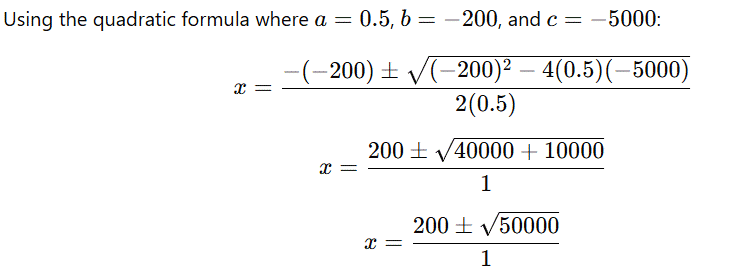
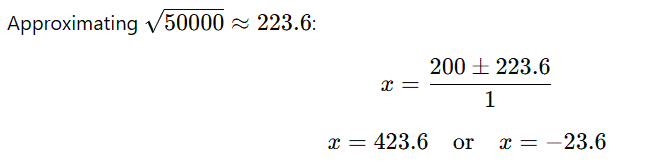
The domain of C(x) represents the number of smartphones that can be produced. Since production cannot be negative, we consider x≥0. However, since the cost function includes a quadratic term, we also need to ensure the cost remains realistic (non-negative).
Setting C(x)≥0:

Source: Kapdec.com
Solving the quadratic inequality:

Source: Kapdec.com
Source: Kapdec.com
Source: Kapdec.com
Step 2: Finding the Number of Smartphones That Minimizes Cost
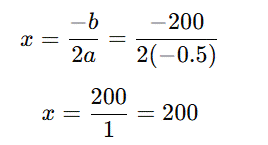
The function C(x) is a quadratic function with a negative leading coefficient, meaning it forms a parabola opening downward. The minimum or maximum occurs at the vertex, given by:
Source: Kapdec.com
Thus, producing 200 smartphones minimizes the cost.
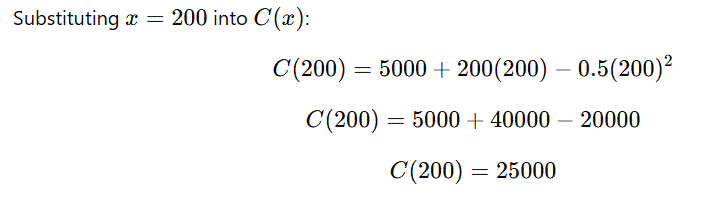
Step 3: Finding the Minimum Cost
Source: Kapdec.com
Thus, the minimum production cost is $25,000.
Here are five conclusive points for the topic Introduction to Functions:
- Functions Establish Clear Relationships
Functions define a unique dependency between variables, ensuring that each input has a single corresponding output. This characteristic distinguishes functions from general relations and makes them essential in mathematical modeling. - Multiple Representations Enhance Understanding
Functions can be expressed in various formats, including equations, graphs, tables, and verbal descriptions. Each representation provides different insights into the function’s behavior, making them useful for analysis and problem-solving. - Domain and Range Define the Scope of Functions
The domain represents all permissible input values, while the range consists of resulting outputs. Understanding these concepts helps determine the limitations and applicability of a function in different contexts. - Functions Are Fundamental in Real-World Applications
From physics and economics to computer science and biology, functions model real-world phenomena such as growth patterns, financial trends, and motion. Their widespread application highlights their significance in both academic and practical fields. - Different Types of Functions Serve Unique Purposes
Linear, quadratic, and exponential functions exhibit distinct characteristics, such as constant or variable rates of change. Recognizing their differences allows for the selection of appropriate models for solving diverse mathematical and real-life problems.
