KAPDEC® | Elite STEM Learning Platform | https://kapdec.com
Unit: Zeros, Parabolas, And Polynomial Graphing
Chapter: Function Transformations
Reference: – Understanding vertical and horizontal shifts of functions, Effects of vertical and horizontal stretches and compressions, Reflections of functions across the x-axis and y-axis, Combinations of multiple transformations in sequence, identifying parent functions and their transformed versions, writing equations for transformed graphs, sketching graphs using transformation rules, understanding how transformations affect domain and range
After studying this chapter, you should be able to understand:
- Understanding vertical and horizontal shifts of functions
- Effects of vertical and horizontal stretches and compressions
- Writing equations for transformed graphs
- Understanding how transformations affect domain and range
Here’s a theoretical elaboration for each point under Function Transformations in algebra, without any numerical references:
- Vertical and Horizontal Shifts
A shift refers to moving the entire graph of a function along the vertical or horizontal axis. Vertical shifts alter the output values while keeping the input unchanged, whereas horizontal shifts modify the input values without affecting the output directly. These movements do not change the shape of the graph, only its position. - Stretches and Compressions
Stretching a graph means increasing its distance from the axis, making it appear narrower; while compressing it brings the graph closer to the axis, making it appear wider. These effects are caused by multiplying the function by a constant, either inside or outside the function, altering the scale of either the input or output. - Reflections Across Axes
A reflection flips the graph of a function across either the horizontal or vertical axis. Reflecting across the horizontal axis inverts the output values, while reflecting across the vertical axis inverts the input values. These transformations preserve the shape but invert the orientation. - Combining Multiple Transformations
More than one transformation can be applied to a function sequentially, such as a reflection followed by a shift. The order of these transformations matters and can affect the final graph. Understanding how to combine and analyse them is key to mastering functional behavior. - Parent Functions and Variants
A parent function serves as the most basic form of a particular type of function, such as linear, quadratic, or cubic. Transformed versions of the parent function exhibit changes in position, orientation, or scale but retain the fundamental shape of the graph. - Writing Equations of Transformed Graphs
After analysing the changes to a graph, the corresponding algebraic expression can be written to represent those transformations. This involves modifying the parent function’s equation to reflect shifts, stretches, compressions, or reflections. - Sketching Graphs from Transformations
By understanding each type of transformation, one can accurately sketch the resulting graph without plotting numerous individual points. This skill involves visualizing how a graph morphs from its original shape through specific transformations. - Changes in Domain and Range
Transformations can alter the set of possible input and output values for a function. While shifts and reflections may not always affect the domain, stretches, compressions, and certain shifts can influence both domain and range significantly. - Comparing Original and Transformed Functions
By placing a parent function and its transformed counterpart side by side, one can analyse the nature and extent of the transformation. This comparison is essential in understanding the graphical and algebraic implications of changes. - Application in Real-World Contexts
Function transformations are often used to model real-world scenarios where variables undergo systematic changes. Understanding these transformations helps interpret how conditions affect outcomes in fields like physics, economics, and biology.
Example: –
A function f(x) is defined as the parent cubic function f(x)=x3. A transformation is applied to it, resulting in a new function:

Source: Kapdec.com
Analyse and describe each transformation that has occurred to the parent function. Then:
- Write the domain and range of g(x).
- Sketch or describe the graph of g(x) by identifying key points.
- Identify how the transformations affect the turning point and orientation of the graph.
- Solution: –
Step 1: Identify the Parent Function
Parent function: f(x)=x3
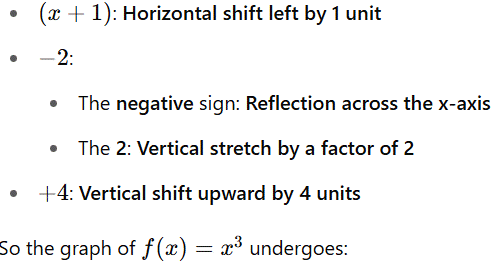
Step 2: Break Down the Transformations in

Source: Kapdec.com
Source: Kapdec.com
- Shift left 1 unit
- Reflect across x-axis
- Stretch vertically by 2
- Shift up 4 units
Step 3: Domain and Range
Domain of g(x): Since cubic functions are defined for all real numbers, and no transformation restricts this

Source: Kapdec.com
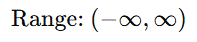
Range of g(x): Reflected and stretched, but still all real numbers
Source: Kapdec.com
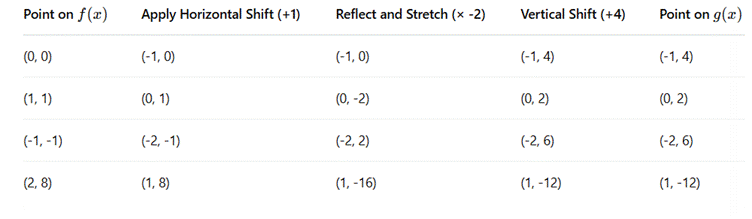
Step 4: Key Points for Graphing
Source: Kapdec.com
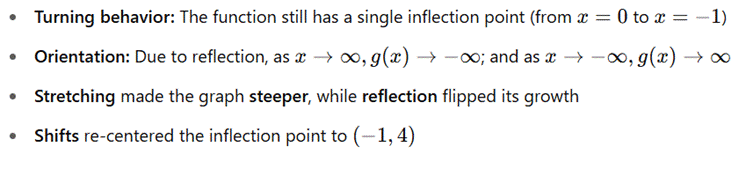
Step 5: Impact of Transformations
Source: Kapdec.com
This example demonstrates all major transformation concepts:
- Shifts (horizontal & vertical)
- Stretch
- Reflection
- Writing transformed equations
- Effect on domain, range, and graph behavior
Here are five conclusive points for the chapter on Function Transformations:
- Understanding function transformations allows learners to predict how algebraic changes affect the graph’s position, shape, and orientation.
- Vertical and horizontal movements, along with stretches, compressions, and reflections, are fundamental tools for graph manipulation.
- Mastery of parent functions and their variants aids in recognizing and constructing function families.
- Interpreting and combining multiple transformations sharpens analytical thinking and graphing efficiency.
- These concepts form the basis for modeling and solving complex real-world problems across disciplines like engineering, economics, and physics.
