KAPDEC® | Elite STEM Learning Platform | https://kapdec.com
Unit – Chemistry of life
Chapter- Properties of biological macromolecules
Reference: Biomolecules, Carbohydrates, Monosaccharides, Disaccharides, Polysaccharides, Lipids, General Physical Properties of Lipids, Phospholipids Steroids Proteins, Physical properties of proteins, Chemical properties of proteins, Nucleic acids
Learning objectives
- To understand physical and chemical properties of carbohydrates, lipids, proteins, and nucleic acids.
Biomolecules
Biomolecules have a wide range of sizes and structures and perform a vast array of functions. The four major types of macromolecules are carbohydrates, lipids, nucleic acids, and proteins.
Carbohydrates– are aldehyde and ketone compounds with multiple hydroxyl groups. They are one of the most abundant classes of biomolecules in nature. They are widely distributed in all life forms and serves many roles, such as
- They serve as energy stores, fuels and metabolic intermediates.
- They are constituent of RNA and DNA backbones as ribose and deoxyribose sugars.
- Polysaccharides are constituents of cell walls of bacteria and plants.
- Carbohydrates are linked to surfaces of proteins and lipids where they play role as informational materials e.g., in cell-cell interaction and interaction between cells with other elements in the cellular environment.
Carbohydrate can be classified into three groups: monosaccharide, oligosaccharides, and polysaccharides.
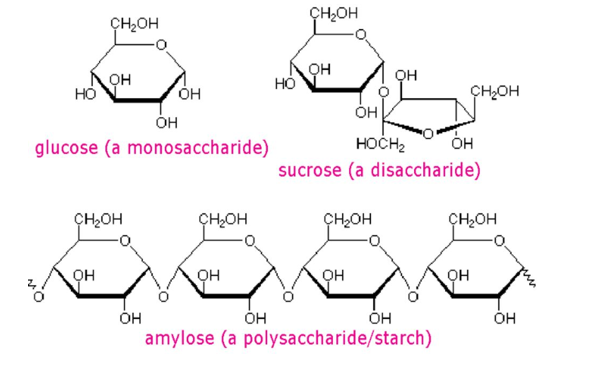
Monosaccharides– All the monosaccharides have the formula as (CH2O) n. Here, the two hydrogen atoms and one oxygen atom associate itself to the central carbon molecule. A hydroxyl group is formed when oxygen will bond with hydrogen. Several carbon molecules bond together because 4 bonds can form on carbon. E. g glucose and galactose
- Monosaccharides are crystalline solids at room temperature and quite soluble in water.
- Monosaccharides are reducing sugars; they reduce mild oxidizing agents, such as Tollens’ or Benedict’s reagents.
Disaccharides – A disaccharide is the sugar formed when two monosaccharides are joined by glycosidic linkage. E.g., sucrose and maltose.
- They are polar compounds.
- They are readily soluble in water due to hydrogen bonding.
- They have sweet taste.
- They cannot diffuse through cellular membranes.
Polysaccharides– They are long-chain polymeric carbohydrates composed of monosaccharide units bound together by glycosidic linkages. E.g., starch, glycogen, and cellulose.
- They are not sweet in taste.
- Many are insoluble in water.
- They are hydrophobic in nature.
- They do not form crystals on desiccation.
- Can be extracted to form a white powder.
- They are high molecular weight carbohydrates.
Source: Kapdec.com
Lipids – Lipids are one of the major macromolecules present in our body, and others include nucleic acids, carbohydrates, and proteins. But unlike the other macro biomolecules, lipids are not polymers – they aren’t composed of monomers. They are hydrophobic in nature because of the predominance of hydrocarbon chains (–CH2–CH2–CH2–CH2–) in their structures.
General Physical Properties of Lipids
- They are soluble in non-polar solvents, such as ether, alcohol, chloroform, acetone, and benzene.
- Lipids are insoluble in water.
- Lipid molecules have no ionic charges.
- Pure fats and oils are colourless, odorless, and tasteless.
- Lipids are considered hydrophobic or amphiphilic small molecules
Phospholipids – A phospholipid is a molecule with two fatty acids and a modified phosphate group attached to a glycerol backbone. The phosphate may be modified by the addition of charged or polar chemical groups. Due to this, phospholipids are considered amphipathic because they have both hydrophobic and hydrophilic components.
Steroids – Unlike the phospholipids and fats, steroids have a fused ring structure. Although they do not resemble the other lipids, they are grouped with them because they are also hydrophobic and insoluble in water. Cholesterol is a form of steroid in animal cells’ plasma membrane. Cholesterol is also the forerunner of steroid hormones such as testosterone.
Proteins– are polymers composed of amino acids, which are connected by peptide bonds. Proteins, the protein building blocks are the naturally occurring twenty amino acids. Proteins are, therefore, the multimers made up of amino acids.
Physical properties of proteins include:
- They are colourless and usually tasteless
- Their shape varies from simple crystalloid spherical structures to long fibrillar structures have large molecular weights
- Proteins are amphoteric like amino acids (i.e., they act both as acids and alkalis)
- Proteins form salts with both anions and cations, based on their net charge
- The solubility of proteins is affected by pH
Chemical properties of proteins:
- Hydrolysis: Proteins are hydrolysed by several hydrolytic agents
- When free amino acids or proteins are treated with Hydrochloric acid, the acid salts are formed
Nucleic acids
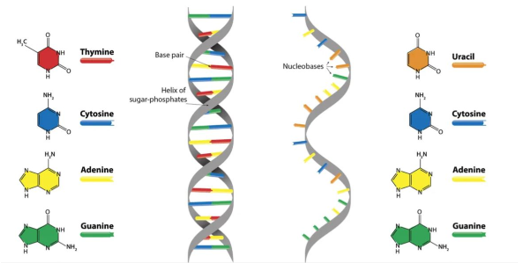
- Nucleic acids are long chainlike molecules composed of a series of nearly identical building blocks called nucleotides.
- Each nucleotide consists of a nitrogen-containing aromatic base attached to a pentose (five-carbon) sugar, which is in turn attached to a phosphate group.
Source: Kapdec.com
The biochemical properties of nucleic acids are:
- Ultraviolet absorption: The extent to which DNA is single-stranded or double-stranded can be determined by monitoring UV absorption
- Chemical modification: DNA can also be cleaved and degraded by enzymes called nucleases
- Mutation: Chemical modification of DNA can lead to mutations in the genetic material.
Solved examples
Example 1. What nitrogenous bases are found in RNA?
- A, T, G, U
- A, T, G, C
- A, U, C, T
- A, U, G, C
Solution 1: d) A, U, G, C because it has uracil instead of thymine.
Example 2. Why do different polysaccharides have different orientations of monomers?
a) The structural orientations are unimportant for polysaccharides
b) The differing structural orientations give the different compounds unique properties and functions
c) Each cell has a unique orientation for polysaccharides like a finger print
d)Organisms evolved from different sources that built carbohydrates differently
Solution 2: b. The different polysaccharides have different orientations of monomers because it gives different compounds unique properties and functions.
Summary
- Carbohydrate can be classified into three groups: monosaccharide, oligosaccharides, and polysaccharides.
- Monosaccharides are crystalline solids at room temperature and quite soluble in water
- A disaccharide is the sugar formed when two monosaccharides are joined by glycosidic linkage
- They are long-chain polymeric carbohydrates composed of monosaccharide units bound together by glycosidic linkages.
- Lipids are one of the major macromolecules present in our body, and others include nucleic acids, carbohydrates, and proteins.
- Proteins- are polymers composed of amino acids, which are connected by peptide bonds.
- Nucleic acids are long chainlike molecules composed of a series of nearly identical building blocks called nucleotides.
Unit – Chemistry of life
Chapter- Properties of biological macromolecules
Reference: Biomolecules, Carbohydrates, Monosaccharides, Disaccharides, Polysaccharides, Lipids, General Physical Properties of Lipids, Phospholipids Steroids Proteins, Physical properties of proteins, Chemical properties of proteins, Nucleic acids
Learning objectives
- To understand physical and chemical properties of carbohydrates, lipids, proteins, and nucleic acids.
Biomolecules
Biomolecules have a wide range of sizes and structures and perform a vast array of functions. The four major types of macromolecules are carbohydrates, lipids, nucleic acids, and proteins.
Carbohydrates– are aldehyde and ketone compounds with multiple hydroxyl groups. They are one of the most abundant classes of biomolecules in nature. They are widely distributed in all life forms and serves many roles, such as
- They serve as energy stores, fuels and metabolic intermediates.
- They are constituent of RNA and DNA backbones as ribose and deoxyribose sugars.
- Polysaccharides are constituents of cell walls of bacteria and plants.
- Carbohydrates are linked to surfaces of proteins and lipids where they play role as informational materials e.g., in cell-cell interaction and interaction between cells with other elements in the cellular environment.
Carbohydrate can be classified into three groups: monosaccharide, oligosaccharides, and polysaccharides.
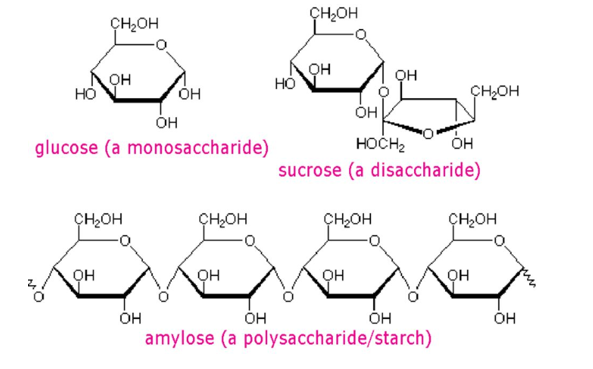
Monosaccharides– All the monosaccharides have the formula as (CH2O) n. Here, the two hydrogen atoms and one oxygen atom associate itself to the central carbon molecule. A hydroxyl group is formed when oxygen will bond with hydrogen. Several carbon molecules bond together because 4 bonds can form on carbon. E. g glucose and galactose
- Monosaccharides are crystalline solids at room temperature and quite soluble in water.
- Monosaccharides are reducing sugars; they reduce mild oxidizing agents, such as Tollens’ or Benedict’s reagents.
Disaccharides – A disaccharide is the sugar formed when two monosaccharides are joined by glycosidic linkage. E.g., sucrose and maltose.
- They are polar compounds.
- They are readily soluble in water due to hydrogen bonding.
- They have sweet taste.
- They cannot diffuse through cellular membranes.
Polysaccharides– They are long-chain polymeric carbohydrates composed of monosaccharide units bound together by glycosidic linkages. E.g., starch, glycogen, and cellulose.
- They are not sweet in taste.
- Many are insoluble in water.
- They are hydrophobic in nature.
- They do not form crystals on desiccation.
- Can be extracted to form a white powder.
- They are high molecular weight carbohydrates.
Source: Kapdec.com
Lipids – Lipids are one of the major macromolecules present in our body, and others include nucleic acids, carbohydrates, and proteins. But unlike the other macro biomolecules, lipids are not polymers – they aren’t composed of monomers. They are hydrophobic in nature because of the predominance of hydrocarbon chains (–CH2–CH2–CH2–CH2–) in their structures.
General Physical Properties of Lipids
- They are soluble in non-polar solvents, such as ether, alcohol, chloroform, acetone, and benzene.
- Lipids are insoluble in water.
- Lipid molecules have no ionic charges.
- Pure fats and oils are colourless, odorless, and tasteless.
- Lipids are considered hydrophobic or amphiphilic small molecules
Phospholipids – A phospholipid is a molecule with two fatty acids and a modified phosphate group attached to a glycerol backbone. The phosphate may be modified by the addition of charged or polar chemical groups. Due to this, phospholipids are considered amphipathic because they have both hydrophobic and hydrophilic components.
Steroids – Unlike the phospholipids and fats, steroids have a fused ring structure. Although they do not resemble the other lipids, they are grouped with them because they are also hydrophobic and insoluble in water. Cholesterol is a form of steroid in animal cells’ plasma membrane. Cholesterol is also the forerunner of steroid hormones such as testosterone.
Proteins– are polymers composed of amino acids, which are connected by peptide bonds. Proteins, the protein building blocks are the naturally occurring twenty amino acids. Proteins are, therefore, the multimers made up of amino acids.
Physical properties of proteins include:
- They are colourless and usually tasteless
- Their shape varies from simple crystalloid spherical structures to long fibrillar structures have large molecular weights
- Proteins are amphoteric like amino acids (i.e., they act both as acids and alkalis)
- Proteins form salts with both anions and cations, based on their net charge
- The solubility of proteins is affected by pH
Chemical properties of proteins:
- Hydrolysis: Proteins are hydrolysed by several hydrolytic agents
- When free amino acids or proteins are treated with Hydrochloric acid, the acid salts are formed
Nucleic acids
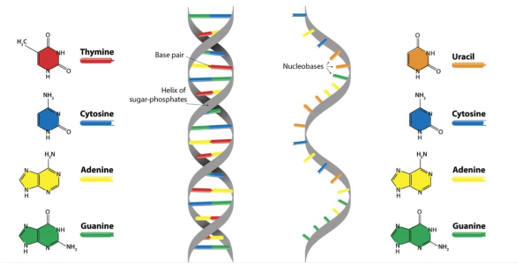
- Nucleic acids are long chainlike molecules composed of a series of nearly identical building blocks called nucleotides.
- Each nucleotide consists of a nitrogen-containing aromatic base attached to a pentose (five-carbon) sugar, which is in turn attached to a phosphate group.
Source: Kapdec.com
The biochemical properties of nucleic acids are:
- Ultraviolet absorption: The extent to which DNA is single-stranded or double-stranded can be determined by monitoring UV absorption
- Chemical modification: DNA can also be cleaved and degraded by enzymes called nucleases
- Mutation: Chemical modification of DNA can lead to mutations in the genetic material.
Solved examples
Example 1. What nitrogenous bases are found in RNA?
- A, T, G, U
- A, T, G, C
- A, U, C, T
- A, U, G, C
Solution 1: d) A, U, G, C because it has uracil instead of thymine.
Example 2. Why do different polysaccharides have different orientations of monomers?
a) The structural orientations are unimportant for polysaccharides
b) The differing structural orientations give the different compounds unique properties and functions
c) Each cell has a unique orientation for polysaccharides like a finger print
d)Organisms evolved from different sources that built carbohydrates differently
Solution 2: b. The different polysaccharides have different orientations of monomers because it gives different compounds unique properties and functions.
Summary
- Carbohydrate can be classified into three groups: monosaccharide, oligosaccharides, and polysaccharides.
- Monosaccharides are crystalline solids at room temperature and quite soluble in water
- A disaccharide is the sugar formed when two monosaccharides are joined by glycosidic linkage
- They are long-chain polymeric carbohydrates composed of monosaccharide units bound together by glycosidic linkages.
- Lipids are one of the major macromolecules present in our body, and others include nucleic acids, carbohydrates, and proteins.
- Proteins- are polymers composed of amino acids, which are connected by peptide bonds.
- Nucleic acids are long chainlike molecules composed of a series of nearly identical building blocks called nucleotides.
Scan to visit this resource online
https://kapdec.com/resources/properties-of-biological-macromolecules
