KAPDEC® | Elite STEM Learning Platform | https://kapdec.com
Unit: Electrostatics
Chapter: Gauss’s Law, Fields and potentials
Reference: AP Physics Electricity and Magnetism, Electrostatics, Gauss’s Law, Fields and potentials, Gauss’s Law and its Application, Fields and potentials of other charge distributions
After studying this chapter, you should be able to,
- Understand the concept of Gauss’s Law
- Explain the concept of Fields and potentials of other charge distributions
Gauss’s Law and its Application
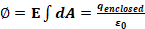
• The flux of the electric field through any closed surface S is

Source: Kapdec.com
times the total charge enclosed by S.
Source: Kapdec.com
- The law is mainly useful in determining electric field E, when the source distribution has simple symmetry:
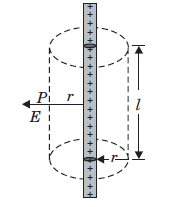
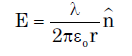
- Thin infinitely long straight wire of uniform linear charge density λ.
Source: Kapdec.com
Fig. Thin infinitely long Straight wire
Source: Kapdec.com
Where r is the radial (perpendicular) distance of the point from the wire and n

Source: Kapdec.com
is the radial unit vector in the plane normal to the wire passing through the point.
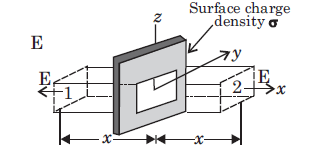
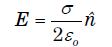
• Infinite plane sheet (thin) of uniform surface charge density σ.
Source: Kapdec.com
Fig. Infinite plane sheet (thin)
Source: Kapdec.com
Where ˆn is a unit vector normal to the plane and going away from it.
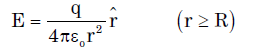
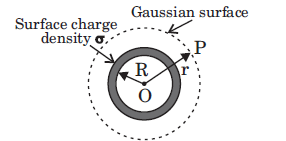
• Thin spherical shell of uniform surface charge density σ.
Source: Kapdec.com
Source: Kapdec.com
Fig.: Thin uniformly surface-charged spherical
shell (r > R)
(For r > R)
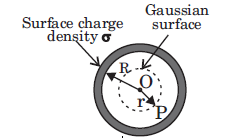
E = 0 (r < R)
Source: Kapdec.com
Fig.: Thin uniformly surface-charged spherical
shell (r < R)
(For r < R)
Where r is the distance of the point from the centre of the shell whose radius is R with the total charge q. The electric field outside the shell is the same as the total charge is concentrated at the centre. A solid sphere of uniform volume charge density shows the same result. Inside the shell at all the points, the field is zero.
Fields and potentials of other charge distributions
Continuous charge distribution:
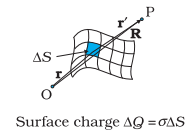
For the continuous charge distribution, let us consider an area element ∆s on the surface of the conductor and the charge ∆Q on the element. Then we can define a surface charge density σ at the area element by

Source: Kapdec.com
Source: Kapdec.com

Source: Kapdec.com
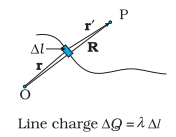
Similarly, for a line charge distribution. The linear charge density λ of a wire is defined by

Source: Kapdec.com
Source: Kapdec.com
where ∆l is a small line element of wire and ∆Q is the charge contained in that line element. The unit of λ is

Source: Kapdec.com
.
The volume charge density is defined in the same manner:

Source: Kapdec.com
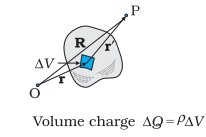
where ∆Q is the charge included in the macroscopically small volume element ∆V that includes a large number of microscopic charged constituents. The units for ρ are C/m3.
The field due to a continuous charge distribution can be obtained in much the same way as for a system of discrete charges. For the origin O let the position vector of any point in the charge distribution be r. The charge in a volume element ∆V is ρ∆V.
Source: Kapdec.com
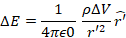
Now for any point p (inside or outside the distribution) with the position vector R. Electric field due to the charge ρ∆V is given by Coulomb’s law;
Source: Kapdec.com
Where r’ is the distance between the charge element and P, and r’ is a unit vector in the direction from the charge element to P.
- The electric field due to a discrete charge configuration is not defined at the locations of the discrete charges. For continuous volume charge distribution, it is defined at any point in the distribution. For a surface charge distribution, the electric field is discontinuous across the surface.
- The continuous charge distribution requires an infinite number of charge elements to characterize it.
Example:
The electrostatic potential inside a charged spherical ball is given by ϕ = ar2 + b where 𝑟 is the distance from the centre; 𝑎, 𝑏 are constants. Then the charge density inside the ball is __________.
Solution:
We know that,
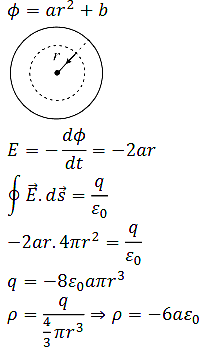
Source: Kapdec.com
Key points:
Gauss’s Law is a fundamental principle in electromagnetism that relates the electric field to the distribution of electric charges. Here are some key points about Gauss’s Law:
Statement: Gauss’s Law states that the electric flux through any closed surface is equal to the net charge enclosed by that surface divided by the permittivity of the medium.
Flux and Electric Field: Electric flux is a measure of the number of electric field lines passing through a given area. Gauss’s Law relates the flux to the charge enclosed by the surface. If the net charge enclosed is zero, the total flux through the surface will also be zero.
Closed Surface: Gauss’s Law applies to any closed surface, such as a sphere, cube, or any other shape that forms a complete surface with no openings.
Charge Enclosed: The charge enclosed refers to the sum of all the charges located within the closed surface. Charges outside the surface do not contribute to the flux through that surface.
Permittivity: The permittivity of the medium is a property that characterizes the response of the material to an applied electric field. It determines how much electric field is required to induce a given amount of electric displacement.
Integral Form: Gauss’s Law is often written in integral form using the surface integral of the electric field over a closed surface. The integral form is given by ∮E · dA = (1/ε₀)Q, where E is the electric field, dA is a differential area element on the surface, ε₀ is the permittivity of free space, and Q is the total charge enclosed.
Differential Form: Gauss’s Law can also be expressed in differential form using the divergence operator. In this form, it states that the divergence of the electric field is proportional to the charge density at any given point in space. Mathematically, it is written as ∇ · E = (1/ε₀)ρ, where ∇ · E is the divergence of the electric field, ε₀ is the permittivity of free space, and ρ is the charge density.
Applications: Gauss’s Law is widely used to calculate electric fields and charges in symmetric systems, such as spherical, cylindrical, or planar symmetries. It is especially useful when there is a high degree of symmetry, allowing for simplifications in the calculations.
Relation to Coulomb’s Law: Gauss’s Law is mathematically equivalent to Coulomb’s Law, which describes the force between two-point charges. Gauss’s Law provides a more general and powerful way to analyze electric fields and charges in a wider range of situations.
Fields and potentials of charge distributions depend on the specific configuration of charges. Here are some key points regarding different charge distributions:
Point Charge:
A point charge is a concentrated charge located at a single point.
The electric field created by a point charge follows an inverse square law, decreasing with the square of the distance from the charge.
The electric potential due to a point charge also follows an inverse square law.
Line Charge:
A line charge is a distribution of charge along an infinitely long line.
The electric field created by a line charge is perpendicular to the line and falls off inversely with the distance from the line.
The electric potential due to a line charge depends on the shape and density of the charge distribution and can be calculated using integration.
Surface Charge:
A surface charge is a distribution of charge over a two-dimensional surface.
The electric field created by a surface charge is perpendicular to the surface and depends on the charge density and the shape of the surface.
The electric potential due to a surface charge can be calculated by integrating the electric field over the surface.
Volume Charge:
A volume charge is a distribution of charge within a three-dimensional region.
The electric field created by a volume charge depends on the charge density and the shape of the charge distribution.
The electric potential due to a volume charge can be calculated by integrating the electric field over the entire volume.
Spherical Charge Distribution:
A spherical charge distribution has charges distributed uniformly over the surface of a sphere or within a spherical volume.
The electric field created by a uniformly charged sphere (both surface charge and volume charge) is radially symmetric and depends on the distance from the centre of the sphere.
The electric potential due to a uniformly charged sphere can be calculated using integration or by considering the potential of a point charge at the centre.
