KAPDEC® | Elite STEM Learning Platform | https://kapdec.com
Unit: Lines and Angles
Chapter: Introduction to Lines and Angles
Reference: – Definition of Lines and Angles, Types of Lines, Types of Angles, Angle Relationships, Linear Pair of Angles, Intersecting Lines and Angles, Parallel Lines and Angles, Angle Sum Property of a Triangle, Real-Life Applications of Lines and Angles, Basic Theorems Related to Lines and Angles
After studying this chapter, you should be able to understand:
- Definition of Lines and Angles
- Types of Lines & Angles
- Angle Relationships & Linear Pair of Angles
- Basic Theorems Related to Lines and Angles
Definition of Lines and Angles
A line is a one-dimensional figure that extends infinitely in both directions without any thickness. An angle is formed when two rays share a common endpoint, known as the vertex. Lines and angles are fundamental elements in geometry, helping define shapes, structures, and measurements in various applications.
Types of Lines
Lines can be classified based on their orientation and relationship with other lines. Parallel lines remain equidistant and never intersect, while perpendicular lines meet at a right angle. Intersecting lines cross at a common point, forming angles, and transversal lines cut across two or more other lines at different points, creating various angle relationships.
Types of Angles
Angles are categorized based on their measure. An acute angle is smaller than a right angle, while an obtuse angle is larger. A right angle has a perfect quarter-turn, and a straight angle forms a straight line. A reflex angle is greater than a straight angle but less than a full revolution.
Angle Relationships
When two angles have a combined effect, they form specific relationships. Complementary angles add up to a defined value, while supplementary angles contribute to a greater sum. Adjacent angles share a common arm and vertex, and vertical angles are formed by the intersection of two straight lines, always appearing opposite each other.
Linear Pair of Angles
A linear pair consists of two adjacent angles that lie on the same straight line. These angles always share a common arm and a common vertex while forming a straight-line relationship. This property helps in proving angle-related theorems and solving geometric problems.
Intersecting Lines and Angles
When two lines cross each other at a point, they form different angles. The opposite angles formed at the intersection are called vertical angles, which exhibit a symmetrical property. The angles adjacent to one another often form supplementary pairs, and understanding these relationships is crucial in geometric proofs.
Parallel Lines and Angles
Parallel lines remain at a constant distance and do not meet. When a transversal intersects two parallel lines, various angle pairs are formed, including corresponding angles, alternate interior angles, and alternate exterior angles. These relationships provide a foundation for proving congruency and similarity in geometric shapes.
Angle Sum Property of a Triangle
A triangle consists of three angles, and understanding their sum is essential in geometry. This property is fundamental in proving the relationships within different types of triangles, including equilateral, isosceles, and scalene triangles. It also plays a crucial role in understanding polygonal angle properties.
Real-Life Applications of Lines and Angles
Lines and angles are used in architecture, engineering, and navigation. City planning relies on parallel and perpendicular lines to design roadways, while angles play a role in measuring slopes and inclines in construction. These concepts are also applied in computer graphics, physics, and astronomy.
Basic Theorems Related to Lines and Angles
Several theorems help define the behavior of lines and angles in geometric problems. The vertical angle theorem states that angles opposite each other when two lines intersect are always equal. Other theorems describe how angles behave when parallel lines are intersected by a transversal, forming specific angle pairs used in problem-solving.
Geometry: Lines and Angles
Introduction:
Geometrical Definitions
- A point is a fine dot which neither has length nor breadth nor thickness, but only has a position.
- A part or a portion of a line with two end points is called a line-segment.

Source: Kapdec.com
- When a line-segment is extended indefinitely in both directions, it forms a line.

Source: Kapdec.com
- A part of a line with one endpoint is called a ray.

Source: Kapdec.com
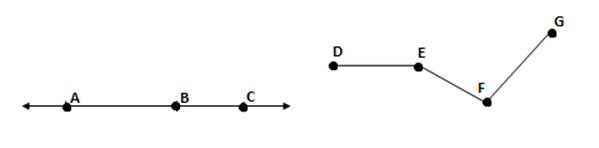
- If three or more points lie on the same line, they are called collinear points; otherwise, they are called non-collinear points.
- Here points A, B & C are collinear points but points D, E, F & G are non-collinear points.
Source: Kapdec.com
Types of Angles
As we have learnt some of these concepts in previous classes, this will be a quick review.
- An angle is formed when two rays originate from the same endpoint.
- The rays making an angle are called the arms of the angle.
- The endpoint is called the vertex of the angle.
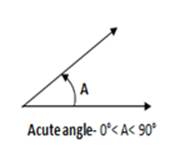
1) Acute Angle– An angle whose measure is less than 90 degrees.
Source: Kapdec.com
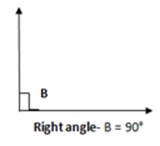
2) Right Angle- An angle whose measure is 90 degrees.
Source: Kapdec.com
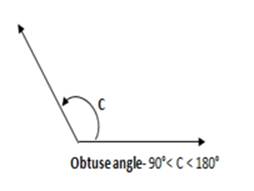
3) Obtuse Angle- An angle whose measure is between 90 degrees and 180 degrees.
Source: Kapdec.com
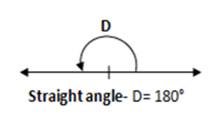
4) Straight angle– An angle whose measure is 180 degrees. Thus, a straight angle looks like a straight line.
Source: Kapdec.com
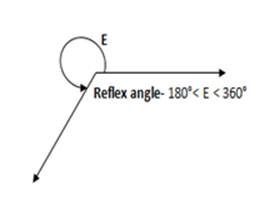
5) Reflex Angle- An angle whose measure is bigger than 180 degrees but less than 360 degrees.
Source: Kapdec.com
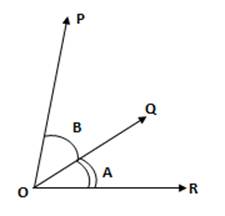
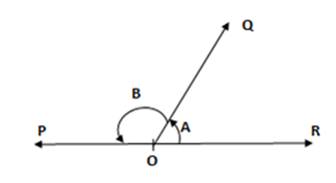
6) Adjacent Angle– Angles with a common vertex and one common side. ∠A and ∠ B are adjacent angles.
-
- Also, when two angles are adjacent, then their sum is always equal to the angle formed by the two non-common arms. Therefore, ∠ POR = ∠ POQ + ∠ ROQ
Source: Kapdec.com
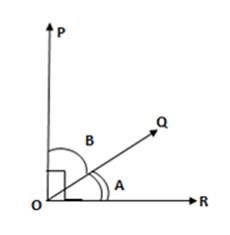
7) Complementary Angle- Complementary Angles are those whose sum is 90°.
∠ A +∠ B = 90°; therefore, both of them are complementary angles.
Source: Kapdec.com
8) Supplementary Angle– Supplementary Angles are those whose sum is 180°.
∠ A +∠ B = 180°; therefore, both of them are supplementary angles
Source: Kapdec.com
Types of Lines
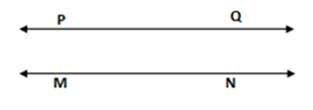
- Parallel Lines- Two sides are parallel, if they are coplanar and they do not intersect each other even if they are extended on either side.
Parallel lines are also known as Non-Intersecting lines.
Source: Kapdec.com
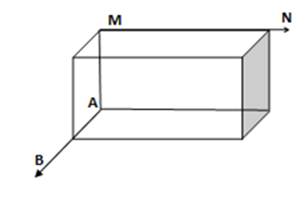
However, there are lines which do not intersect and yet are not parallel. These likes are not co-planar and are known as Skew Lines.
Lines AB and MN are Skew Lines. Skew Lines can only exist in three dimensions.
Source: Kapdec.com
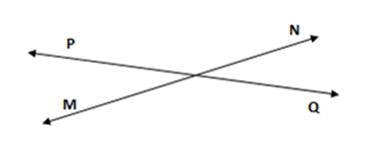
- Intersecting Lines– Lines which are coplanar and not parallel to each other always intersect at one point, and therefore are known as intersecting lines.
Source: Kapdec.com
Fundamental Concepts – Lines and angles are the foundation of geometry, forming the basis for understanding more complex shapes, figures, and relationships in mathematical reasoning.
Interdependence of Lines and Angles – The relationships between different types of lines and angles help establish rules and theorems that are crucial for solving geometric problems, including those involving parallel and intersecting lines.
Real-World Applications – The principles of lines and angles are widely applied in fields such as engineering, architecture, physics, and design, making them essential in practical problem-solving.
Logical Reasoning and Proofs – Studying lines and angles enhances logical thinking, as many geometric proofs rely on angle relationships and line properties to establish conclusions.
Foundation for Advanced Geometry – Understanding the properties of lines and angles is necessary for exploring more advanced topics in geometry, such as polygons, trigonometry, and three-dimensional figures.
