KAPDEC® | Elite STEM Learning Platform | https://kapdec.com
Unit: Revisiting real numbers
Chapter: Classification of Numbers
Reference: – Natural Numbers, Whole Numbers, Integers, Rational Numbers, Irrational Numbers, Real Numbers, Prime Numbers, Composite Numbers, Even and Odd Numbers, Perfect Squares, Perfect Cubes, Terminating Decimals, Non-Terminating Recurring Decimals, Non-Terminating Non-Recurring Decimals, Number Line Representation
After studying this chapter, you should be able to understand:
- Natural Numbers & Whole Numbers
- Integers, Rational Numbers & Irrational Numbers
- Even and Odd Numbers & Perfect Squares
- Non-Terminating Recurring Decimals & Non-Terminating Non-Recurring Decimals
- Natural Numbers
Natural numbers are the basic counting numbers used for ordering and counting discrete objects. They are the foundational building blocks of arithmetic.
- Whole Numbers
Whole numbers are an extension of natural numbers that include zero. They represent quantities that are complete and non-negative.
- Integers
Integers include all whole numbers and their negatives. They are used to express values that can go below zero as well as above, making them useful for gains, losses, elevations, and temperatures.
- Rational Numbers
Rational numbers are values that can be expressed as the ratio of two integers, where the denominator is not zero. Their decimal representations either terminate or repeat in a predictable pattern.
- Irrational Numbers
Irrational numbers are values that cannot be expressed as a ratio of two integers. Their decimal expansions are infinite and do not show any repeating pattern.
- Real Numbers
Real numbers encompass both rational and irrational numbers. They represent all possible values that can be located on a continuous number line.
- Prime Numbers
Prime numbers are natural numbers greater than one that have exactly two distinct positive divisors: one and themselves. They are the “atoms” of multiplication in number theory.
- Composite Numbers
Composite numbers are natural numbers that have more than two distinct positive divisors. They can be formed by multiplying smaller natural numbers together.
- Even and Odd Numbers
Even numbers are integers that are divisible by two with no remainder, while odd numbers are integers that leave a remainder when divided by two. This classification helps in identifying patterns in arithmetic.
- Perfect Squares
Perfect squares are numbers that result from multiplying a whole number by itself. They have special geometric and algebraic significance.
- Perfect Cubes
Perfect cubes are numbers formed by multiplying a whole number by itself twice (raised to the power of three). They appear in volume calculations and polynomial identities.
- Terminating Decimals
Terminating decimals are decimal numbers that come to an end after a finite number of digits. They indicate a rational number with an exact fractional representation.
- Non-Terminating Recurring Decimals
These decimals go on forever but follow a fixed repeating pattern. They also represent rational numbers and can be converted back into fractional form.
- Non-Terminating Non-Recurring Decimals
These decimals continue infinitely without repeating. They are characteristic of irrational numbers and cannot be represented by exact fractions.
- Number Line Representation
This is a visual method of plotting all types of numbers on a continuous horizontal line, showing their relationships, order, and distance from zero.
Example: –
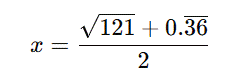
Given the number:
Source: Kapdec.com
Classify the number x into the correct type(s) within the number system.
Solution: –
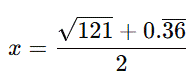
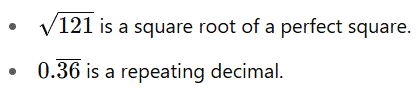
Step 1: Analyse the components of the expression
The expression is:
Source: Kapdec.com
Source: Kapdec.com
Step 2: Simplify the components

Source: Kapdec.com
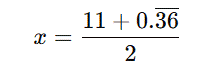
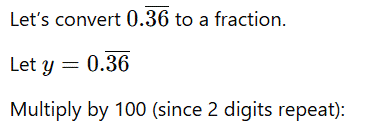
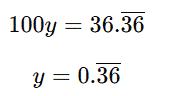
It is a repeating decimal, which can be written as a rational number (specifically, a fraction). All repeating decimals are rational numbers.
Thus,
Source: Kapdec.com
Step 3: Add the values
Source: Kapdec.com
Source: Kapdec.com
Step 4: Simplify the expression
Convert 11 to a fraction with denominator 11:

Source: Kapdec.com
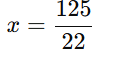
Step 5: Classify the final result
Source: Kapdec.com
Step 5: Classify the final result
- This is a ratio of two integers, and the denominator is not zero.
- Therefore, it is a rational number.
- It is not an integer, not a whole number, and not a natural number.
- Since it is rational, it is also a real number.
- It is not irrational, because it has an exact fractional form.
✅ Five Conclusive Points
- All Numbers Can Be Systematically Categorized
Every number in algebra belongs to one or more well-defined categories, such as natural, whole, integer, rational, or irrational, allowing for organized understanding and application.
- Rational and Irrational Numbers Form the Real Number System
The combination of rational and irrational numbers includes all possible numerical values that can be placed on a number line, making up the complete set of real numbers.
- Hierarchy and Overlap Exist Among Number Types
Number sets are often nested within each other; for example, natural numbers are part of whole numbers, which are part of integers, which in turn are part of rational numbers.
- Understanding Decimal Behavior Aids Classification
The behavior of a number’s decimal expansion—whether it terminates, repeats, or neither—helps determine whether it is rational or irrational.
- Visualizing Numbers on a Number Line Enhances Comprehension
Representing different types of numbers on a number line clarifies their relationships, distances, and positions, reinforcing understanding of their classification.
