KAPDEC® | Elite STEM Learning Platform | https://kapdec.com
Source: Kapdec.com
Unit: Quadratic Equations
Techniques of Solving Quadratic Equations
Splitting middle term:
There is a method that works in simple cases. With the quadratic equation in this form:
ax2 + bx + c = 0
Step1: Find two numbers that multiply to give ac (in other words a times c), and add to give b.
Example: x2 + 4x – 12 = 0
ac is -12 x 1= 6 and b is 4
So, we want two numbers that multiply together to make -12, and there difference is 4.
In fact, 6 and -2 do that (6 x – 2 = -12 and 6 – 2 = 4)
Step2: Rewrite the middle term with those numbers:
Rewrite 4x with 6x and -2x
x2 + 6x – 2x – 12
Step3: Factor the first two and last two terms separately.
The first two terms x2 + 6x factor into x(x + 6)
The last two terms -2x – 12 factors into -2(x + 6)
So, we get:
x(x+6) – 2(x + 6)
Step4: If we have done this correctly, our two new terms should have a clearly visible common factor.
In this case we can see that (x + 6) is common to both terms, so we can write above calculation as follows:
Start with: x(x+6) – 2(x + 6)
(x – 2)( x + 6)
(x – 2) and (x – 6) are factors of quadratic equation x2 + 4x – 12 = 0.
Here,
(x – 2)(x + 6) = 0
So, (x – 2) = 0
x = 2
And (x + 6) = 0
x = -6
Therefore, 2 and -6 are root or zero of the given equation.
In general, a real number ∝

Source: Kapdec.com
is called a root of the quadratic equation
ax2 + bx + c = 0, a ≠ 0 if a

Source: Kapdec.com
2 + b∝ + c = 0. We also say that x = ∝is a solution of the quadratic equation, or that ∝satisfies the quadratic equation. Note that the zeroes of the quadratic polynomial ax2 + bx + c and the roots of the quadratic equation ax2 + bx + c = 0 are the same.
How to Complete the Square
Let’s start with a general polynomial equation of degree 2:
This time, instead of moving all terms to one side of the equation, we will have all terms with variables on one side of the equation and all constants on the other side:
x2 – x + 10 + x2 + 17x – 10 = -x2 – 17x + 28 + x2 + 17x – 10
2x2 + 16x = 18
In any completing the square problem, there can be no coefficient before the x2. If there is one, all terms must be divided by that coefficient. In this case, we will divide all terms by 2:
2x2 ÷ 2 + 16x ÷ 2 = 18 ÷ 2
x2 + 8x = 9
For any completing the square problem, we must reduce the equation to the form x2 + bx = c. For the next step, we should keep in mind the following identity:
(x + y)2 = x2 + 2xy + y2
Now, let’s assume b = 2y. That would mean x2 + bx is almost (x +

Source: Kapdec.com
)2. All it would be missing is

Source: Kapdec.com
. Therefore, the next step is to add

Source: Kapdec.com
to both sides of the equation. In the case of our example, we will add

Source: Kapdec.com
= 16 to both sides:
x2 + 8x + 16 = 9 + 16
x2 + 8x + 16 = 25
We know from the identity (x + y)2 = x2 + 2xy + y2 that we can now condense x2 + 8x + 16 to (x + 4)2:
(x + 4)2 = 25
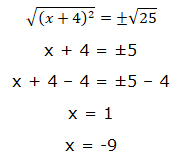
Now you can take the square root of both sides; keep in mind this is both the positive and the negative square root in this case:
Source: Kapdec.com
The solutions to the equation x2 – x + 10 = -x2 – 17x + 28 are x = 1 and x = -9. To check our answer, let’s see what happens if we expand the factors (x – 1) and (x + 9):
(x – 1)(x + 9) = 0
x(x + 9) – x – 9 = 0
x2 + 8x = 9
This leads us right back to the equation we had earlier, showing that we get the same answers through factoring and through completing the square.
In summary, go through the following steps to complete the square:
- Condense the equation to the form x2 + bx = c ()
- Add.

Source: Kapdec.com
to each side of the equation.
- Condense the equation to the form (x +

Source: Kapdec.com
)2 = c +

Source: Kapdec.com
- Take the positive and negative square roots of both sides.
- Subtract

Source: Kapdec.com
from both sides to find the values of x.
Completing the Square Again
To see how the quadratic formula works, we will need a general form of completing the square.
First, we must condense our polynomial equation to the form we would start with if we were factoring:
ax2 + bx + c = 0
Then, we need to move the constant to the other side of the equation and divide everything by a to complete the square:
ax2 + bx + c – c = 0 – c
ax2 + bx = -c
x2 +

Source: Kapdec.com
x =

Source: Kapdec.com
Now, instead of adding

Source: Kapdec.com
to both sides, we must add

Source: Kapdec.com
to both sides:
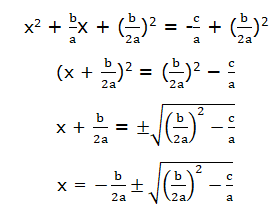
Source: Kapdec.com
We now have a general formula that can solve any quadratic equation. However, it is a very awkward formula that needs refinement to become the Quadratic Formula:
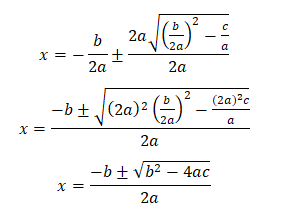
Source: Kapdec.com
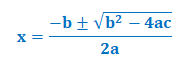
The final formula is the Quadratic Formula. It can be applied to any polynomial equation of degree 2 with coefficients ax2 + bx + c = 0.
If b2 – 4ac ≥ 0, then the roots of the quadratic equation ax2 + bx + c = 0 are given by
Source: Kapdec.com
This formula for finding the roots of a quadratic equation is known as the quadratic formula. Let us consider some examples for illustrating the use of the quadratic formula.
Nature of Roots:
Determinant
There is only one part of the Quadratic Formula that lies within the square root:

Source: Kapdec.com
. Because of this, the expression b2 – 4ac is called the determinant of a quadratic equation; it determines how many solutions the equation has. We don’t even need to finish the whole Quadratic Formula to see how many solutions a quadratic equation has:
If b2 – 4ac > 0, then the equation has two solutions.
If b2 – 4ac = 0, then the equation has one solution.
If b2 – 4ac < 0, then the equation has no real solutions.
Scan to visit this resource online
https://kapdec.com/resources/techniques-of-solving-quadratic-equations
