KAPDEC® | Elite STEM Learning Platform | https://kapdec.com
Unit: Exponents & Powers
Chapter: Laws of Exponents
Reference: – Understanding the meaning of exponents, Product of powers property, Quotient of powers property, Power of a power rule, Power of a product rule, Power of a quotient rule, Zero exponent rule, Negative exponents
After studying this chapter, you should be able to understand:
- Understanding the meaning of exponents
- Products of Power property
- Quotient of Power property & Quotient rule
- Zero Exponent rule & Negative Exponents
- Understanding the meaning of exponents
Exponents represent how many times a number, called the base, is multiplied by itself. This notation simplifies repeated multiplication and provides a foundation for understanding powers and exponential growth or decay. - Product of powers property
When multiplying expressions with the same base, the operation combines the repeated factors. Instead of multiplying each term individually, the exponents are added, streamlining the calculation process while maintaining the base. - Quotient of powers property
In division scenarios involving the same base, the rule allows simplification by subtracting the exponent of the denominator from that of the numerator. This helps in reducing expressions and identifying underlying patterns in algebraic forms. - Power of a power rule
This rule arises when an exponent is applied to an already exponentiated base. It involves multiplying the two exponents to represent repeated layers of multiplication, aiding in solving complex exponential equations. - Power of a product rule
When a product of multiple bases is raised to a power, each factor within the product is individually raised to that power. This distributes the exponent across the terms, ensuring all parts of the expression are equally scaled. - Power of a quotient rule
If a quotient is raised to an exponent, both the numerator and denominator are raised to that exponent. This maintains balance in the expression and supports simplification and evaluation of fractional powers. - Zero exponent rule
This principle establishes that any non-zero number raised to the power of zero results in one. It reinforces the logical consistency of exponent rules and serves as a boundary condition in algebraic expressions. - Negative exponents
A negative exponent indicates the reciprocal of the base raised to the corresponding positive exponent. This transforms large or small quantities into manageable forms and plays a key role in scientific notation and real-world modeling.
Example: –
Simplify the following expression and express your final answer with positive exponents only:
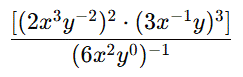
Source: Kapdec.com
Solution: –
Step 1: Apply power of a power rule to the numerator
Start by simplifying each part separately.
First expression:

Source: Kapdec.com
Second expression:

Source: Kapdec.com
Now multiply both results:

Source: Kapdec.com
Step 2: Simplify the denominator
Denominator expression:

Source: Kapdec.com
Step 3: Divide the simplified numerator by the simplified denominator

Source: Kapdec.com
Step 4: Final answer with positive exponents only
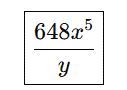
Source: Kapdec.com
Here are five conclusive points for the topic Laws of Exponents under Exponents & Powers:
- Laws of exponents create a standardized framework to simplify and manipulate expressions involving powers, making algebraic calculations more efficient.
- These rules are foundational for understanding complex mathematical operations like exponential functions, polynomial expressions, and scientific notation.
- Mastery of exponent laws supports problem-solving in both pure and applied mathematics, including real-world contexts like finance and physics.
- The properties help in reducing large computations into manageable steps by transforming repeated multiplication or division.
- Understanding zero and negative exponents deepens comprehension of inverse relationships and mathematical structure.
