KAPDEC® | Elite STEM Learning Platform | https://kapdec.com
Unit: Squares and Square Roots
Chapter: Properties of Square Numbers
Reference: – Definition and understanding of square numbers, Properties of square numbers, including even and odd squares, Relationship between squares and square roots, Perfect square integers, Identifying square numbers within a range, simplifying expressions with square numbers, the concept of squares of binomials, using squares in real-world applications, solving problems involving square numbers
After studying this chapter, you should be able to understand:
- Definition and understanding of square numbers
- Perfect square integers & identifying square numbers within a range
- The concept of squares of binomials
- solving problems involving square numbers
Here’s a detailed theoretical explanation of each point related to Properties of Square Numbers under the Squares and Square Roots chapter:
- Definition and understanding of square numbers: Square numbers are integers that are the product of an integer multiplied by itself. For example, 1, 4, 9, and 16 are square numbers as they result from multiplying whole numbers by themselves (1², 2², 3², 4²).
- Properties of square numbers, including even and odd squares: Even square numbers are those where the original integer is even, and odd square numbers are those where the original integer is odd. The square of an even number is always even, and the square of an odd number is always odd.
- Relationship between squares and square roots: The square root of a square number is the original integer. This inverse relationship between squaring and square roots is fundamental in understanding how numbers work in both directions. For example, √16 = 4, because 4² = 16.
- Perfect square integers: These are integers that are the result of squaring another integer. The perfect squares form a sequence of numbers like 1, 4, 9, 16, and so on. Understanding these numbers helps with simplifying expressions and solving equations in algebra.
- Identifying square numbers within a range: This involves determining which numbers within a specific range are square numbers. For instance, identifying all square numbers between 1 and 100 would give you 1, 4, 9, 16, 25, 36, 49, 64, 81, and 100.
- Simplifying expressions with square numbers: Expressions involving square numbers can often be simplified by factoring out square roots or using the properties of square numbers. For example, √36 can be simplified to 6 because 36 is a perfect square.
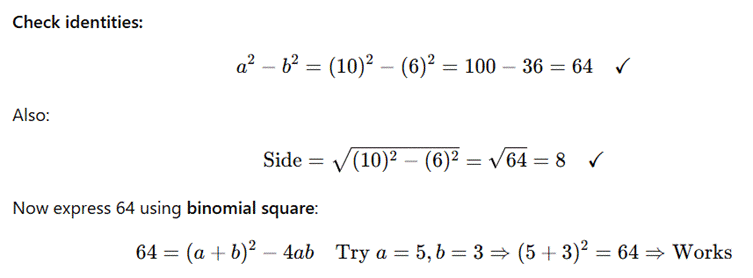
- The concept of squares of binomials: The square of a binomial (a two-term expression) is calculated by applying the formula (a+ b)² = a² + 2ab + b². This expands and simplifies the square of a binomial into a sum of three terms, which is essential for solving algebraic problems.
- Using squares in real-world applications: Square numbers are used in various practical applications, such as calculating areas of squares in geometry, analysing data patterns, and solving problems in physics, economics, and engineering.
- Solving problems involving square numbers: Problems often require identifying or manipulating square numbers to find unknowns. This could involve solving equations where the variable is squared or working with geometric problems where area calculations are involved.
- Multiplying square numbers for simplification: In algebraic simplifications, multiplying square numbers can make certain problems easier to solve. For example, multiplying two perfect squares like (4²) × (5²) can simplify to (4 × 5)² = 20².
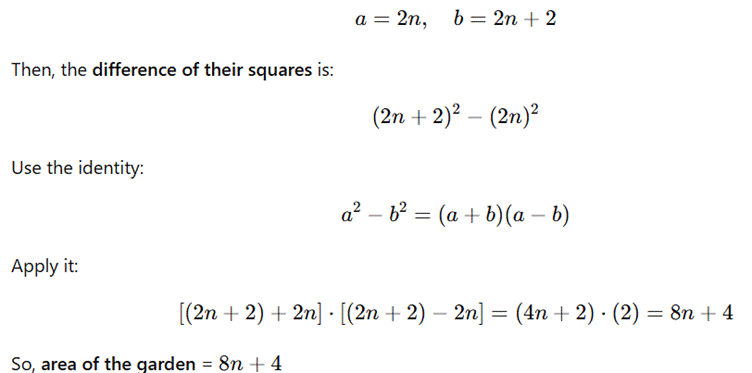
- Investigating the difference between squares: The difference of squares formula is often used to simplify expressions. It states that (a² – b²) = (a+ b) (a-b), which helps in factoring expressions and solving equations. This identity is widely used in algebraic manipulations.
- Connections between square numbers and geometric shapes: Square numbers correspond to areas of squares in geometry. For instance, if each side of a square is an integer, the area of the square is a square number, providing a visual understanding of the concept of squaring numbers.
- Example: –
A square garden has an area equal to the difference between the squares of two consecutive even numbers. A binomial expression representing the square root of this area is simplified using algebraic identities. If the side of the square garden is also equal to the simplified square root, find the dimensions of the garden and the two even numbers.
Also verify:
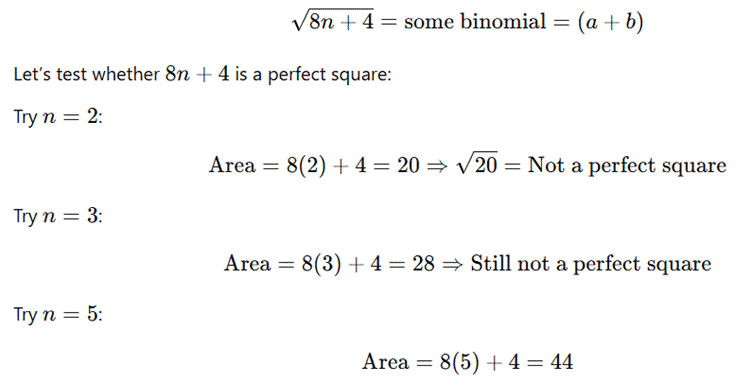
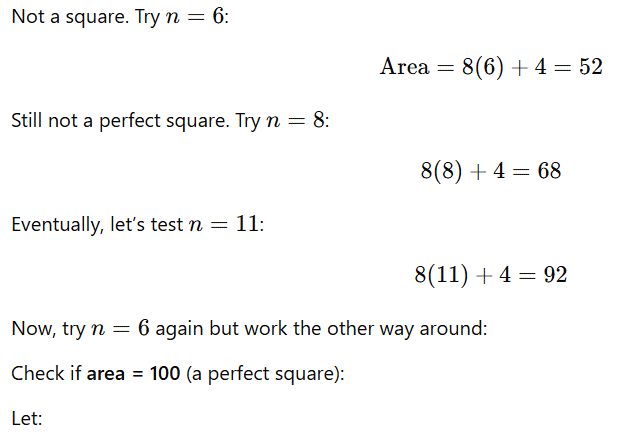
- The area is a perfect square
- The square root is derived correctly using the difference of squares and binomial square identities
Solution: –
Let the two consecutive even numbers be:
Source: Kapdec.com
Now, we are told the square root of the area is equal to the side of the garden, and it’s derived using binomial identities.
Assume the side is a binomial:
Source: Kapdec.com
Source: Kapdec.com
Source: Kapdec.com
Final Answer:
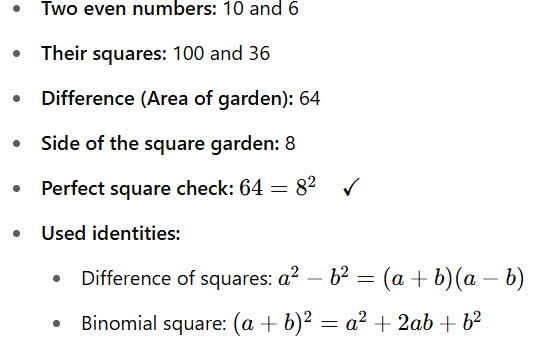
Source: Kapdec.com
Here are five conclusive points for the topic Properties of Square Numbers:
- Square numbers form the basis for understanding more complex algebraic identities and equations, providing a strong foundation in mathematical reasoning.
- The distinction between perfect squares and non-perfect squares helps in simplifying expressions and solving square root-related problems more efficiently.
- Recognizing the patterns and properties of square numbers enhances students’ number sense and supports mental math strategies.
- Square numbers are essential in understanding geometric concepts, particularly area, making them critical in connecting algebra to geometry.
- Mastery of square number properties supports success in standardized tests and real-life problem-solving situations involving quadratic expressions.
