KAPDEC® | Elite STEM Learning Platform | https://kapdec.com
Unit: Graphing: Types of Graphs
Chapter: Linear, Quadratic, Polynomial and Exponential Functions Graphs
Reference: – Introduction to Graphs of Functions, Cartesian Coordinate System, Graphing Linear Functions, Graphing Quadratic Functions, Graphing Polynomial Functions, Graphing Exponential Functions, Intercepts and Slope for Linear Graphs, Vertex, Axis of Symmetry, and Direction for Quadratic Graphs, Zeros, Factors, and Turning Points of Polynomial Graphs, Asymptotic Behavior in Exponential Graphs, Domain and Range from Graphs, Real-World Applications of Different Function Graphs
After studying this chapter, you should be able to understand:
- Introduction to Graphs of Functions
- Graphing Linear Functions & Graphing Quadratic Functions
- Intercepts and Slope for Linear Graphs
- Asymptotic Behavior in Exponential Graphs
- Introduction to Graphs of Functions
A graph of a function visually represents the relationship between input values (domain) and output values (range) on a coordinate plane, showing how each input corresponds to one output.
- Cartesian Coordinate System
A two-dimensional plane defined by a horizontal axis (x-axis) and a vertical axis (y-axis), where each point is located using an ordered pair of numbers representing horizontal and vertical positions.
- Graphing Linear Functions
Linear functions produce straight-line graphs where the rate of change between variables is constant. These graphs represent relationships with a uniform rate of increase or decrease.
- Graphing Quadratic Functions
Quadratic functions produce parabolic curves. These graphs typically open upwards or downwards and have distinct features such as a vertex and an axis of symmetry.
- Graphing Polynomial Functions
Polynomial functions of higher degree produce curves with multiple turning points and zeros. Their graphs can have varied shapes depending on the degree and coefficients.
- Graphing Exponential Functions
Exponential functions produce graphs where the rate of increase or decrease changes rapidly. These graphs often approach a horizontal asymptote and show exponential growth or decay.
- Intercepts and Slope for Linear Graphs
Intercepts are points where the graph crosses the axes. The slope measures the steepness or inclination of the line, representing the rate of change between two variables.
- Vertex, Axis of Symmetry, and Direction for Quadratic Graphs
The vertex is the highest or lowest point on a parabola. The axis of symmetry is a vertical line that divides the parabola into two mirror images. The direction indicates whether the parabola opens upwards or downwards.
- Zeros, Factors, and Turning Points of Polynomial Graphs
Zeros (or roots) are the x-values where the graph crosses the x-axis. Factors of the polynomial are related to these zeros. Turning points are places where the graph changes direction from increasing to decreasing or vice versa.
- Asymptotic Behavior in Exponential Graphs
An asymptote is a line that a graph approaches but never touches. Exponential graphs typically have horizontal asymptotes that represent a limiting value as the input becomes very large or very small.
- Transformations of Graphs (Shifts, Reflections, Stretching/Shrinking)
Transformations describe how the shape and position of a graph change when the function is modified. Shifts move the graph horizontally or vertically, reflections flip it over an axis, and stretching/shrinking affects its steepness.
- Domain and Range from Graphs
The domain includes all possible input values (x-values) for which the function is defined. The range includes all possible output values (y-values) that the function produces, both determined by observing the graph.
- Rate of Change from Graphs
The rate of change describes how much the output value changes in response to changes in the input. For linear functions, it’s constant (slope), while for non-linear functions, it varies across the graph.
- Symmetry in Graphs (Even, Odd, or Neither)
Symmetry refers to whether a graph is mirrored over the y-axis (even function), rotationally symmetric around the origin (odd function), or has no symmetry.
- Real-World Applications of Different Function Graphs
Graph of functions model many real-world situations like distance-time relationships (linear), projectile motion (quadratic), population growth (exponential), or economic data trends (polynomial).
Example: –
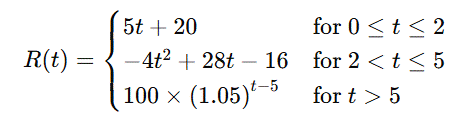
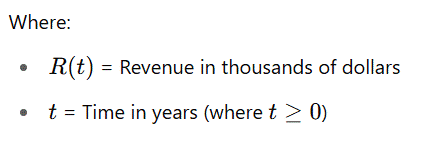
A company models its revenue (in thousands of dollars) over time (in years) using the following piecewise-defined function:
Source: Kapdec.com
Source: Kapdec.com
Solution: –
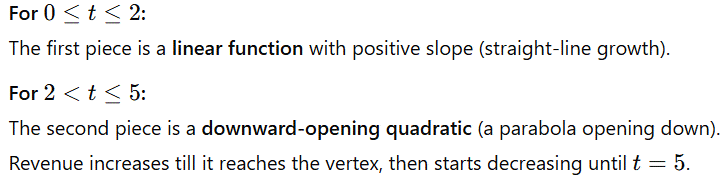
Sketching the Graph (Conceptual Description):
Source: Kapdec.com

Source: Kapdec.com
Domain and Range:
Domain:
All t from 0 to 8:

Source: Kapdec.com
Range:
Considering all output values R(t) from the graph across all three segments (linear, quadratic, exponential).
Start from the lowest revenue (at t=0) to the highest revenue (as t→8, which increases exponentially).
Revenue Decrease Interval:
- Revenue decreases only during the quadratic section, specifically after the vertex of the parabola till t=5.
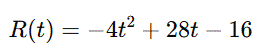
- First find the vertex of the quadratic section:
For the quadratic:
Source: Kapdec.com
The vertex occurs at:
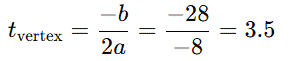
Source: Kapdec.com
Thus,
Graph behavior:
Linear growth → Parabolic rise and fall → Exponential increase.
Domain:

Source: Kapdec.com
Revenue decrease interval:

Source: Kapdec.com
Maximum revenue (within the interval):
At t=8 due to exponential growth.
Here are five conclusive points for “Linear Functions in a Coordinate Plane”:
- Understanding Different Function Families is Essential for Graph Interpretation
Each type of function—linear, quadratic, polynomial, or exponential—has a distinct graph shape and behavior. Recognizing these patterns helps students quickly identify and interpret relationships between variables.
- Key Features Define the Nature of Graphs
Important graph features like intercepts, slopes, vertices, turning points, and asymptotes provide critical information about the function’s behavior, including where it increases, decreases, or remains constant.
- Transformations Allow Flexibility in Graph Manipulation
Shifting, reflecting, and stretching/squeezing graphs helps students understand how algebraic changes affect the graph’s position and shape, making function behavior predictable and easier to model.
- Domain and Range Determine the Scope of a Function’s Graph
Understanding how to extract domain and range from a graph is crucial for solving real-world problems, as it clarifies where the function is applicable and what outputs are possible.
- Graphing Functions Builds a Strong Foundation for Advanced Math and Real-World Applications
Mastery of graphing linear, quadratic, polynomial, and exponential functions prepares students for more advanced studies like calculus and statistics, while also enhancing their ability to model and solve real-life problems.
Scan to visit this resource online
https://kapdec.com/resources/linear-quadratic-polynomial-and-exponential-functions-graphs
