KAPDEC® | Elite STEM Learning Platform | https://kapdec.com
Unit: Thermodynamics
Chapter: Thermodynamics collisions and Entropy
Reference: AP Physics Algebra, Thermodynamics, Thermodynamics collisions and Entropy, Collision, Heat engines, Working of Heat Engine, Refrigerator or Heat Pump, The second law of thermodynamics, Carnot cycle, Entropy (S)
After studying this chapter, you should be able to know,
- Collision
- Heat engines,
- Refrigerators and heat pumps,
- The second law of thermodynamics
- Carnot Cycle
- Entropy
Collision:
- In a collision, two objects interact and exchange energy and momentum.
- In an elastic collision, the total kinetic energy of the colliding objects is conserved. This means that the kinetic energy before the collision is equal to the kinetic energy after the collision.
- In an inelastic collision, some of the kinetic energy is transformed into other forms of energy, such as thermal energy or sound energy. This means that the kinetic energy before the collision is not equal to the kinetic energy after the collision.
- In an elastic collision, the colliding objects will bounce off each other with the same speed and direction they had before the collision.
- In an inelastic collision, the colliding objects will stick together or deform and continue moving together as a single object after the collision.
- The type of collision that occurs depends on the properties of the colliding objects and the nature of the collision. For example, collisions between hard, non-deformable objects tend to be more elastic, while collisions between soft, deformable objects tend to be more inelastic
Heat engines:
A heat engine is a device by which a system is made to undergo a cyclic process that results in the conversion of heat to work.
1. Source: The source is a hot body at a constant high temperature from which the heat engine can draw heat.
2. Sink: sink is a cold body at a constant low temperature to which any amount of heat can be rejected.
3. Working substance: Working substance is an ideal gas which on being supplied with heat performs mechanical work.
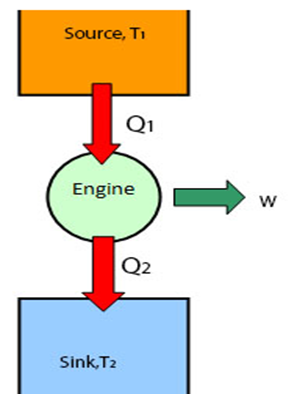
Source: Kapdec.com
Working of Heat Engine
The cycle is repeated again and again to get useful work for some purpose. The discipline of thermodynamics has its roots in the study of heat engines. A basic question relates to the efficiency of a heat engine. The efficiency (h) of a heat engine is defined by
h=WQ1
where Q1 is the heat input i.e., the heat absorbed by the system in one complete cycle and W is the work done on the environment in a cycle. In a cycle, a certain amount of heat (Q2) may also be rejected to the environment. Then, according to the First Law of Thermodynamics, over one complete cycle,
W = Q1 – Q2
i.e.,
h=1=Q2/Q1
For Q2 = 0, h = 1, i.e., the engine will have 100% efficiency in converting heat into work.
Refrigerator or Heat Pump.
A refrigerator or heat pump is basically a heat engine running in the reverse direction.
It essentially consists of three same parts.
The performance of a refrigerator is expressed by means of the coefficient of
Performance β

Source: Kapdec.com
which is defined as the ratio of the heat extracted from the cold body to the work needed to transfer it to the hot body.
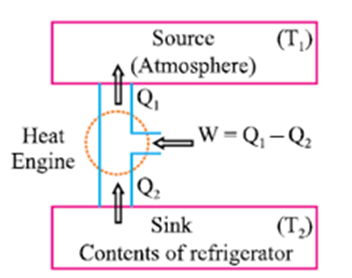
Source: Kapdec.com
β
Source: Kapdec.com
=Heat extractedWork Done =Q2/W

Source: Kapdec.com
=Q2/Q1–Q2
A perfect refrigerator
W = 0 so that Q1 = Q2 and hence β
Source: Kapdec.com
=∞

Source: Kapdec.com
Carnot refrigerator:
For Carnot refrigerator =
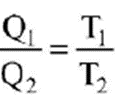
Source: Kapdec.com
coefficient of performance =
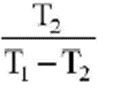
Source: Kapdec.com
where T1 = temperature of surrounding, T2 = temperature of cold body
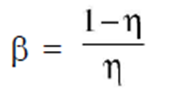
(2) Relation between the coefficient of performance and efficiency of the refrigerator
Source: Kapdec.com
The second law of thermodynamics:
Kelvin-Planck’s statement is based on the experience of the performance of heat engines. (Heat engine is discussed in the next section.) In a heat engine, the working substance extracts heat from the source (hot body), converts a part of it into work and rejects the rest of the heat to the sink (environment). There is no engine which converts the whole heat into work, without rejecting some heat to the sink. These observations led Kelvin and Planck to state the second law of thermodynamics as
It is impossible for any system to absorb heat from a reservoir at a fixed temperature and convert the whole of it into work.
Clausius’s statement of the second law of thermodynamics is based on the performance of a refrigerator. A refrigerator is a heat engine working in the opposite direction. It transfers heat from a colder body to a hotter body when external work is done on it. Here the concept of external work done on the system is important.
To do this external work, a supply of energy from some external source is a must. These observations led Clausius to state the second law of thermodynamics in the following form.
It is impossible for any process to have as its sole result to transfer heat from a colder body to a hotter body without any external work.
Thus, the second law of thermodynamics plays a unique role for practical devices like heat engines and refrigerator.
Carnot cycle
The Carnot cycle consists of the following 4 processes:
This process has a reversible isothermal gas expansion. In it the ideal gas in the system absorbs qin amount of heat from a heat source at a high temperature Thigh, expands and does work on surroundings.
This process has a reversible adiabatic gas expansion. In it the system is thermally insulated. The gas continuously expands and do work on the surroundings, which causes the system to cool to a lower temperature, Tlow.
This process has a reversible isothermal gas compression. In it surroundings do work to the gas at Tlow, and causes a loss of heat, qout.
This process has a reversible adiabatic gas compression. In it the system is thermally insulated. Surroundings continuously do work to the gas, which causes the temperature to rise back to Thigh
Entropy (S)
- The degree of randomness or disorderliness is known as entropy
- Entropy change for a system
∆ssystem =Q/T

Source: Kapdec.com
- On the increasing temperature, volume, mole or molecule, dissociation/decomposition/vaporisation/ fusion entropy increases.
- On increasing pressure, crystallization/Bond formation/association entropy decreases
- On mixing two solids or two liquids or two gases (non-reacting) randomness increases
- Mobility or Randomness
∝

Source: Kapdec.com
1Molecular Weight
- If the molecular weight of 2 species is the same then more atomicity indicates more randomness
e.g.: H2 > N2 > O2
e.g.: C2H4 > N2
- Unit of Entropy –
JK

Source: Kapdec.com
or CalK
- Unit of molar Entropy-
JK-mole or CalK-mole
- Entropy is an extensive property
- Molar entropy is an intensive property
- It is a state function
Example: When 1 𝑘𝑔 of ice at 0°C melts to water at 0°C, the resulting change in its entropy, taking the latent heat of ice to be 80 𝑐𝑎𝑙/°C is _________
Solution:
∆S=∆QT=80×1000273=293 cal/K
Key Points:
- A refrigerator or heat pump is basically a heat engine running in the reverse direction. It essentially consists of three same parts.
- The performance of a refrigerator is expressed by means of the coefficient of
- Performance β

Source: Kapdec.com
which is defined as the ratio of the heat extracted from the cold body to the work needed to transfer it to the hot body.
- It is impossible for any system to absorb heat from a reservoir at a fixed temperature and convert the whole of it into work.
- Clausius’s statement of the second law of thermodynamics is based on the performance of a refrigerator. A refrigerator is a heat engine working in the opposite direction. It transfers heat from a colder body to a hotter body when external work is done on it. Here the concept of external work done on the system is important.
- It is impossible for any process to have as its sole result to transfer heat from a colder body to a hotter body without any external work.
- A device which can convert heat into work is called a heat engine.
- It is a theoretical cycle that is often used as a standard of comparison for real-world heat engines.
- The cycle is named after the French physicist Sadi Carnot, who developed it in the early 19th century.
- The Carnot cycle is composed of four processes:
- Isothermal expansion: The working fluid is heated at a constant temperature and expands.
- Adiabatic expansion: The working fluid expands further without exchanging heat with its surroundings.
- Isothermal compression: The working fluid is cooled at a constant temperature and is compressed.
- Adiabatic compression: The working fluid is compressed further without exchanging heat with its surroundings.
- The Carnot cycle is reversible, meaning that the four processes can be run in reverse order to return the system to its initial state.
- The Carnot cycle is the most efficient cycle possible for a heat engine operating between two temperature reservoirs.
- The efficiency of a Carnot cycle is given by the temperature difference between the two reservoirs, with higher temperature differences resulting in higher efficiency.
- The Carnot cycle is an idealized model, and no real engine can achieve its theoretical efficiency. However, the closer an engine’s efficiency is to the Carnot efficiency, the more efficient it is considered to be
