KAPDEC® | Elite STEM Learning Platform | https://kapdec.com
Unit: Polynomials
Chapter: Introduction & Properties of Polynomials
Reference: – Definition and Structure of Algebraic Expressions, Like and Unlike Terms, Addition and Subtraction of Algebraic Expressions, Multiplication of Algebraic Expressions, Standard Algebraic Identities, Application of Identities in Simplification, Verification of Algebraic Identities, Substitution in Expressions, Real-life Application of Expressions and Identities, Formation of Algebraic Expressions from Word Problems, Identifying Errors in Algebraic Manipulations
After studying this chapter, you should be able to understand:
- Definition and Structure of Algebraic Expressions, Like and Unlike Terms
- Addition and Subtraction of Algebraic Expressions & Multiplication of Algebraic Expressions
- Verification of Algebraic Identities
- Identifying Errors in Algebraic Manipulation
- Definition and Structure of Algebraic Expressions
Algebraic expressions are mathematical phrases that include variables, constants, and arithmetic operations. They do not include equality signs. These expressions form the foundational language of algebra and can represent real-world quantities and relationships. - Like and Unlike Terms
Like terms have the same variable components raised to the same power, allowing them to be combined using arithmetic operations. Unlike terms differ in variable parts and cannot be directly simplified with one another. - Addition and Subtraction of Algebraic Expressions
Expressions can be simplified by grouping and combining like terms through addition or subtraction. This process requires aligning similar variable parts and handling their coefficients appropriately. - Multiplication of Algebraic Expressions
When algebraic expressions are multiplied, each term of one expression is multiplied by each term of the other using the distributive property. This leads to new expressions with possibly higher degrees and different structures. - Standard Algebraic Identities
These are generalized patterns or formulas derived from algebraic operations. Identities like the expansion of a binomial squared or the difference of squares provide quick ways to simplify or expand expressions without full multiplication. - Application of Identities in Simplification
Algebraic identities help in rewriting expressions in expanded or factored form efficiently. They reduce computational effort and help in recognizing structural patterns within complex expressions. - Verification of Algebraic Identities
This involves proving that two expressions are equivalent by algebraic simplification. It helps in validating the identity and reinforcing understanding of algebraic manipulations. - Substitution in Expressions
Substitution is the process of replacing variables in expressions with given values. It helps in evaluating expressions or checking the correctness of simplifications and is essential in problem-solving contexts. - Real-life Application of Expressions and Identities
Algebraic expressions are used to model and solve real-world problems such as calculating interest, predicting growth, or analysing data. Identities simplify such models, making problem-solving more efficient. - Formation of Algebraic Expressions from Word Problems
This skill involves interpreting verbal descriptions and converting them into algebraic expressions. It builds the ability to transition between language and algebra, which is key in applied mathematics. - Identifying Errors in Algebraic Manipulations
Spotting and correcting mistakes in algebraic processes enhances conceptual clarity and helps prevent common errors in simplification, distribution, or combining like terms. - Introduction to Factorization through Identities
Algebraic identities are also used in reverse to factorize expressions. Recognizing patterns that match identities allows one to break down expressions into simpler multiplicative components.
Example: –
Given the expression:

Source: Kapdec.com
- Simplify the expression using standard algebraic identities.
- Substitute x=2, y = -1 in the simplified expression.
- Identify and explain any errors one might commonly make while simplifying or substituting.
Solution: –
Step 1: Use identities to simplify
Let’s recall the identities:
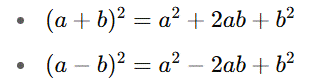
Source: Kapdec.com
Apply them one by one:
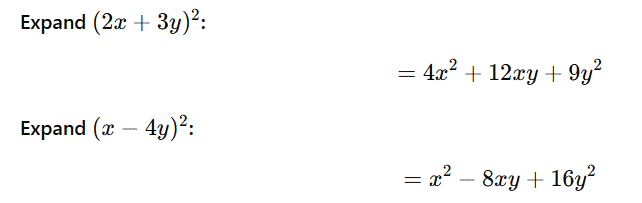
Source: Kapdec.com
Now write the original expression expanded:

Source: Kapdec.com
Distribute minus signs:

Source: Kapdec.com
Now simplify like terms:
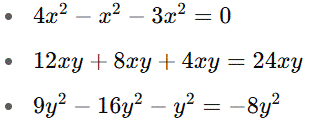
Source: Kapdec.com
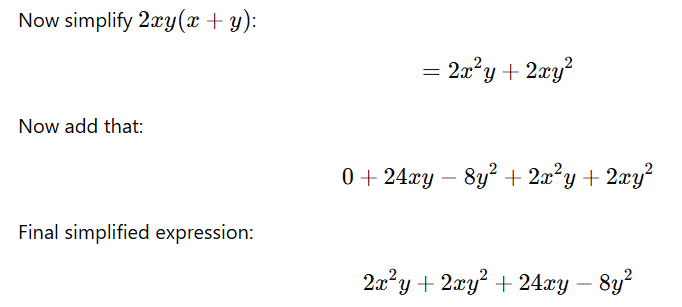
Source: Kapdec.com
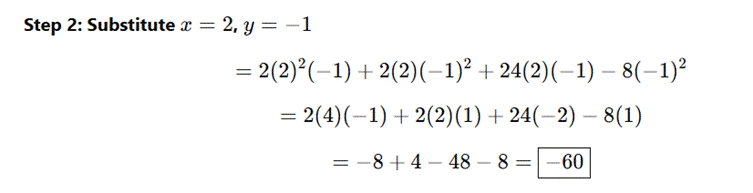
Source: Kapdec.com
Step 3: Common errors to avoid
- Sign errors in expansion: Forgetting to apply minus signs properly when distributing or squaring binomials.
- Misapplying identities: Using wrong identities or forgetting terms (e.g., missing the 2ab term).
- Incorrect substitution: Forgetting order of operations, especially with negatives or exponents.
- Dropping variables: When simplifying or substituting, students might accidentally drop variables or powers.
Final Answer: –

Source: Kapdec.com
Here are five conclusive points for the topic “Introduction to Algebraic Expressions and Identities” under the AP Algebra/High School Algebra curriculum:
- Algebraic expressions are foundational in representing real-life scenarios through mathematical relationships using variables and constants.
- Mastery of identities enhances efficiency in both simplifying expressions and solving equations without performing step-by-step expansions every time.
- Combining like terms and performing operations on expressions deepens understanding of structure and manipulation in algebra.
- Translating verbal statements to expressions bridges language and mathematics, reinforcing algebra as a problem-solving tool.
- Verification and application of identities develop both critical thinking and analytical skills essential in higher-level algebra and calculus.
Scan to visit this resource online
https://kapdec.com/resources/introduction-properties-of-polynomials
