KAPDEC® | Elite STEM Learning Platform | https://kapdec.com
Unit (5): Heredity
Chapter: Non-mendelian genetics
Reference: Non-Mendelian genetics, Types of non-mendelian inheritance, Codominance, Incomplete dominance, Multiple alleles, A polygenic trait, Polygenic inheritance, Lethal or lethal genes, Extracellular inheritance
Learning objectives
- To understand about the types of non-mendelian inheritance
- To learn about polygenic inheritance, lethal genes, and extracellular inheritance
Non-Mendelian genetics
- Non-mendelian genetics involves the pattern of inheritance that does not follow Mendel’s laws.
- It describes the inheritance of traits linked to a single gene on chromosomes. When scientists began exploring more and more test crosses, they observed that there are several traits that do not match up with Mendel’s laws.
Types of non-mendelian inheritance
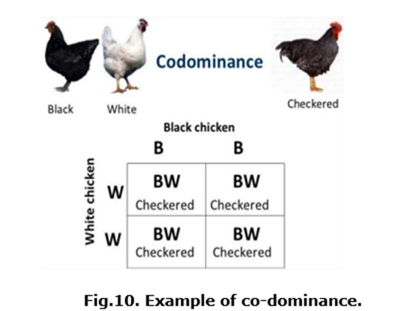
Codominance -happens when both the alleles get expressed equally in the heterozygote phenotype.
- The phenotype of the offspring is a combination of the phenotype of the parents. Thus, the trait is neither dominant nor recessive.
- exemplified by a plant that bears flowers with two distinct colour phenotypes.
- For instance, a white-spotted red flower could be caused by a cross between a red flower and a white flower. The alleles for the red and white colour phenotypes mean that they are codominant.
Source: Kapdec.com
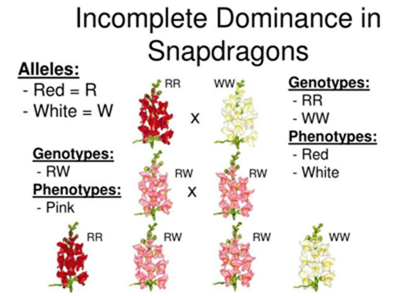
Incomplete dominance is a form of gene interaction in which both alleles of a gene at a locus are partially expressed, often resulting in an intermediate or different phenotype.
- It is also known as partial dominance.
- For e.g., in roses, the allele for red colour is dominant over the allele for white colour.
Source: Kapdec.com
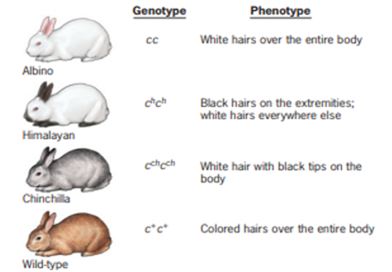
Multiple alleles are located on homologous chromosomes on the equal locus.
- When there are, three or more kinds of genes located on the same locus in a chromosome, they are called multiple alleles.
- An excellent example of multiple allele inheritance is human blood type. Blood type exists as four possible phenotypes: A, B, AB, & O. There are 3 alleles for the gene that determines blood type.
Source: Kapdec.com
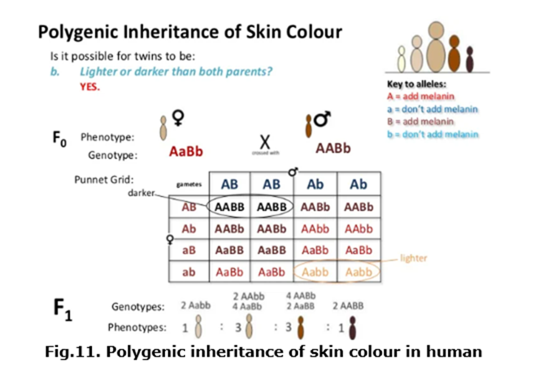
A polygenic trait is a characteristic, such as height or skin colour, that is influenced by two or more genes.
- Because multiple genes are involved, polygenic traits do not follow the patterns of Mendelian inheritance.
- Many polygenic traits are also influenced by the environment and are called multifactorial.
Polygenic inheritance refers to the inheritance of a trait governed by more than one gene.
- Generally, three or more genes govern the inheritance of polygenic traits. Multiple independent genes have an additive or similar effect on a single quantitative trait.
- In humans, height, skin colour, hair colour, and eye colour are examples of polygenic traits. Type-2 diabetes, coronary heart disease, cancer, and arthritis are also deemed polygenic.
- However, these conditions are not just genetic since polygenes can be influenced by environmental factors.
Source: Kapdec.com
Lethal or lethal genes or lethal alleles are alleles causing the end of an entity which carries it.
- Basically, lethal genes are lethal to the organism carrying it, lethal meaning (here) death.
- Typically, it is the consequence of gene-mutation that is required to grow and develop.
Extracellular inheritance is a non-Mendelian inheritance wherein a trait was transmitted from the parent to the offspring not nuclear in nature but involving other organellar genetic material.
- There are traits manifested in certain eukaryotes that result from extranuclear inheritance. The mitochondria, for instance, contain genetic material independent of the chromosomes inside the nucleus.
Solved examples
Example 1. In butterfly bushes, dark purple and pink parents will produce offspring with lavender flowers. This is a result of
a) codominance b) incomplete dominance
c)complete dominance d) recessive dominance
Solution 1: b. In butterfly bushes, dark purple and pink parents will produce offspring with lavender flowers. This is a result of incomplete dominance
Example 2. Which term(s) best describes the inheritance of human blood types?
a) incomplete dominance and multiple alleles
b) codominance and epistasis
c)codominance and multiple alleles
d)incomplete dominance and codominance
Solution 2: c. the inheritance of human blood types best describes about co dominance and multiple alleles.
Summary
- Non-mendelian genetics involves the pattern of inheritance that does not follow Mendel’s laws.
- Codominance -happens when both the alleles get expressed equally in the heterozygote phenotype.
- Incomplete dominance is a form of gene interaction in which both alleles of a gene at a locus are partially expressed, often resulting in an intermediate or different phenotype.
- Multiple alleles are located on homologous chromosomes on the equal locus.
- A polygenic trait is a characteristic, such as height or skin colour, that is influenced by two or more genes.
- Polygenic inheritance refers to the inheritance of a trait governed by more than one gene.
- Lethal or lethal genes or lethal alleles are alleles causing the end of an entity which carries it.
- Extracellular inheritance is a non-Mendelian inheritance wherein a trait was transmitted from the parent to the offspring not nuclear in nature but involving other organellar genetic material.
