KAPDEC® | Elite STEM Learning Platform | https://kapdec.com
Unit: Factorization of Expressions
Chapter: Introduction, Expressions Factorization
Reference: – Introduction to Algebraic Expressions, Factorization Techniques, Solving Equations Using Factorization, Connections to Graphing and Functions, Factorization of Polynomials, Using Factorization in Simplifying Algebraic Fractions, Applications of Factorization in Word Problems, Connections Between Factorization and the Distributive Property
After studying this chapter, you should be able to understand:
- Introduction to Algebraic Expressions
- Solving Equations Using Factorization
- Factorization of Polynomials & Using Factorization in Simplifying Algebraic Fractions
- Connections Between Factorization and the Distributive Property
1. Factorization of Polynomials
- Factorization is the process of breaking down a polynomial into simpler expressions that, when multiplied, produce the original polynomial.
- This method helps in simplifying equations, making it easier to solve for unknown variables.
- Common techniques include taking out the greatest common factor, grouping terms, and using special identities.
- Recognizing patterns like the difference of squares, perfect square trinomials, and sum/difference of cubes is essential.
- Factorization is useful in algebraic operations, equation solving, and polynomial simplifications.
2. Identifying Common Factors in Expressions
- A common factor is a term that appears in multiple parts of an expression and can be factored out.
- Identifying common factors simplifies algebraic expressions and prepares them for further manipulation.
- This technique is essential for solving equations, especially when dealing with polynomials.
- Common factors can include variables, constants, or combinations of both.
- Extracting common factors reduces complexity and provides a structured approach to solving problems.
3. Using Factorization in Simplifying Algebraic Fractions
- Algebraic fractions contain polynomial expressions in the numerator and denominator that can be simplified using factorization.
- Factorization helps in identifying common terms, allowing the fraction to be reduced to its simplest form.
- Simplifying fractions makes them easier to manipulate in algebraic equations.
- This technique is particularly useful in rational expressions, limits, and calculus.
- Factorization ensures a more straightforward representation of mathematical relationships, improving clarity and problem-solving efficiency.
4. Factorization of Quadratic Expressions
- Quadratic expressions can often be factored into two binomial expressions.
- This process is crucial for solving quadratic equations without using the quadratic formula.
- The structure of the quadratic expression determines which factorization method is most appropriate.
- Recognizing patterns like perfect square trinomials and difference of squares aids in factorization.
- Factoring quadratics is widely used in real-world applications like physics, finance, and engineering.
5. Factorization of Higher-Degree Polynomials
- Polynomials of higher degrees can be factored by identifying patterns, using synthetic division, or applying the factor theorem.
- The presence of common terms, binomial structures, or special identities simplifies the factorization process.
- Understanding how to break down complex expressions into linear or quadratic factors is essential for advanced algebra.
- The ability to factor higher-degree polynomials is useful in calculus, optimization problems, and mathematical modeling.
- Factoring polynomials correctly allows for the determination of roots and intercepts in graphical representations.
6. Applications of Factorization in Word Problems
- Many real-world problems involve expressions that can be simplified using factorization.
- Problems related to area, motion, business profits, and physics often require polynomial factorization for accurate solutions.
- Using factorization in applied mathematics helps in breaking down complex problems into solvable components.
- Factorization assists in finding relationships between different variables in equations.
- A strong grasp of factorization enhances problem-solving skills and logical reasoning.
7. Connections Between Factorization and the Distributive Property
- The distributive property states that multiplying a sum by a number is equivalent to distributing the multiplication over each term.
- Factorization reverses the distributive process, grouping terms into a common factor or structured polynomial expression.
- Understanding this connection aids in verifying and simplifying algebraic expressions.
- The distributive property is fundamental in expanding and factoring expressions efficiently.
- A strong understanding of this relationship provides a solid foundation for higher-level algebraic concepts.
8. Factorization and Its Role in Solving Equations
- Factorization is a key method for solving polynomial equations by setting factors equal to zero.
- The zero-product property states that if a product of terms equals zero, then at least one of the factors must be zero.
- Factoring equations simplifies the process of identifying solutions and graphing functions.
- It is widely used in quadratic equations, polynomial inequalities, and higher-degree algebraic equations.
- Mastery of factorization techniques ensures efficiency in solving mathematical problems across different disciplines.
Example: –
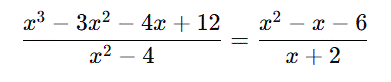
Solve the following equation by factorization:
Source: Kapdec.com
Solution: –
Step 1: Factorizing the Numerator and Denominator
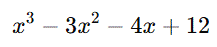
- Factorizing the numerator of the left-hand side:
Source: Kapdec.com
Using factorization by grouping:

Source: Kapdec.com

Source: Kapdec.com
Factorizing the denominator of the left-hand side:

Source: Kapdec.com
Factorizing the numerator of the right-hand side:

Source: Kapdec.com
Step 2: Simplify the Equation
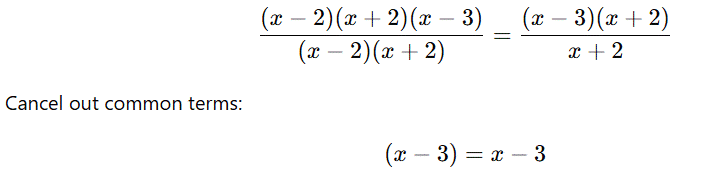
After factorization, the equation becomes:
Source: Kapdec.com
Step 3: Solve for x
Since both sides of the equation are equal, the equation holds for all values of x, except where the denominator is zero.
Step 4: Identifying Restricted Values
From the denominators:

Source: Kapdec.com
Thus, the final solution is:
x≠2,−2
Conclusive Points for Factorization of Expressions
- Factorization Simplifies Complex Expressions
- Factorization breaks down algebraic expressions into simpler components, making them easier to work with.
- It helps in rewriting polynomials in a form that reveals key properties like roots and intercepts.
- Essential for Solving Equations
- Many algebraic equations can be solved efficiently using factorization.
- The zero-product property allows for solving polynomial equations by setting factors to zero.
- Fundamental in Algebraic Manipulation
- Factorization is widely used in simplifying expressions, rationalizing fractions, and solving word problems.
- It provides a structured approach to handling algebraic operations and transformations.
- Connections to Real-World Applications
- Factorization is used in various fields, including physics, engineering, and economics.
- Problems involving area, motion, and profit calculations often rely on factorization methods.
- Provides a Strong Foundation for Advanced Mathematics
- A deep understanding of factorization supports learning higher mathematical concepts, including calculus and number theory.
- Mastering factorization enhances logical reasoning and problem-solving skills for future mathematical challenges.
Scan to visit this resource online
https://kapdec.com/resources/introduction-expressions-factorization
