KAPDEC® | Elite STEM Learning Platform | https://kapdec.com
Unit: Conics
Chapter: The Circle Formula
Reference: – Definition of a Circle, Standard Equation of a Circle, Center and Radius Representation, Derivation of the Circle Formula, General Form of the Circle Equation, Completing the Square to Find Circle Properties, Graphing a Circle in the Coordinate Plane, Tangent Lines to a Circle, Equations of Circles in Different Positions, Applications of the Circle Formula
After studying this chapter, you should be able to understand:
- Definition & Standard Equation of a Circle
- Derivation of the Circle Formula & General Form of the Circle Equation
- Completing the Square to Find Circle Properties
- Equations of Circles in Different Positions & Applications of the Circle Formula
Definition of a Circle
A circle is a two-dimensional geometric figure consisting of all points that are equidistant from a fixed point called the center. This constant distance from the center to any point on the circle is known as the radius. Circles are fundamental shapes in geometry and have numerous properties related to symmetry and proportionality.
Standard Equation of a Circle
The standard representation of a circle expresses the relationship between its center and any point lying on its boundary. This equation serves as a mathematical description of a circle’s geometric structure, allowing for analysis and problem-solving in coordinate geometry.
Center and Radius Representation
The center of a circle is a fixed point that determines its position in a plane, while the radius defines its size. Both elements are critical in distinguishing one circle from another and help in understanding transformations such as translations, reflections, and dilations in coordinate geometry.
Derivation of the Circle Formula
The equation of a circle is derived based on the fundamental property that every point on the circle maintains a fixed distance from the center. This derivation links algebraic principles with geometric reasoning, demonstrating the relationship between distance and the shape of the circle.
General Form of the Circle Equation
The general representation of a circle’s equation is an alternative way of expressing its geometric structure. While it does not directly show the center and radius, it can be manipulated to extract these properties. This form is useful for identifying circles within more complex mathematical expressions.
Completing the Square to Find Circle Properties
In cases where a circle’s equation is given in its general form, algebraic techniques can be applied to convert it into a more interpretable structure. This process reveals the essential characteristics of the circle, such as its center and radius, and helps in graphing and solving related geometric problems.
Graphing a Circle in the Coordinate Plane
Representing a circle visually requires plotting its center and determining points that lie on its boundary. By identifying key features such as symmetry and orientation, circles can be accurately depicted in a coordinate system, aiding in the study of their intersections and relationships with other geometric figures.
Tangent Lines to a Circle
A tangent is a straight line that touches a circle at exactly one point without crossing it. This point of tangency has a unique property: the line drawn from the center to the point of tangency is always perpendicular to the tangent. This principle plays a significant role in solving geometric problems involving circles and lines.
Equations of Circles in Different Positions
The position of a circle in the coordinate plane influences how its properties are expressed mathematically. If a circle is shifted from one location to another, adjustments must be made to its equation to account for the new center. This concept is essential in understanding how transformations affect geometric figures.
Applications of the Circle Formula
The study of circles extends beyond theoretical mathematics into real-world applications, including engineering, physics, architecture, and navigation. Understanding the properties of circles allows for practical problem-solving, such as designing round structures, analyzing planetary orbits, and optimizing mechanical components.
The Circle Formula
Geometry and algebra have distinct enough differences to go through the first ten chapters of this grade without delving too much into algebraic information. However, all math is interrelated, and there is definitely overlap between the two topics.
To start our unit on the overlap between geometry and algebra, we will cover in this chapter a couple basic shapes that can be graphed with algebraic formulas onto the coordinate plane. In this lesson, we will learn about graphing circles onto the coordinate plane.
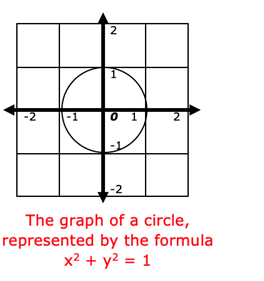
Source: Kapdec.com
Centered at the Origin
Every point on a circle is a distance r from the center. Distance in terms of x and y from the origin, if you remember from the distance formula, is

Source: Kapdec.com
. Therefore, the formula of a circle centered at the origin can be expressed as:

Source: Kapdec.com
= r
The radical sign is a bit awkward, so the formula is usually expressed as:
x2 + y2 = r2
Note: Remember that

Source: Kapdec.com
≠ x + y because (x + y)2 = x2 + 2xy + y2.
General Circle Formula
What if a circle is not centered at the origin? Let’s take another look at the distance formula that we simplified earlier with distance from the origin:

Source: Kapdec.com
In our first formula, the point (x2, y2) was any point on the circle (x, y), and the point (x1, y1) was simply the origin (0, 0). We will keep representing (x2, y2) as the general (x, y), but we must change (x1, y1) to represent all possible centers.
The center of a circle is typically represented as (h, k). Therefore, we can rewrite the formula as:
This is the general formula for any graphed circle. Be mindful of the subtraction signs! If there is an addition sign in between x and h or between y and k, h or k are negative, respectively.
Circles Aren’t Functions
If you remember the vertical line test from Grade 8, it is quite clear that a circle is not a function. For each input x besides at the ends of the circle and outside of the circle, there are two possible y outputs. A single input cannot yield more than one output if the relationship is that of a function, so the circle is not a function.
However, algebraically, an equation is a function if the y variable can be isolated on the left side of the equation. Let’s look at the equation for a circle centered at the origin:
x2 + y2 = r2

Source: Kapdec.com
This is odd; we have isolated y on the left side of the equation!
While it is true that y =

Source: Kapdec.com
is a function, y2 = r2 – x2 is not a function. If we set r2 – x2 equal to 4, then y could be 2. In geometric problems, we haven’t usually dealt with negative numbers, so that was typically the only solution we would consider. However, we must remember that (-2) × (-2) is also 4. Thus, a circle is more accurately represented as such:
y =

Source: Kapdec.com
AND y =

Source: Kapdec.com
While a circle itself is not a function, it can be represented as a collection of two functions. For general circles not centered at the origin, we simply change it to:
y =
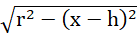
Source: Kapdec.com
– k AND y =
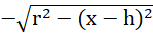
Source: Kapdec.com
– k
Fundamental Representation – The equation of a circle provides a precise mathematical description of its shape, allowing for accurate representation in coordinate geometry. This equation serves as the foundation for understanding circular motion, symmetry, and transformations.
Geometric and Algebraic Connection – The study of circles bridges algebra and geometry, demonstrating how distance relationships translate into mathematical equations. This connection enhances problem-solving techniques in both disciplines.
Transformational Insights – The ability to express and manipulate the equation of a circle helps in understanding how circles change position and size in the coordinate plane, supporting studies in translation, dilation, and reflection.
Tangent and Intersection Analysis – The properties of tangents and intersecting lines with circles play a crucial role in solving geometric problems. Understanding these relationships aids in advanced applications, such as optimization in physics and engineering.
Real-World Applications – Circles are integral to numerous real-life contexts, from architecture to planetary motion. Mastering their equations enables practical applications in various scientific and technological fields, reinforcing their significance in geometry and beyond.
