KAPDEC® | Elite STEM Learning Platform | https://kapdec.com
Unit: Limits & Continuity
Chapter: Continuity of a Function & Domain
Reference: – Jump & Infinite Continuous function, Interval of continuity, Continuity & Limits, Piecewise functions, Domain Restrictions, Infinite & Asymptote limits, Uniform Continuity, Common Functions, Vertical Asymptotes, Exponential limits, Logarithmic limits, Hole in the domain, Behaviour of functions & Domain
After studying this chapter, you should be able to understand:
- The Pointwise & Interval of Continuity
- Continuity & Limits, Piecewise Functions
- Domain Restrictions & its Impact.
- Various Intervals within its domain
Continuity of a Function
The definition of continuity of a function state that a function f(x) is said to be continuous at a point x = c if three conditions are satisfied:
- The function must be defined at c: The function f(x) must be defined and have a value at x = c.
- The limit of the function exists at c: The limit of f(x) as x approaches c must exist. In other words, the left-hand limit and the right-hand limit of f(x) as x approaches c must be equal.
- Mathematically, this condition can be written as:
- Lim(x→c) f(x) = f(c)
- The function’s value must match its limit at c: The value of the function at x = c must be equal to the limit of the function at x = c.
- Mathematically, this condition can be written as:
- f(c) = lim(x→c) f(x)
If these three conditions are satisfied, then the function is continuous at x = c. This definition can be extended to a function being continuous on an interval or its entire domain if it is continuous at every point within that interval or domain.
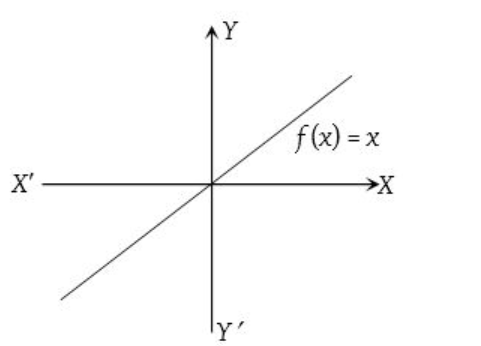
Source: Kapdec.com
(Continuous)
It’s important to note that if any of these conditions are not met, the function is considered to be discontinuous at that point or within that interval. Discontinuities can take various forms, such as removable, jump, or infinite discontinuities, and they indicate a break in the function’s continuity.
Additional Concept based on Calculus
- Continuity and the Three Conditions: To recap, a function f(x) is continuous at a point x = c if the following conditions are satisfied: –
- The function is defined at c: This means that f(c) has a valid and finite value.
- The limit of the function exists at c: As x approaches c, the values of f(x) must converge to a specific value. The limit of f(x) as x approaches c should exist and be finite.
- The function’s value matches its limit at c: The value of f(c) must be equal to the limit of f(x) as x approaches c.
- Continuity on an Interval: A function is said to be continuous on an interval if it is continuous at every point within that interval. In other words, the function maintains its continuity across the entire interval without any breaks or jumps.
- Types of Discontinuities: Discontinuities occur when one or more of the conditions for continuity are not met. Here are some common types of discontinuities:
- Removable Discontinuity: This occurs when a function has a hole or gap at a particular point. By filling in the hole, the function can become continuous at that point.
- Jump Discontinuity: A jump discontinuity happens when the function “jumps” from one value to another at a specific point.
- Infinite Discontinuity: In an infinite discontinuity, the function approaches infinity or negative infinity as x approaches a certain point.
- Oscillating Discontinuity: This type of discontinuity occurs when the function oscillates or alternates between different values near a point.
- Continuity and Differentiability: Continuity is a necessary condition for differentiability. If a function is differentiable at a point, it must be continuous at that point as well. However, it’s important to note that continuity alone does not guarantee differentiability.
- Continuity and Limits: Continuity is closely related to the concept of limits. The conditions for continuity at a point involve the existence and equality of limits. Continuity ensures that the function behaves well as x approaches a specific value, allowing us to evaluate the function’s behavior using limits.
- The Intermediate Value Theorem: The Intermediate Value Theorem is an important result that follows from continuity. It states that if a function is continuous on a closed interval [a, b], and it takes on two distinct values f(a) and f(b), then the function must take on every value between f(a) and f(b) at some point within the interval.
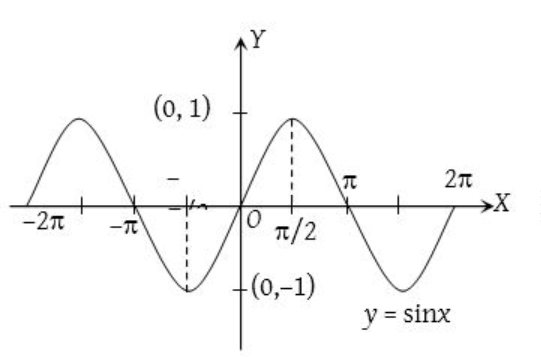
Source: Kapdec.com
(Continuous)
Understanding continuity is crucial for analyzing the behavior of functions, determining their limits, identifying points of discontinuity, and exploring other important concepts in calculus and mathematical analysis.
Domain in Limits & Continuity: –
The domain of a function refers to the set of all possible input values for which the function is defined. In the context of limits and continuity, the domain plays a significant role in determining the behavior of the function and the conditions under which the function is continuous: –
- Domain and Limits: When evaluating the limit of a function, it is essential to consider the domain of the function. The limit is determined as the input approaches a particular value within the domain. If the value is within the domain of the function, the limit can be computed using various techniques such as direct substitution, factoring, or algebraic manipulation. However, if the value lies outside the domain, the limit may not exist or needs to be approached through a different approach, such as using one-sided limits.
- Domain and Pointwise Continuity: The domain is directly connected to the concept of pointwise continuity. For a function to be continuous at a specific point, the function must be defined at that point. In other words, the point must lie within the domain of the function. If the function is not defined at a particular point within its domain, it can’t be continuous at that point.
- Domain Restrictions and Discontinuities: The domain of a function can impose restrictions on the continuity of the function. Discontinuities often occur at points where the function is not defined or is restricted within its domain. These restrictions can lead to different types of discontinuities, such as removable, jump, or infinite discontinuities. Therefore, understanding the domain of a function is crucial in identifying potential points of discontinuity.
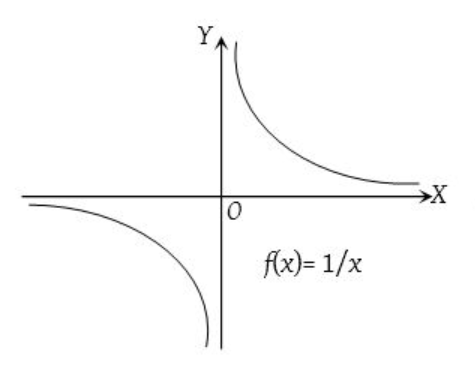
Source: Kapdec.com
(Discontinuous)
- Domain Extension: Sometimes, it is possible to extend the domain of a function to make it continuous at certain points or intervals. This is often done by filling in the gaps or removing removable discontinuities. By extending the domain appropriately, the function can achieve continuity where it was previously discontinuous.
- Domain and Interval of Continuity: The domain also affects the interval of continuity of a function. The interval of continuity refers to the subset of the function’s domain where the function remains continuous. It is important to determine the intervals where the function is continuous to understand its behavior and properties.
In summary, the domain of a function plays a crucial role in determining the limits, continuity, and discontinuities of the function. It defines the set of valid inputs and influences the behavior of the function at different points and intervals. Analyzing the domain is essential in understanding the overall behavior and properties of a function.
Example: –
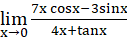
Evaluate the following limit based on domain functionality: –
limx→07x cosx-3sinx4x+tanx
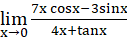
Source: Kapdec.com
Solution: –
To solve the given limit, we will use trigonometric identity.
We have,
Source: Kapdec.com
è It is of form 0
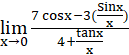
Dividing the numerator and denominator by x
Source: Kapdec.com
As we know,

Source: Kapdec.com
= 1
Key Points
- Continuity Definition: A function is continuous if it has no abrupt jumps, holes, or breaks in its graph.
- Three Conditions: Continuity at a point requires the function to be defined at that point, have a limit as x approaches the point, and have the value match the limit.
- Pointwise Continuity: Pointwise continuity refers to a function being continuous at each point in its domain.
- The interval of Continuity: An interval of continuity is a subset of the function’s domain where the function remains continuous.
- Discontinuities: Discontinuities occur when one or more of the conditions for continuity are not satisfied at a particular point or interval.
- Types of Discontinuities: Common types of discontinuities include removable, jump, and infinite discontinuities.
- Domain Restrictions: The domain of a function determines the set of valid input values and can affect the continuity of the function.
- Intermediate Value Theorem: The Intermediate Value Theorem states that if a function is continuous on a closed interval, it takes on every value between the values it assumes at the endpoints of the interval.
- Relationship with Limits: Continuity is closely related to limits, as the conditions for continuity involve the existence and equality of limits.
- Connection to Differentiability: Continuity is a necessary condition for differentiability, meaning a function must be continuous at a point to be differentiable at that point.
These key points provide a concise overview of the main aspects and implications of continuity for a function and its domain.
