KAPDEC® | Elite STEM Learning Platform | https://kapdec.com
Source: Kapdec.com
Unit: Exponents and Roots
Exponent Rules, Roots and Equivalent Expressions
First Law
If m is any non-zero rational number and p and q are natural numbers, then:
mp X mq= m p+q
Generalization form of the above law:
If m is any non-zero rational number and p, q and r are natural numbers then:
mp X mq X mr= mp+q+r
Example: Simplify and write the answer: 33×32×34
3×3×3×3×3×3×3×3×3 =39=33+2+4
Dividing Powers with the Same Base:
Consider the following division:
54÷52=

Source: Kapdec.com
= 5×5=25
Or 54÷52= 54-2=52= 25
95 ÷ 92=

Source: Kapdec.com
= 93=27
Or 95 ÷ 92 = 95-2=93= 27
m6÷ m3=
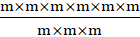
Source: Kapdec.com
= m3
In all the above divisions of powers with the same base, we can say that the division of powers with the same base is equal to a power of the same base whose exponent is equal to the difference of exponent of numerator and denominator.
Second Law:
If m is any non-zero rational number and p and q are natural numbers such that p>q, then
mp÷mq= mp─q or

Source: Kapdec.com
= mp─q
Now students, from the above concept we can calculate following questions quickly:
108 ÷ 103 = 108 – 3 = 105
79 ÷ 76 = 79-6 = 73
a8 ÷ a5 = a8─5= a3
Example : Simplify and write the answer: 912÷ 99
We have, 912÷ 99 = 912─9= 93=243
Taking Power of a Power:
We shall look at what is the power of a power. In order to understand the concept of the power of power Consider the following
Simplify (33)2 and (22)4
Now, (33)2 means 33 is multiplied two times with itself.
(33)2 = 33 × 33
= 33 + 3 (Since am × an = am + n)
= 36 = 33 × 2
Thus (33)2 = 33×2
Similarly (22)4
(22)4 = 22 × 22 × 22 × 22
= 22 + 2 + 2 + 2
= 28 (Observe 8 is the product of 2 and 4).
= 22 × 4
Third Law:
From the above result we can generalize for any non-zero integer ‘a’, where ‘m’ and ‘n’ are whole numbers,
(am )n= amn
Example : Calculate the value of (24)5
We have
(24)5 So from (am)n= amn
(24)5= 24×5= 220
Example: Calculate (42)3× (46)3
We have (42)3× (46)3
So from (am)n= amn
42×3×46×3
46×418
46+18=424
Multiplying Powers with the Same Exponent:
Students consider the following Products:
23 × 33 = (2 × 2 × 2) × (3 × 3 × 3)
= (2 × 3) × (2 × 3) × (2 × 3)
= 6 × 6 × 6
= 63 (Observe 6 is the product of bases 2 and 3)
Consider 44 × 34 = (4 × 4 × 4 × 4) × (3 × 3 × 3 × 3)
= (4 × 3) × (4 × 3) × (4 × 3) × (4 × 3)
= 12 × 12 × 12 × 12
= 124
Similarly, a4 × b4 = (a × a × a × a) × (b × b × b × b)
= (a × b) × (a × b) × (a × b) × (a × b)
= (a × b)4
= (ab)4
It is clear from the above that the product of powers with different bases and same exponents is equal to the power whose base is equal to the product of different bases and exponent equal to the common exponent.
Fourth Law:
If p, q are non-zero rational numbers and “n” is a natural number, then
pn×qn= (pq)n
Generalization: If p, q and r are non zero rational numbers and “n” is a natural number, then
pn × qn × rn= (pqr)n
Example: Express the following products of powers as the exponent of a rational number: 43×63
We have,
43×63
So, from pn×qn= (pq)n
43×63= (24)3=13824
Dividing Powers with the Same Exponent:
Consider the following Simplifications:

Source: Kapdec.com
=

Source: Kapdec.com
=

Source: Kapdec.com
Consider

Source: Kapdec.com
=

Source: Kapdec.com
=

Source: Kapdec.com
Consider, also,

Source: Kapdec.com
=

Source: Kapdec.com
=

Source: Kapdec.com
Similarly,

Source: Kapdec.com
=

Source: Kapdec.com
=

Source: Kapdec.com
It is clear from the above that the division of powers with the same exponents is equal to the power whose base is equal to the division of bases and exponent equal to the same exponent.
Fifth Law:
If p, q are non-zero rational numbers and “n” is a natural number, then

Source: Kapdec.com
=

Source: Kapdec.com
Example: Simplify

Source: Kapdec.com
We have,

Source: Kapdec.com
So, from,

Source: Kapdec.com
=

Source: Kapdec.com

Source: Kapdec.com
=

Source: Kapdec.com
=

Source: Kapdec.com
=

Source: Kapdec.com
=

Source: Kapdec.com
Algebra: Exponents and Powers
Laws of Exponents ON Negative Powers:
We have learned the following laws of exponents of rational numbers when exponents are whole numbers.
(i)mp × mq= m p+q (First Law)
(ii) mp÷mq= mp─q

Source: Kapdec.com
=mp─q , p>q (Second Law)
(iii) (am )n= amn (Third Law)
(iv) pn×qn= (pq)n (Fourth Law)
(v)

Source: Kapdec.com
(Fifth Law)
These laws also hold good for negative integral exponents.
Techniques for Creating Equivalent Expressions:
- Rearranging Like Terms: Just like rearranging ingredients in a recipe doesn’t change the final product, you can rearrange terms (numbers and variables) within an expression as long as you don’t change their order of operation (+, -, x, /).
- Example: 2x + 3y is equivalent to 3y + 2x
- The Commutative Property: This property applies to addition and multiplication, stating that the order doesn’t affect the outcome.
- Addition: a + b = b + a (e.g., 5 + 7 = 7 + 5)
- Multiplication: a x b = b x a (e.g., 3 x 4 = 4 x 3)
- The Associative Property: This property applies to addition and multiplication, allowing you to group terms differently without affecting the result.
- Addition: (a + b) + c = a + (b + c) (e.g., (2 + 3) + 4 = 2 + (3 + 4))
- Multiplication: (a x b) x c = a x (b x c) (e.g., (2 x 3) x 5 = 2 x (3 x 5))
Tips and Tricks:
- Factoring and Expanding: Sometimes, an expression can be simplified by factoring out common terms or expanding parentheses using the distributive property (a(b + c) = ab + ac). Recognizing equivalent forms after factoring or expanding is crucial.
- Practice Makes Perfect: The more you practice manipulating expressions, the better you’ll become at recognizing equivalent forms.
-
Source: Kapdec.com
Scan to visit this resource online
https://kapdec.com/resources/exponent-rules-roots-and-equivalent-expressions
