KAPDEC® | Elite STEM Learning Platform | https://kapdec.com
Unit: Electric Circuits
Chapter: Kirchhoff’s Rules
Reference: AP Physics Algebra, Electric Circuits, Kirchhoff’s Rules, Kirchhoff’s First Rule (Junction Rule), Kirchhoff’s Second Rule (Loop Rule)
After studying this chapter, you should be able to,
- apply Kirchhoff’s rules to closed electrical circuits;
Kirchhoff formulated two rules which enable us to know the distribution of current in complicated electrical circuits or electrical networks.
Kirchhoff’s First Rule (Junction Rule):
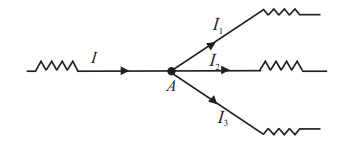
It states that the sum of all currents directed towards a junction (point) in an electrical network is equal to the sum of all the currents directed away from the junction.
Source: Kapdec.com
Kirchhoff’s first rule: The sum of currents coming to a junction is equal to the sum of currents going away from it.
Refer to Fig. If we take currents approaching point A as positive and those leaving it as negative, then we can write
I = I1 + I2 + I3
or I – (I 1 + I 2 + I 3) = 0
In other words, the algebraic sum of all currents at a junction is zero. Kirchhoff’s first rule tells us that there is no accumulation of charge at any point if steady current flows in it. The net charge coming towards a point should be equal to that going away from it in the same time. In a way, it is an extension of the continuity theorem in electrical circuits.
Kirchhoff’s Second Rule (Loop Rule):
This rule is an application of the law of conservation of energy for electrical circuits. It tells us that the algebraic sum of the products of the currents and resistances in any closed loop of an electrical network is equal to the algebraic sum of electromotive forces acting in the loop.
While using this rule, we start from a point on the loop and go along the loop either clockwise or anticlockwise to reach the same point again. The product of current and resistance is taken as positive when we traverse in the direction of the current. The e.m.f. is taken positively when we traverse from negative to the positive electrode through the cell. Mathematically, we can write
Source: Kapdec.com
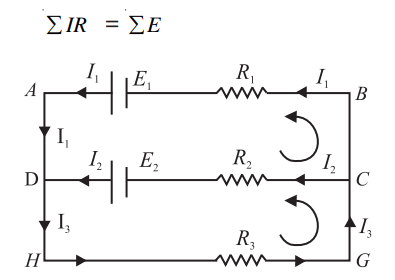
A network to illustrate Kirchhoff’s second rule
Let us consider the electrical network shown in Fig. above. For closed mesh ADCBA, we can write
I1 R1 – I 2 R2 = E1 – E2
Similarly, for the mesh DHGCD
I 2 R2 + (I 1 + I2) R3 = E2
And for mesh AHGBA
I 1 R1 + I 3 R3 = E
At point D I1 + I2 = I3
In more general form, Kirchhoff’s second rule is stated as: The algebraic sum of all the potential differences along a closed loop in a circuit is zero
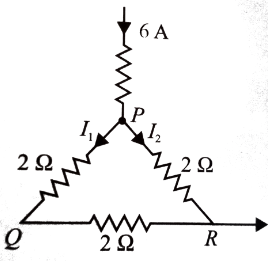
Example: A current of A enters one corner P of an equilateral triangle 𝑃𝒬𝑅 having 3 wires of resistance 2 Ω each and leaves by the corner R. Then the current 𝐼1 and 𝐼2 are ________
Source: Kapdec.com
Solution:
From Kirchhoff’s first law at junction P,
I1 + I2 = 6 …(i)
From Kirchhoff’s second law to the closed circuit PQRP,
-2I1 – 2I1 + 2I2 = 0
⟹ -4I1 + 2I2 = 0
⟹ 2I1 – 𝐼= = 0 …(ii)
Adding Eqs. (i) and (ii), we get
3I1 = 6 ⟹ I1 = 2𝐴
From Eq. (i),
I2 = 6 – 2 = 4𝐴
Key points
- KCL and KVL are based on the principle of conservation of charge and energy, respectively.
- KCL is used to analyze circuits with junctions, while KVL is used to analyze circuits with loops.
- The rules apply to both DC (direct current) and AC (alternating current) circuits.
- The rules can be used to solve for unknown values such as current, voltage, and resistance in a circuit.
- Kirchhoff’s rules can be used in combination with Ohm’s law (which relates current, voltage, and resistance) to solve complex circuits.
- The rules are named after Gustav Kirchhoff, a German physicist who developed them in the mid-19th century.
- Kirchhoff’s rules are essential for understanding and designing electrical circuits in a wide range of applications, from simple household wiring to advanced electronics and telecommunications systems.
