KAPDEC® | Elite STEM Learning Platform | https://kapdec.com
Unit: Circles
Chapter: Arc Length and Sector Area
Reference: – Definition of Arc Length, Definition of a Sector, Formula for Sector Area, Relation Between Arc Length and Sector Area, Central Angle in Radians, Full Circle and Proportionality, Relationship Between Arc Length Radius and Central Angle, Applications of Arc Length and Sector Area
After studying this chapter, you should be able to understand:
- Definition of Arc Length & Sector
- Relation Between Arc Length and Sector Area
- Central Angle in Radians & Full Circle and Proportionality
- Relationship Between Arc Length, Radius and Central Angle
- Applications of Arc Length and Sector Area
Definition of Arc Length – Arc length is the measurement of the distance along a curved path of an arc on a circle. It represents a portion of the circle’s boundary and depends on both the central angle of the arc and the radius of the circle. Essentially, arc length is the “curved” equivalent of linear distance, reflecting how much of the circle’s circumference is covered by the arc.
Formula for Arc Length – This topic involves understanding that arc length is directly proportional to the central angle and the radius of the circle. As the angle increases or the radius grows, the arc length also increases. The arc length is a fraction of the total circumference of the circle, with the central angle determining how large or small that fraction is.
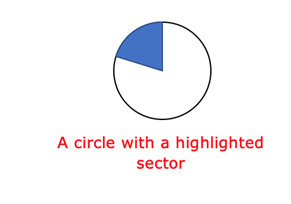
Definition of a Sector – A sector is a region inside a circle bounded by two radii and the arc between them. The sector can be thought of as a “slice” of the circle, where the two radii act as the straight edges, and the arc forms the curved boundary. The area of the sector is a portion of the entire area of the circle, based on the central angle.
Formula for Sector Area – The area of a sector is the portion of the entire area of a circle that is enclosed by the sector. Just as the arc length represents part of the circumference, the sector area represents part of the circle’s total area. The size of the sector’s area depends on the central angle, with a larger angle resulting in a larger sector.
Relation Between Arc Length and Sector Area – Both arc length and sector area are influenced by the central angle of the sector. As the central angle increases, the arc length grows, and the sector area increases as well. Essentially, both quantities are portions of the circle’s total circumference and area, respectively, and their sizes are directly proportional to the central angle.
Central Angle in Radians – In this context, radians provide an alternative way of measuring angles. When the central angle is measured in radians, both arc length and sector area are expressed in a more direct proportional manner to the radius. Radians are used in many real-world situations where circular motion or rotation is involved, making it easier to compute distances and areas in circular geometry.
Full Circle and Proportionality – A full circle corresponds to a central angle of 360°. When dealing with arc length and sector area, the central angle divides the circle into portions. If the central angle is 360°, the entire circumference is the arc length, and the entire area of the circle is the sector. When the central angle is less than 360°, the arc length and sector area represent fractions of the total circumference and area, respectively.
Relationship Between Arc Length, Radius, and Central Angle – The arc length is influenced by both the radius of the circle and the central angle. A larger radius results in a longer arc, and a larger central angle means a longer portion of the circle’s boundary is covered by the arc. Similarly, a larger central angle and radius will result in a larger sector area.
Applications of Arc Length and Sector Area – These concepts have practical applications in various fields, such as calculating the distance traveled by an object moving along a circular path, determining the area of sections in circular designs (like gardens, clock faces, or wheel spokes), and in physics when analyzing rotational motion or circular orbits.
Real-Life Problem Solving – Understanding arc length and sector area allows us to solve real-life problems that involve circular shapes and motions. For instance, determining the distance an object travels along a circular track or finding the area of a segment of a circular field are problems that require knowledge of arc length and sector area to solve effectively.
Arc Length and Sector Area
The arc length is the distance along the curved part of the circle between two points. If you imagine a complete circle, it has a perimeter called the circumference. When you take a portion of that circle, the length of the curved section between two points is called the arc length.
Think of it as the length of a piece of string that is stretched along the curved part of a circle. The more the angle between the two points opens, the longer the arc length becomes. The arc length depends on the angle that is subtended at the centre of the circle.
Sector Area
The sector area is the region enclosed between two radii (straight lines from the centre to the circle’s edge) and the arc connecting them. If you imagine a slice of pizza, the sector is the shape of the slice itself, where the crust is the arc and the two straight edges are the radii.
The sector area is essentially a portion of the total area of the circle. Just like how the arc length is a fraction of the total circumference, the sector area is a fraction of the entire area of the circle. If the sector is very small (a narrow slice), its area will be a small fraction of the full circle. If the sector spans a large angle, the area it covers will be larger.
In essence:
- Arc Length is the distance along the curve between two points on the circle.
- Sector Area is the area enclosed between two radii and the arc.
Source: Kapdec.com
Let’s approach this the same way we approached arc length. We know that the area of a circle is πr2. The angle measure for a full circle is 360o. Thus, for a semicircle of 180o, the area would be

Source: Kapdec.com
πr2, and so on. Just like with arc length, we can find sector area with just the radius and the angle measure treated as a proportion of the entire area of the circle:

Source: Kapdec.com
with A being area, r being radius, and “a” being angle measure in degrees. We will use the formula with 180o whenever degrees are involved for the rest of this lesson simply because it more clearly shows the relationship with radians. Speaking of radians, this formula, like arc length, becomes much easier when treated with radians:

Source: Kapdec.com
with A being area, r being radius, and a being angle measure in radians.
Arc Length
We know already from several lessons that the circumference of a circle is 2πr. What if we were to find the perimeter of a semicircle missing its straight edge, like the figure to the right?
Well, a semicircle is quite obviously half of a circle, so we simply take half of 2πr, which is πr.
What if it were a quarter of a circle? Then, we would take a fourth of 2πr, which is πr/2.
Unknowingly, you have been finding arc lengths with this reasoning. The entire circumference of a circle could even be considered an arc length if the arc spans the entire circle.
In case you don’t remember, an arc is a curved line segment along a circle connecting two points on a circle. We differentiate arcs from chords because the only points on a chord that are on the circle are the endpoints, whereas all the points of an arc belong on a circle.
We know how to find the arc lengths for half and a quarter of a circle, but we won’t always be able to look at an arc and easily be able to determine its portion of the circle. We will, however, always get degrees.
If you recall, all circles have 360o. An arc with 360o has length 2πr. An arc with 360o ×

Source: Kapdec.com
= 180o has length 2πr ×

Source: Kapdec.com
= πr. Do you see a pattern yet?
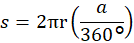
If we have the degree measure, we can generalize the formula for all arc lengths to be
Source: Kapdec.com
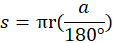
with “s” being the arc length and “a” being the angle measure in degrees. We could simply this formula to
Source: Kapdec.com
Use whichever formula is easier for you to memorize. For the rest of this lesson, we will be using the simplified form.
Radians
There are two primary ways to measure angles: in degrees and in radians. We have worked with degrees a lot in our geometry work over the past few grades, but we have not had much reason to work with radians.
Radians are mostly useful for algebraic purposes, so we may not work with them too closely, but they simplify the arc length formula strongly, so we will introduce ourselves to them now and come back to them in grades 11 and 12.
There are 2π radians or 360o in a circle. Or in other words we can say that, 2π radians = 360o
This gives us the conversion factor that 1 degree =

Source: Kapdec.com
, which simplifies to à 1 degree =

Source: Kapdec.com
.
Or you could also say that 1 radian =

Source: Kapdec.com
Using this conversion factor, we can change our arc length formula into

Source: Kapdec.com
where s is the arc length, r is the radius, and “a” is the angle measure in radians.
Five-point conclusion summarizing the key aspects of the Arc Length and Sector Area chapter in HS Geometry:
- Interconnected Concepts – The concepts of arc length and sector area are closely related, both being fractions of the circle’s total circumference and area, respectively. Understanding their relationship to the central angle is key to mastering circular geometry.
- Geometric Proportions – Both arc length and sector area depend on the central angle. As the central angle increases, both the arc length and the sector area increase proportionally, providing a clear understanding of how geometric figures scale with respect to angles.
- Practical Applications – The knowledge of arc length and sector area is not just theoretical but has wide applications in real-life scenarios, such as calculating distances in circular motion, designing circular structures, or analysing rotational movements in physics.
- Radius and Angle Relationship – The size of the arc and sector is directly impacted by the radius of the circle and the central angle, emphasizing the importance of these two variables in circle-related problems and designs.
- Foundation for Advanced Problems – Mastering the understanding of arc length and sector area forms a foundational skill for solving more complex geometric problems involving circles and prepares students for further exploration in fields such as engineering, architecture, and physics.
