KAPDEC® | Elite STEM Learning Platform | https://kapdec.com
Unit: Conductors, Capacitors, Dielectrics
Chapter: Electrostatics with Conductors
Reference: AP Physics Electricity and Magnetism, Conductors, Capacitors, Dielectrics, Electrostatics with Conductors, Electrostatics of conductors, Conductors contain mobile charge carriers, important results regarding the electrostatics of conductors, Electrostatic shielding
After studying this chapter, you should be able to,
- State the definition of conductor, Insulator and dielectric.
- Explain the concept of important results regarding electrostatics of conductors
Electrostatics of conductors:
Conductors:
• The substances which easily allow the flow of electric charge through them are called conductors. This is because conductors contain the large number of free electrons as charge carriers.
• Eg: All metals are good conductors of electricity.
Insulators:
• The substances which do not allow the flow of electric charge through them are called Insulators.
Eg: Glass, Rubber, etc.
Dielectric:
• Certain non-conducting materials in which induced charge appear on their surface when an external electric field is applied are known as Dielectrics.
Eg: Dry air, mica, etc.
Conductors contain mobile charge carriers.
- In metallic conductors, these charge carriers are electrons. In the metal, there are free electrons. These electrons are free within the metal but not free to leave the metal.
- In the gaseous system, the free electrons move randomly in a different direction and collide to each other. In an external electric field, they drift against the direction of the field.
- In electrolytic conductors, the charge carriers are both positive and negative ions.
Let us note important results regarding the electrostatics of conductors:
- Inside a conductor, the electrostatic field is zero.
In electrostatics, when there is no current inside or on the surface of the conductor, the electric field is zero everywhere inside the conductor. As long as an electric field is not zero, the free-charge carriers would experience force and drift. In the static situation, the free charges have so distributed themselves that the electric field is zero everywhere inside. An electrostatic field is zero inside a conductor.
- At the surface of a charged conductor, the electrostatic field must be normal to the surface at every point.
In the electrostatic, the electric field lines are normal to the surface, if it is not so then it would have some non-zero component along the surface. Free charges on the surface of the conductor would then experience force and move in the static situation, therefore, E should have no tangential component. Thus, the electrostatic field at the surface of a charged conductor must be normal to the surface at every point.
- The interior of a conductor can have no access charge in the static situation:
In any charged conduct the excess charge can reside only on the surface in the static situation.
According to Gauss’s law, we know that on the closed surface S bounding the volume element v, the electrostatic field is zero. Thus, the total electric flux through S is zero.
This means there is no net charge at any point inside the conductor, and any excess charge must reside at the surface.
- The electrostatic potential is constant throughout the volume of the conductor and has the same value (as inside) on its surface.
Since E = 0 inside the conductor and has no tangential component on the surface, no work is done in moving a small test charge within the conductor and on its surface. That is, there is no potential difference between any two points inside or on the surface of the conductor.
In a system of conductors of arbitrary size, shape and charge configuration, each conductor is characterised by a constant value of potential.
- The electric field at the surface of a charged conductor

Source: Kapdec.com
where σ is the surface charge density and nˆ is a unit vector normal to the surface in the outward direction.
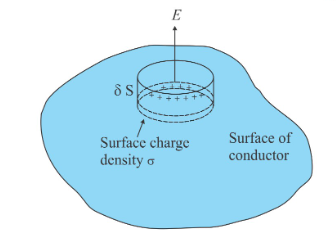
Source: Kapdec.com
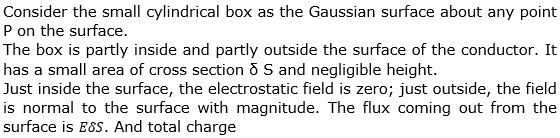
Source: Kapdec.com
Now according to gauss’s law,

Source: Kapdec.com

Source: Kapdec.com
For σ > 0, the electric field is normal to the surface outward; for σ < 0, the electric field is normal to the surface inward.
Electrostatic shielding:
Electrostatic shielding refers to the practice of using conductive materials to prevent or minimize the effects of electric fields on sensitive electronic components or systems. It is commonly employed in various industries, including electronics, telecommunications, and aerospace, to protect equipment from electromagnetic interference (EMI) and electrostatic discharge (ESD).
Here are some important notes regarding electrostatic shielding:
Purpose: The primary goal of electrostatic shielding is to create a conductive barrier that intercepts and redirects electric fields away from sensitive components. By doing so, it prevents the build-up of static electricity and reduces the risk of EMI and ESD-related damage.
Conductive Materials: Shielding materials should have high electrical conductivity to effectively redirect electric fields. Commonly used materials include metals like copper, aluminium, and steel. These metals are often in the form of foils, sheets, or conductive paints that can be applied to surfaces.
Faraday Cage: A Faraday cage is a type of electrostatic shield formed by an enclosure made of conductive material. The cage completely surrounds the protected components, creating a closed conductive surface that prevents electric fields from passing through. It works based on the principle of charge distribution and repulsion, ensuring that any external electric fields are cancelled out.
Grounding: To enhance the effectiveness of the shielding, it is crucial to properly ground the conductive material. Grounding provides a path for electric charges to flow away from the protected components, ensuring that any induced currents or charges are safely dissipated. This prevents the build-up of charges and potential discharge events.
Shielding Effectiveness: The effectiveness of electrostatic shielding is measured by its shielding effectiveness (SE). SE is the ratio of the electric field strength without shielding to the field strength with shielding. It is typically expressed in decibels (dB) and varies depending on the materials used, the frequency of the electric field, and the design of the shielding system.
Design Considerations: When designing electrostatic shielding, several factors should be considered. These include the desired level of shielding effectiveness, the size and shape of the shielded area, the materials used, the grounding scheme, and the accessibility requirements for maintenance or repairs.
Testing and Verification: It is essential to test and verify the effectiveness of electrostatic shielding to ensure its reliability. Testing methods can include using specialized equipment, such as a spectrum analyser, to measure the attenuation of electric fields. Additionally, ESD testing can be performed to assess the shielding’s ability to protect against electrostatic discharge events.
Example: A spherical charged conductor has a surface density of charge = σ, and electric field intensity on its surface is E. If the radius of the surface is doubled, point σ unchanged, what will be the electric field intensity on the new sphere?
Solution: 𝐸 = σ/ε0, the value of 𝐸 does not depend upon the radius of the sphere.
Key points
The electric field inside a conductor placed in the external electric field is zero. Explain the statement.
Suppose a conductor is placed in an external field of intensity 𝐸ₒ.
Then induction takes place on the surface of the conductor. Side A of the conductor becomes positively charged and side B of the conductor becomes negatively charged.
Let 𝐸𝑝 be the induced electric field opposite to 𝐸ₒ which will Cancel the applied electric field 𝐸ₒ inside the conductor.
Hence, the electric field inside the conductor placed in the external electric field is zero.
Conductors: Conductors are materials that allow electric charges to move freely within them. They typically have a large number of free electrons that can easily flow when subjected to an electric field.
Electrostatic Equilibrium: When a conductor is in electrostatic equilibrium, the electric charges are distributed uniformly on its surface, and the electric field inside the conductor is zero. This means that the charges on the conductor have come to a stable configuration, and there is no net movement of charges.
Electric Field Inside a Conductor: Inside a conductor in electrostatic equilibrium, the electric field is zero. Any excess charge placed inside a conductor will redistribute itself on the surface, creating an electric field that cancels out the external field.
Electric Field Outside a Conductor: Outside a conductor in electrostatic equilibrium, the electric field is not zero. It follows the familiar rules of electrostatics, obeying the principle of superposition and Coulomb’s law.
Faraday Cage: A Faraday cage is a type of conductor that completely shields its interior from external electric fields. It is constructed with a mesh of conductive material, and any external electric field induces surface charges that cancel out the field inside the cage.
Conducting vs. Insulating Objects: Conducting objects allow the free movement of charges while insulating objects (non-conductors) do not allow easy charge flow. Insulators can hold static charges on their surface and do not redistribute them like conductors.
Capacitance: Conductors can store electric charge and have capacitance. The capacitance of a conductor depends on its geometry and the permittivity of the surrounding medium. Capacitors are devices that use conductors to store charge and are widely used in electronic circuits.
