KAPDEC® | Elite STEM Learning Platform | https://kapdec.com
Unit: Number System
Chapter: Introduction to Integers & Their Absolute Value
Reference: – Introduction to Integers, Positive & Negative Numbers, The Number Line, Absolute Value, Opposite of an Integer, Comparing & Ordering Integers, Real-Life Applications
After studying this chapter, you should be able to understand:
- Introduction to Integers & Their Need
- Positive and Negative Numbers
- Representation of Integers on the Number Line
- Absolute Value of an Integer
- Opposite of an Integer
- Comparing and Ordering Integers
- Real-Life Applications of Integers
Introduction to Integers, Negative Numbers
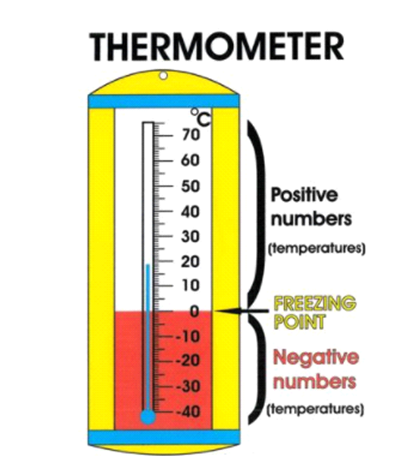
We have learnt about natural numbers or the counting numbers. For each of these positive numbers there exists an opposite i.e. a negative number. Negative Numbers are numbers less than 0. The opposite of a number is a number that is on the same distance from 0 on the number line on the opposite side.

Source: Kapdec.com
As we can see from the above number line, the opposite of 1 is -1, 2 is -2, 4 is -4 and so on. Here 1, 2, 3, 4,.. are positive numbers and -1, -2, -3, … are negative numbers.
Negative numbers are used at various places in our day to day life like-
- Loss from a transaction: -$45
- Temperature of places 0deg Celsius: -12deg Celsius
- Falling stock prices: -$5
- Depth of an ocean
Examples-
Source: Kapdec.com
- Use negative numbers to express the following situations-
- The diver is 40 feet below sea level
-40 ft.
- The vendor is at a loss of $1.31
-$1.31
- The temperature in London dropped by 5 deg Celsius
-5deg
- Write 4 negative numbers greater than -15.
-11, -7, -4, -2
Integers
Natural numbers also called as counting numbers were first to be discovered. When ‘0’ got added to the set of natural numbers, they were referred to as the set of whole numbers.
Now, we have learnt about negative numbers too. When the negative numbers are included in the set of whole numbers the new set would look like 0, 1, 2, 3, 4, 5, … , -1, -2, -3, -4, -5, … .
This collection of natural numbers, zero and negative numbers is called as integers.
- The numbers 1, 2, 3, 4, … are set of positive integers which are represented on the right side of zero on the number line.
- The numbers with a negative sign i.e. -1, -2, -3, -4, … are set of negative integers which are shown on the left side of zero on the number line.
Examples-
Look at the points on the number line shown below-

Source: Kapdec.com
- If point K is +6, then which point is -6?
Point M is -6
- Is point P a positive integer or negative integer?
Point P is a negative integer
- Which point marked on the above number line has the highest value and which has the least value?
Point L has the highest value and point M has the lowest value.
- What is the value of point P?
The value of point P is -2
Ordering of Integers
A number which is on the right side of the number line is always greater than the ones on its left. As we move from left to right on the number line, the numbers are ordered from least to greatest.
Let us take few numbers: 2, -9, 0, 5, -3, 9
Suppose these numbers represent the money Samantha has. Now, smaller the number implies lesser the money Samantha has.
- Samantha would not like to have the smallest number i.e. – 9 dollars showing she is in debt and she has to repay this amount.
- She would not like -3 dollars either, though here she has to payback an amount which is less than -9.
- It is better for her to have $0 i.e. no money, than having negative money i.e. being in debt.
- Now, 2 < 5 < 9. So, Samantha would like to have $9 than $2.
Let us represent these numbers on the number line-

Source: Kapdec.com
We see as we move towards right on the number line, the value of the number increases.
So, -9 < -3 < 0 < 2 < 5 < 9
So, we can say,
- When we move left towards zero on the number line, the value of positive integers decrease.
- When we move right away from zero on the number line, the value of positive integers increase.
- When we move left further away from zero on the number line, the value of negative integers decrease.
- When we move left away from zero on the number line, the value of negative integers decrease.
Examples-
- Write all the integers between 6 and -6
-1, -2, -3, -4, -5, 0, 1, 2, 3, 4, 5
- Write the smallest positive integer and smallest negative integer
Smallest positive integer = 1
Smallest negative integer = -1
- Which is greater?
- -3 or 3
3 > -3
- 5 or -8
5 > -8
- -7 or -14
-7 > -14
Scan to visit this resource online
https://kapdec.com/resources/introduction-to-integers-their-absolute-value
