KAPDEC® | Elite STEM Learning Platform | https://kapdec.com
Division of multidigit numbers:
Source: Kapdec.com
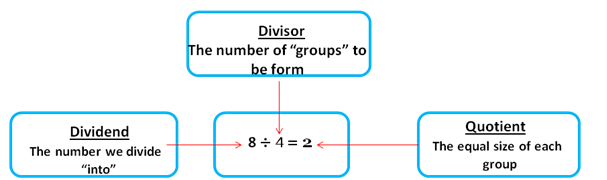
A divisor can also be thought of as a factor: 84=

Source: Kapdec.com
2 or 8/4 = 2 or Note that when 8 divided by 4 is 2, then 8 divided by 2 will be 4, since 2 x 4 = 8, and we are “undoing” the multiplication
Division: of two numbers can be treated as repeated subtraction. It is subtracting the smaller number from the greater number repeatedly till you reach zero or get a remainder.
Examples:
- 20 ÷ 4 = 5
20 – 4 – 4 – 4 – 4 – 4 = 0 i.e. by 5 times subtracting 4 from 20.
- 18 ÷ 6 = 3
18 – 6 – 6 – 6 = 0 i.e. by 3 times subtracting 6 from 18.
Now, suppose John has 2040 chocolates and he wants to divide them among 170 students. He wants to find out how many chocolates each would get. It is not possible for him to repeatedly subtract 170 from 2040 and find the quotient as the numbers are large and it would be a time taking process.
So, how can he divide to find the number of chocolates for each student?
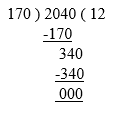
Jared uses Long Division Method to find the solution. Let us have a look-
Source: Kapdec.com
In this method,
- We start dividing left most digit of the dividend by the divisor and remainder is calculated.
- This remainder is carried forward and is followed by next digit of the number brought down from the dividend.
- This process continues until remainder is 0 or not divisible further.
So, we can say that each student would get 12 chocolates.
Source: Kapdec.com
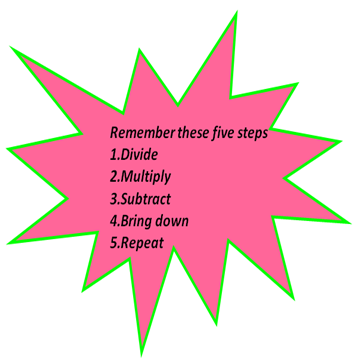
We use long division method when the divisor is of two or more digits to make the calculations easier and faster.
Let us look at practical problem on division of large numbers-
Example-
The cost of 125 Play Stations is $31,625. Find the cost of 1 Play Station.
Solution-
Cost of 125 Play Stations = $31,625
Cost of 1 Play Station = 31625 ÷ 125
Source: Kapdec.com
So, the cost of 1 Play Station is $253.
Properties of Division:
Properties help us to make our calculations easier, faster and reliable when used at appropriate places. Let us have a look-
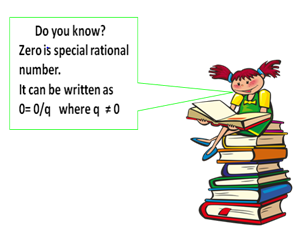
- Division by 0: Division by 0 is not possible.
Example: 51,841 ÷ 0 = Not Possible
Source: Kapdec.com
- Division by 1: If a number is divided by 1, the result is the number itself.
Example: 859,283 ÷ 1 = 859,283
- Division by number itself: If a number is divided by itself, the result is always 1.
Example: 455,993 ÷ 455,993 = 1
- Dividing 0: If 0 is divided by any number (except 0), the result is always 0.
Example: 0 ÷ 493,661 = 0
- Division Algorithm-
Dividend = Divisor × Quotient + Remainder
This equation is used to check division.
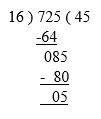
Example- 725 ÷ 16
Source: Kapdec.com
Divisor = 16
Quotient = 45
Remainder = 5
So,
Divisor × Quotient + Remainder
= 16 × 45 + 5 = 720 + 5 = 725 = Dividend
Division of a number by 10, 100, 1000, 10000
- When a number is divided by 10, we simply remove the last digit to get the quotient. The last digit of the number forms the remainder.
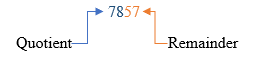
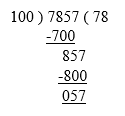
- When a number is divided by 100, we simply remove the last two digits to get the quotient. The last two digits of the number form the remainder.
- When a number is divided by 1000, we simply remove the last three digits to get the quotient. The last three digits of the number form the remainder.
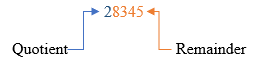
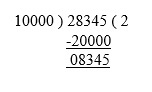
- When a number is divided by 10000, we simply remove the last four digits to get the quotient. The last four digits of the number form the remainder.
Examples-
- 7857 ÷ 100
Source: Kapdec.com
Source: Kapdec.com
- 28345 ÷ 10000
Source: Kapdec.com
Source: Kapdec.com
Key points:
1. If we divide a number by 1 the quotient is the number itself.
2. If we divide a number by the number itself, the quotient is 1.
3. Division of a number by 1 the quotient is the number itself.
4. 0 divided by a number gives 0 as the quotient
