KAPDEC® | Elite STEM Learning Platform | https://kapdec.com
Unit: Number System
Chapter: Order of Operations: BODMAS Rule / PEMDAS Rule
Reference: – Introduction to Order of Operations, Brackets/Parentheses, Orders/Exponents, Division and Multiplication (Left to Right), Addition and Subtraction (Left to Right), Mnemonics (BODMAS, PEMDAS, BIDMAS, BEDMAS), Worked Examples, Common Errors
After studying this chapter, you should be able to understand:
- Introduction to Order of Operations & Its Need
- Brackets/Parentheses & Grouping Symbols
- Orders/Exponents (Powers and Roots)
- Division and Multiplication (Left-to-Right Rule)
- Addition and Subtraction (Left-to-Right Rule)
- BODMAS vs PEMDAS: Meaning and Equivalence
- Worked Examples & Common Mistakes
Importance of Brackets
We have learnt till now that while solving any mathematical expression we follow a particular order i.e. the DMAS Rule. But the original rule further extends to BODMAS i.e.
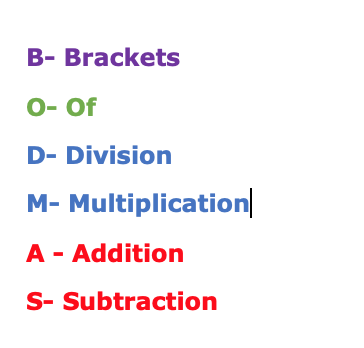
Source: Kapdec.com
implying that while we solve any expression, we solve expression inside the brackets first followed by the rest. Let us learn more about brackets.
Using brackets
Mathematical brackets are the symbols that are generally used to determine the order in which operations are to be done in any algebraic expression. Using brackets simplifies the operation in which there are multiple operators.
Using brackets in any expression implies preference should be given to the operation inside the bracket while solving, followed by other operations outside.
Example-
- (9 + 6) × 14 = 15 × 14 = 210
- (18 ÷ 3) × (16 + 4) = 6 × 20 = 120
Expanding brackets
Use of brackets allows us to follow our procedure systematically. Let us look at few examples on how we use brackets in various ways to expand and make our operations easier to solve!
Examples-
(i) 5 × 105 = 5 × (100 + 5) = 5 × 100 + 5 × 5 = 500 + 25 = 525
(ii) 107 × 109 = (100 + 7) × (100 + 9) = (100 + 7) × 100 + (100 + 7) × 9
= 100 × 100 + 7 × 100 + 100 × 9 + 7 × 9
= 10,000 + 700 + 900 + 63 = 10,000 + 1600 + 63
= 11,663
(iii) 14 × 106 = (10 + 4) × 106 = 10 × 106 + 4 × 106
= 10 × (100 + 6) + 4 × (100 + 6)
= 10 × 100 + 10 × 6 + 4 × 100 + 4 × 6
= 1000 + 60 + 400 + 24
= 1,484
With the help of above examples, we see that how using brackets can help us simplify our calculations by breaking any complex expression into simple ones and further defining the order in which it is to be solved.
Paradox – Can you solve it?
#What is 6 ÷ 2 (1 + 2)?
We know the first step would be solving the addition inside brackets, i.e.
6 ÷ 2 (1 + 2)
=6 ÷ 2(3)
But what now?
Is it
=6 ÷ (2 × 3) or =6 ÷ 2 × 3
=6 ÷ 6 or =3 × 3
= 1 or =9
The correct answer would be 9 because after solving the operation inside of brackets
we open the bracket and then again follow the BODMAS rule.
Scan to visit this resource online
https://kapdec.com/resources/order-of-operations-bodmas-rule-pemdas-rule
