KAPDEC® | Elite STEM Learning Platform | https://kapdec.com
Unit: Basic Algebra
Chapter: Introduction to Variables
Reference: – Introduction to Variables, Constants, Variables in Real-Life Situations, Algebraic Expressions, Terms, Factors and Coefficients, Like and Unlike Terms, Types of Algebraic Expressions (Monomial, Binomial, Trinomial, Polynomial)
After studying this chapter, you should be able to understand:
- Introduction to Variables & Their Need
- Constants vs Variables
- Variables in Real-Life Situations
- Algebraic Expressions & How They Are Formed
- Terms, Factors and Coefficients
- Like and Unlike Terms
- Types of Algebraic Expressions (Monomial, Binomial, Trinomial, Polynomial)
Algebra
What is a variable?

Source: Kapdec.com
We are already familiar with use of symbols or letters in place of numbers to express a relation. For example, we denote the perimeter of a square as 4s where ‘s’ represents the side of the square. The perimeter would vary with change in the side.
These symbols or letters are nothing but variables.
The term ‘variable’ means something that can vary or change. It is a symbol whose value is not fixed and which can take any range of values. It is usually denoted by using letters from English alphabets.
While ‘x’ is the most commonly used variable, any letter can be used as a variable. An algebra problem can have one variable or many. If a variable is used more than once in the same problem, it’s equal to the same number each time.
Why do we use variables?
Let us look at few examples-
- Let’s say you go to the supermarket, you have hundred rupees in your pocket and need to buy some grocery and some beverages. Once you look at the prices, you figure out how much you can put in your cart without getting embarrassed at checkout by having too little cash.
- You live five miles from your friend’s home. Your parents need to drive you, so how long does it take them to get ready? If your parents drive, by taking a shorter way, it will take 15 minutes, but if there is traffic in between, then it will take longer! So what time do you tell your friend you will reach if you leave by 4:00 PM.
How do we deal with these everyday problems? The answer to these is “algebra”.
We use variables to generalize any expression or to define something unknown.
Without variables, we would have to define the expression every time the value changes.
Constants
The quantity whose value remains fixed throughout is called a constant. For example,2, 4, 20, etc.
Example-
Determine the constant part and the variable part in the given terms.
- 2a
2 is a constant and a is a variable.
(ii) -7mn
-7 is a constant and m and n are variables.
(iii) 3x
3 is constant and x is variable
Algebraic Expressions
Algebra is one of the important and broad part of mathematics which is the combination of constants and variables combined by arithmetic operations like addition, subtraction, multiplication, and divisions, hence it is also referred as the study of mathematical symbols!
Algebra helps in solving different mathematical equations and deriving the unknown quantities. The variables like X and Y in algebra are used to represent the unknown quantities making the algebraic equations easier in finding the data for a given set of equations.
For example: x + 5 = 9
Algebra is considered important as it is one of the largest, broadest and most relevant types of mathematics used today in our daily life. It can be used while :
- Shopping groceries for home needs
- Filling up gas tank
- Calculating cost of financing a car
- Calculating the grades, distances, etc.
Let us understand the use of algebra through this example-
If two matchsticks are required to form the letter ‘L’, then we get the following rule:

Source: Kapdec.com
(Letter ‘L’. As shown, 2 matchsticks are used to make one ‘L’)
Number of matchsticks required = 2n.
Here n is the number of Ls required to be made. So, if one L uses two matchsticks, then 2 Ls will use 4 matchsticks. This is obtained by the following rule:
2n = 2(2) = 4.
Here n is a variable and we can put a number depending how many Ls we are required to make.
So, we see how we can use variables to generalize something and define something unknown.
Examples
Question 1: Tom score 70 marks in English and x marks in Hindi. What is his total scores in the two subjects?
Solution:
Marks obtained in English = 70
Marks obtained in Hindi = x
Total marks obtained by Tom = 70 + x
Question 2: One apple weighs 85 grams and one orange weighs 50 grams. Determine the weight of x apples and y oranges.
Solution:
Weight of an apple = 85 grams
Wright of an orange = 50 grams
Weight of x apples = 85 × x = 85x grams
Weight of y oranges = 50 × y = 50y grams
Total weight of x apples and y oranges = (85x + 50y) grams
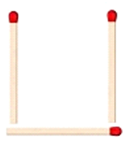
Question 3: Find the rule which gives the number of matchsticks required to make the following matchsticks patterns. Use a variable to write the rule. A pattern of letter as
Source: Kapdec.com
(Letter ‘U’)
Solution:
Number of matchsticks used to make one U = 3
Number of matchsticks required = 3n
where n is the number of Us required to be made.

Source: Kapdec.com
