KAPDEC® | Elite STEM Learning Platform | https://kapdec.com
Unit: Mensuration
Chapter: Types & Mathematical Operations
Reference: – Introduction to Mensuration, Types of Mensuration (1D, 2D, 3D), Perimeter and Area of 2D Shapes (Square, Rectangle, Triangle, Circle, Parallelogram, Rhombus, Trapezium), Surface Area and Volume of 3D Shapes (Cube, Cuboid, Cylinder, Cone, Sphere, Hemisphere), Mathematical Operations in Mensuration (Addition, Multiplication, Division, Using Formulas), Scaling Laws
After studying this chapter, you should be able to understand:
- Introduction to Mensuration & Its Meaning
- Types of Mensuration (1D, 2D, 3D)
- Perimeter and Area of 2D Shapes
- Surface Area and Volume of 3D Shapes
- Mathematical Operations Used in Mensuration
- Scaling Laws (Length, Area, Volume)
Addition of Metric Measures
Metric measures are added in the same way as we add whole numbers or decimals.
We arrange the digits in columns as per their unit and then add as required.
Let us consider an example.
Example-
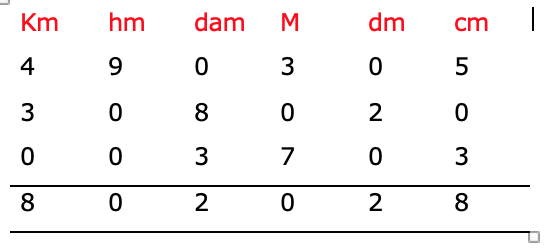
Add 4 km 9 hm 3 m 5 cm, 3 km 8 dam 2 dm and 3 dam 7 m 3 cm.
Solution:
Source: Kapdec.com
We place the digits in columns and add as usual.
Ans. = 8 km 2 dam 2 dm 8 cm
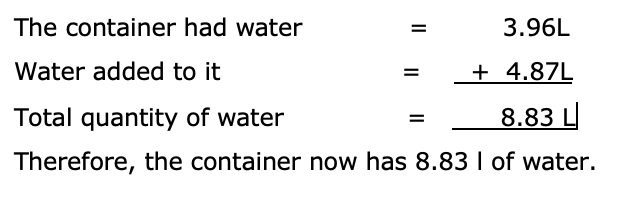
Example: A container had 3.96L of water in it. 4.87L of water was more added to it. What quantity of water does the container have now?
Solution:
Source: Kapdec.com
Subtraction of Metric Measures
Metric measures are subtracted in the same way as we subtract whole numbers or decimals.
We arrange the digits in columns and then subtract as required.
Let us take a look at an example:
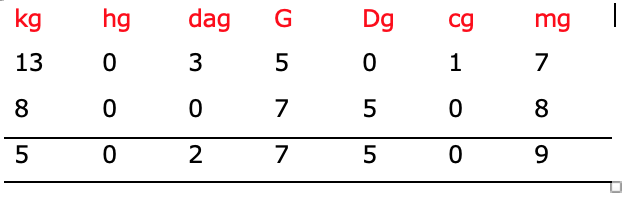
Subtract 8 kg 7 g 5 dg 8 mg from 13 kg 3 dag 5 g 1 cg 7 mg.
Solution:
Source: Kapdec.com
We place the digits in columns and then subtract as usual.
Ans. 5 kg 2 dag 7 g 5 dg 9 mg
Example:
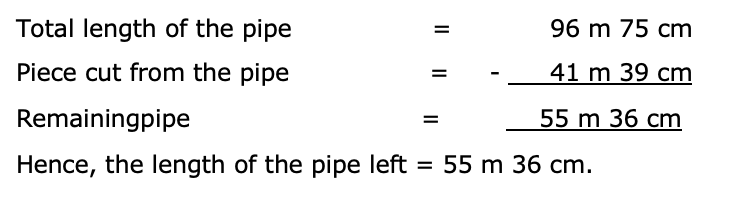
The length of a pipe is 96 m 75cm. If a piece of 41 m 39 cm length is cut, what length of the pipe is left?
Solution:
Source: Kapdec.com
Multiplication of Metric Measures
Metric measures are multiplied in the same way as we multiply whole numbers.
We place the digits in columns and then multiply as usual.
Let us consider some examples-
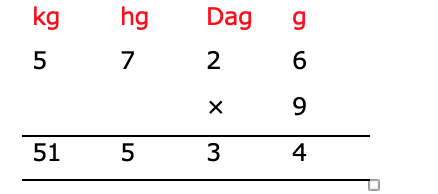
(a). Multiply: 5 kg 7 hg 2 dag 6 g by 9
Source: Kapdec.com
We place the digits in columns and then multiply as usual.
Ans. 51 kg 5 hg 3 dag 4 g
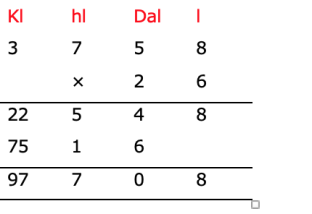
(b). Multiply: 3 kl 7 hl 5 dal 8 l by 26
Source: Kapdec.com
We place the digits in columns and then multiply as usual.
Ans. 97 kl 7 hl 8 l
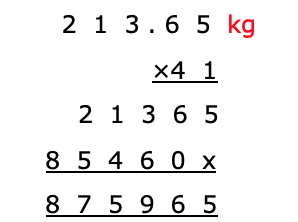
(c). Multiply: 213.65 kg by 41
Source: Kapdec.com
We place the digits in columns and then multiply as usual.
Ans. 8759.65 kg
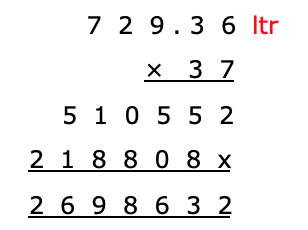
(d). Multiply: 729.36 ltr by 37
Source: Kapdec.com
We place the digits in columns and then multiply as usual.
Ans. 26986.32 ltr.
Examples:
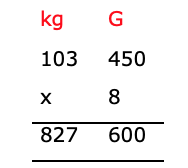
Example: – 8 sacks of rice are kept in a warehouse. Each bag weighs 103 kg 450 g. What is the total weight of all the sacks?
Solution:
Weight of one sack = 103 kg 450 g
Weight of 8 sacks = 103 kg 450 g × 8
Source: Kapdec.com
Total weight of 8 sacks = 827 kg 600 g
Division of Metric Measures
Metric measures are divided in the same way as we divide whole numbers.
We place the digits in columns as per their units and then divide as usual.
Let us consider some examples-
Divide the following:
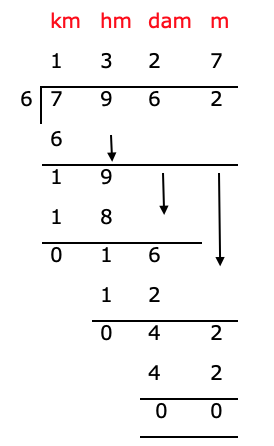
- 7 km 9 hm 6 dam 2 m by 6
Source: Kapdec.com
Ans. 1 km 3 hm 2 dam 7 m
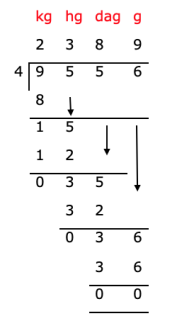
- 9 kg 5 hg 5dag 6 g by 4
Source: Kapdec.com
Ans. 1 kg 3 hg 4 dag 8 g
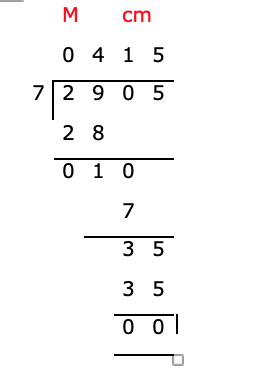
- The total length of 7 wires of equal length is 29 m 5 cm. What is the length of each wire?
Solution:
Total length of 7 wires = 29 m 5 cm
Length of each wire = 29 m 5 cm ÷ 7
Ans: 4 m 15 cm
Source: Kapdec.com
