KAPDEC® | Elite STEM Learning Platform | https://kapdec.com
Unit: Geometry
Chapter: Points, Lines & Curves
Reference: – Introduction to Geometry, Point, Line Segment, Line, Intersecting & Parallel Lines, Ray, Curves (Simple, Open, Closed), Polygons, Angles
After studying this chapter, you should be able to understand:
- Introduction to Geometry & Its Origin
- Point, Line Segment, Line & Ray
- Intersecting & Parallel Lines
- Curves: Simple, Open & Closed
- Polygons & Their Components
- Angles & Their Regions
Graphing Ordered Pairs
A lot of the geometric shapes and figures you have learned thus far will eventually have formulas assigned to them as you delve into the world of algebra and more advanced geometry. In order for those formulas to make physical, geometric sense, they need to be placed in what is called a coordinate plane. In this lesson, we will learn the properties of the coordinate plane and how to graph points on it.
Properties of the Coordinate Plane
Source: Kapdec.com
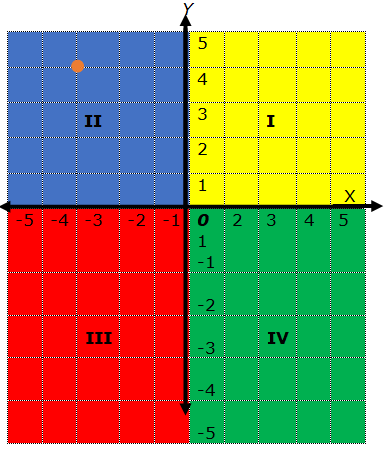
To the right is the Cartesian coordinate plane. Because we are not going to be using any other coordinate plane in the near future, and it is the standard coordinate plane for math students all around the world, we will call it simply the Coordinate Plane.
The thick black lines are called the “axes” (plural of the word axis). The horizontal – right-to-left – axis is called the “x axis”, as indicated by the x to the left of the coordinate plane. The vertical – up-to-down – axis is called the “y axis”, as indicated by the y directly above the coordinate plane. The arrows indicate that the axes go on to infinity.
The numbers along each axis are values a point can have: x-values and y-values. As you go farther to the right, the x-values increase in the positive direction, and as you go farther to the left, the x-values decrease in the negative direction. Similarly, as you go up, the y-values increase in the positive direction, and as you go down, the y-values decrease in the negative direction.
There are four quadrants to the Coordinate Plane: I, II, III, and IV, the Roman numerals for 1, 2, 3, and 4. They are color-coded and labeled on the Coordinate Plane above.
Lastly, any point on the Coordinate Plane is defined by what is called an “ordered pair” enclosed in parentheses like this: (x,y). The x-value always comes first. For example, the orange point in Quadrant II has an ordered pair of (-3,4).
Example:
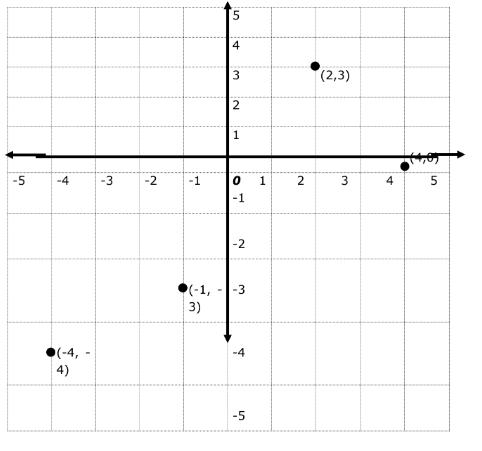
Plot the points defined by the following ordered pairs:
(2, 3)
(-4, -4)
(-1, -3)
(4, 0)
Solution:
Source: Kapdec.com
Application
The Coordinate Plane can be a way to map out locations and distances just as well as it can be a map for ordered pairs and geometric shapes.
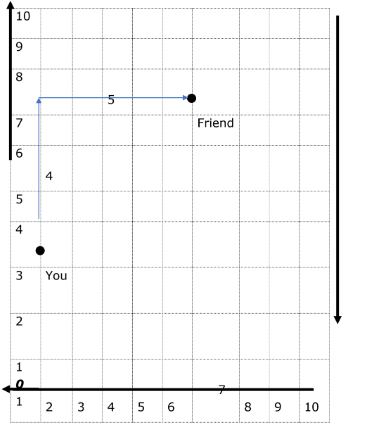
Example: Assume you live in a neighborhood with perfectly square blocks of equal lengths. You have mapped out your neighborhood blocks to the coordinate plane and assigned your house the ordered pair of (1, 3). Your friend lives in a house at (6, 7). How many blocks away from your friend do you live?
Solution: There are two ways to go about solving this problem. One way is to map it all out on the coordinate plane.First, plot each point. Then, draw out the path from you to your friend’s house following the grid lines (no cutting corners in your neighborhood!) and count the amount of blocks traveled in each direction.
Source: Kapdec.com
Since you traveled 4 blocks in the vertical direction and 5 blocks in the horizontal direction, you are 9 blocks from your friend’s house.
Note: No matter what path you take, as long as you don’t cut corners, there is no path shorter than nine blocks. Try it out yourself by drawing out different paths!
Another, simpler way to go about this problem is to find the difference between the x-values and the difference between the y-values and add them up.
(xfriend – xyou) + (yfriend – yyou)
=(6 – 1) + (7 – 3)
=5 + 4
=9 blocks
Source: Kapdec.com
