KAPDEC® | Elite STEM Learning Platform | https://kapdec.com
Unit: Basic Algebra
Chapter: Expressing & Inequality
Reference: – Introduction to Inequality, Inequality Symbols (<, >, ≤, ≥, ≠), Expressing Inequalities from Verbal Statements, Representing Inequalities on the Number Line, Solution Set of an Inequality, Properties of Inequalities
After studying this chapter, you should be able to understand:
- Introduction to Inequality & Its Need
- Inequality Symbols and Their Meanings
- Expressing Inequalities from Real-Life Situations
- Representing Inequalities on the Number Line
- Solution Set of an Inequality
- Properties of Inequalities (Addition, Subtraction, Multiplication, Division)
Expressing with Variables
Rules for Geometry
We have learnt about how to find perimeter of a square and a rectangle in Measurement unit. We can generalize the rules to find them.
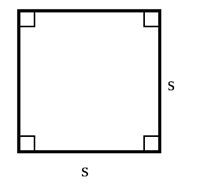
- Perimeter of a square
Source: Kapdec.com
We know perimeter of any polygon is the sum of the length of its side.
Now, a square has 4 sides of equal length.
So, the perimeter of a square = Sum of the lengths of its sides
= 4 times the length of its one side
= 4 × s = 4s
where s is a variable which represents the length of the side a square.
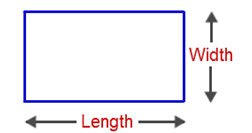
Perimeter of a Rectangle
Source: Kapdec.com
We know, a rectangle has 4 sides such that its opposite sides are of equal length.
Let us denote length of two of its sides i.e. the length as l and remaining two i.e. the width as b.
So, the perimeter of a rectangle = Sum of the lengths of its sides
= 2 times the length of its one side +
2 times the length of its other side
= 2 × l + 2 × b = 2l + 2b
where l and b are variables which represent the length and breadth of the sides of the rectangle.
Rule for Arithmetic
Communicative Property
- Commutative property of addition:
This property states that we can add two numbers in any order.
If a and b represent any two numbers, then a + b = b + a.
where a and b are variables which represents two numbers.
- Commutative property of multiplication:
This property states that we can multiply two numbers in any order.
If a and b represent any two numbers, then a x b = b x a.
where a and b are variables which represents two numbers.
Associative Property
- Associative property of addition:
This property states that we can add three numbers in any order.
If a, b and c represent any three numbers, then (a + b) + c = a + (b + c).
Where a, b and c are variables which represents three numbers.
- Associative property of multiplication:
This property states that we can multiply three numbers can be multiplied in any order.
If a, b and c represent any three numbers, then (a x b) x c = a x (b x c).
Where a, b and c are variables which represents three numbers.
Distributive Property
- Distributive property of multiplication over addition:
This property states that if a, b and c represent any three numbers,
then a x (b + c) = a x b + a x c.
where a, b and c are variables which represents three numbers.
Algebraic Expressions
In both cases we use operators like +, -, × or ÷ to convert them into expressions.
When an operator is put in between two terms, it becomes expression. So, expression is defined as group of terms separated by operator.
3x -8 =7
Expressions can be formed by numbers as well as variables.
- In case of forming expression using only numbers,
5 + (6-3)
These expressions are called numerical expressions
- In case of forming expression using variables and numbers,
5m +9
Such expressions where both constants and variables are included are called algebraic expressions.
Examples of Algebraic Expressions-
1) 3 added to x can be expressed as x + 3.
2) y divided by 3 can be expressed as y/3
3) m multiplied by 7 can be expressed as 7m.
Practical Application
The use of expressions comes handy in daily life. For example, if we know that the price of one kg wheat is $0.22 less than the price of 1kg rice, then we can use expressions to calculate the price of 1kg wheat. Let the price of 1kg rice be x. Then the price of 1kg wheat if $(x-0.22).
Similarly, Suppose Rachel has 10 more chocolates than Sarah.
Now, here we do not know how many chocolates Rachel have.
Let Rachel have x number of chocolates.
So, Sarah would have 5 more.
Number of chocolates Sarah would have = x + 5
Examples
Question 1: Write the following using numbers, literals and signs of basic operations. State what each letter represents:
(i) The diameter of a circle is twice its radius.
(ii) The area of a rectangle is the product of its length and breadth.
(iii) The selling price equals the sum of the cost price and profit.
(iv) The total amount equals the sum of the principal and the interest.
(v) The perimeter of a rectangle is two times the sum of its length and breadth.
(vi) The perimeter of a square is four times its side.
(vii) 2 less than the quotient of x by y
(viii) 4 times x taken away from one-third of y.
(ix) Quotient of x by 3 is multiplied by y.
Solution:
(i) Let r and d be the radius and diameter of the circle, respectively.
Thus, d = 2r
(ii) Let l and b be the length and breadth of the rectangle respectively.
Thus, area of rectangle = lb
(iii) Let s, c and p be the selling price, cost price and profit, respectively.
Thus, s = c + p
(iv) Let A, P and I be the total amount, principal and interest, respectively.
Thus, A = P + I
(v) Let land b be the length and breadth of the rectangle, respectively.
Thus, perimeter of rectangle = 2 × (l + b)
(vi) Let a be the side of the square.
Thus, perimeter of the square = 4a
(vii) 2 less than the quotient of x by y is x/y – 2
(viii) 4 times x taken away from one-third of y is y/3 – 4x
(ix) Quotient of x by 3 is multiplied by y means: x/3 * y
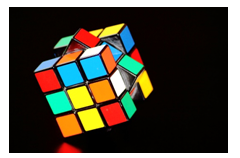
Rubik’s Cube Fun Facts
The Rubik’s Cube behaves in a predictable manner which can be characterized, mathematically, as a form of algebra – abstract algebra.
• Invented in 1974, it took the inventor (Professor Ernő Rubik) over a month to solve it.
• Over 350 million Rubik’s Cube have been sold worldwide
Source: Kapdec.com
• It has been calculated that there are 43,252,003,274,489,856,000 possible permutations of the Rubik’s Cube.
• That is 43 quintillion, 43 followed by 18 zeros!
• If you manage to turn the Rubik’s Cube once every second, it will take you 1.4 trillion years to go through all the permutations.
• It can be estimated that less than 5.8% of the world’s population can solve the Rubik’s Cube
• The world record for solving the Rubik’s Cube is 5.55 seconds by Mats Valk.
