KAPDEC
Middle School Math Roadmap: Grades 5–8
What students learn each year, and how each grade builds toward high school Algebra I. Aligned to the US Common Core State Standards.
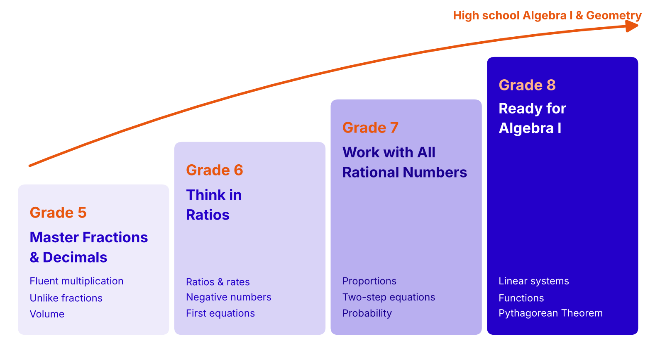
The four-step climb
Each grade has one big goal. Mastering it is the foundation for the next step.
Kapdec at a glance
| 4 Grades (5 to 8) | 5 Learning strands | 56 Kapdec modules | 217 Bite-sized chapters |
Every chapter comes with 10s of thousands of practice questions from basic to advanced, a step-by-step solution for every question, and a tutor students can connect with whenever they need help.
The Strand Map: how each topic grows
Read across a row to follow one strand of math from Grade 5 to Grade 8. Read down a column to see everything in one grade. Names in each cell are Kapdec modules, exactly as they appear in the portal.
| Strand | Grade 5 | Grade 6 | Grade 7 | Grade 8 |
| Number System | Large Numbers, Base Ten Large Numbers, Operations Factors, GCF (HCF) & LCM Fractions Decimals More About Numbers | Knowing our Numbers Whole Numbers Playing With Numbers Fractions Decimals Integers | Integers Fractions and Decimals Rational Numbers Exponents and Powers | Real Numbers Exponents and Powers Squares, Cubes and Roots |
| Ratios, Rates & Percents | Percentages Basic Algebra in Numbers (averages, profit & loss, interest, unitary method) | Ratio & Proportion | Ratio & Proportion (percents, profit & loss, simple interest) | Direct & Inverse Proportion (in Factorization Of Expressions) |
| Algebra & Functions | Patterns, Sequences, Expressions Expressions & Equations | Expressions & Equations | Algebraic Expressions Simple Equations | Linear Equations With One Variable Linear Equations In Two Variables Factorization Of Expressions Functions |
| Geometry & Measurement | Metric System Time Temperature Area & Volume Lines and Angles Circles, Triangles & Quadrilaterals | Basic Geometrical Ideas Elementary Shapes Symmetry Practical Geometry Polygon Perimeter, Area, and Volume | Lines and Angles The Triangle and its Properties Congruence of Triangles Practical Geometry Measuring, Perimeter and Area Visualising Solid Shapes Symmetry | Understanding Quadrilaterals Area of Shapes Visualising Solid Shapes |
| Data & Probability | Line plots (in Metric System) Averages (in Basic Algebra in Numbers) | Data Handling and Analysis (graphs, histograms, box plots) | Data Handling and Analysis (sampling, averages, probability) | Data Handling and Analysis (scatter plots, probability) |
| Modules / chapters | 16 modules · 56 chapters | 14 modules · 56 chapters | 15 modules · 60 chapters | 11 modules · 45 chapters |
Exit Tickets: what a student can do at the end of each grade
Before moving up, a student should be able to say “I can…” to each of these.
| Grade | By the end of the year, I can… |
| Grade 5 | Add, subtract and multiply fractions, including unlike denominators, and divide with unit fractions. Multiply multi-digit numbers fluently and work with decimals to hundredths. Find the volume of solid figures and graph points on a coordinate plane. |
| Grade 6 | Use ratios, unit rates and percents to solve real-world problems. Divide fractions, work with negative numbers and use absolute value. Write and solve one-step equations and summarize data with mean, median and box plots. |
| Grade 7 | Solve multi-step percent and proportion problems, including discounts, tax and interest. Add, subtract, multiply and divide all rational numbers, including negatives. Solve two-step equations and inequalities, work with circles and solids, and find probabilities. |
| Grade 8 | Work with irrational numbers, exponents and scientific notation. Solve linear equations and systems of equations, and understand and compare functions. Use the Pythagorean Theorem and model data with scatter plots — ready for Algebra I. |
How Kapdec takes students up every step
| 1 Micro-chapters Each grade is broken into small, focused chapters so students learn one idea at a time. | 2 Thousands of questions Every chapter has a deep question bank that grows from basic to advanced. | 3 Step-wise solutions Every question is explained step by step, so students learn the method, not just the answer. | 4 A tutor on demand Students connect with a tutor of their choice in a Kapdec Smart Room whenever they get stuck. |
Get started
- Visit kapdec.com, choose your grade, and begin with the first module — or book a tutor to build a personalized plan. Detailed course guides are available for each grade.
Standards source: Common Core State Standards for Mathematics, Grades 5–8 (NGA Center & CCSSO, 2010). Module names reflect the Kapdec US syllabus.