KAPDEC® | Elite STEM Learning Platform | https://kapdec.com
Unit: Geometry
Chapter: Introduction & Types of Symmetry
Reference: – Introduction to Symmetry, Line of Symmetry (Reflection Symmetry), Lines of Symmetry in Regular Polygons, Rotational Symmetry, Centre of Rotation, Angle of Rotation, Order of Rotational Symmetry, Line and Rotational Symmetry in Common Shapes
After studying this chapter, you should be able to understand:
- Introduction to Symmetry & Its Meaning
- Line of Symmetry (Reflection/Mirror Symmetry)
- Lines of Symmetry in Regular Polygons
- Rotational Symmetry & Centre of Rotation
- Angle of Rotation & Order of Rotational Symmetry
- Line and Rotational Symmetry in Common Shapes (Square, Rectangle, Triangle, Circle, Parallelogram)
Symmetry, an Introduction.
Symmetry can be referred to as everyday object that remains identical to various kinds of transformation. There are various sub-topics under it – line symmetry, point symmetry, rotational symmetry, and reflection. But we will cover only line and reflection symmetry. Symmetry can also be related to passage of time.
Line Symmetry
When a figure is divided by a line and it yields two identical parts of it, then the figure is called as symmetrical about that line. The line that divides or cut the figure into two identical parts is called as line of symmetry. Line of symmetry is also known as axis of symmetry or the mirror line. For example, a book, when we open a book there are two sides and they are identical. We can say that it is identical because when we close it two sides overlap each other.

Source: Kapdec.com
The above figures are divided into identical parts with the help of a single straight line. The dotted lines are called line of symmetry.
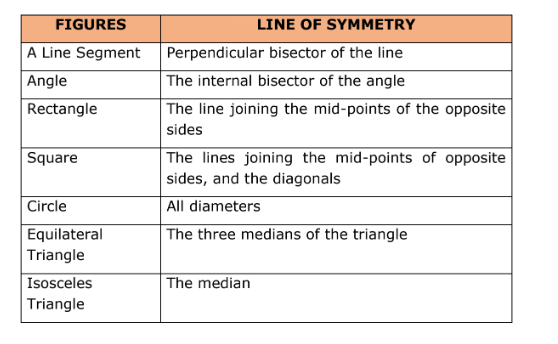
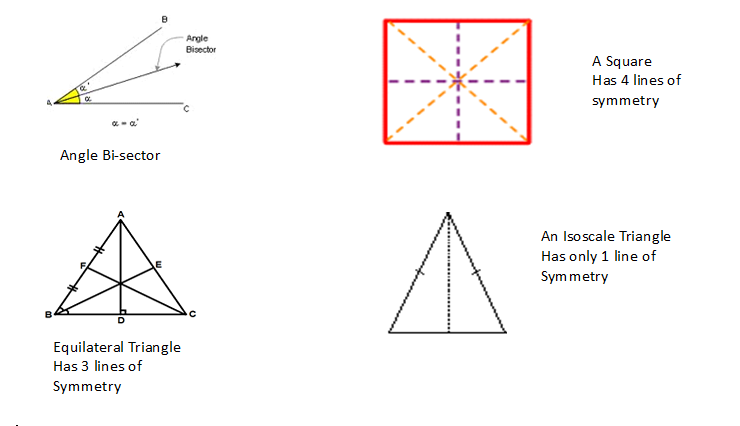
Symmetry of Some Figures
Source: Kapdec.com
Source: Kapdec.com
NOTE: Scalene Triangle does not have any line of symmetry. This is because the three sides of triangle are different!
Reflectional Symmetry

Source: Kapdec.com
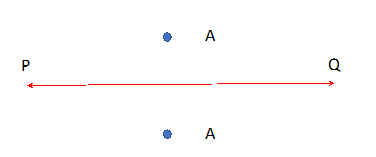
When we look at the mirror we see our reflection. If we notice, the image inside the mirror has the same distance from the mirror as we are actually. Reflectional symmetry is just like that. Reflectional symmetry refers to the mirror image of a figure or any point!
Source: Kapdec.com
Suppose there is a line segment PQ. 5 units above it there is a point A, so the reflectional point will be 5 units below the line segment as A’. The reflection of the point is such that it is the perpendicular bisector of the line PQ. The line PQ is called as axis of reflection or mediator. The point A is called as invariant point.
When the reflection of a point is in axes:
When the reflection is in the axes then the signs of either one or both the co-ordinates change depending upon the situation.
The reflection of a point in the x-axis :
X-coordinate remains the same.
Y-coordinate’s sign changes.
For example: The reflection of point (3,5) in the x-axis will be (3, -5).
The reflection of a point in the y-axis :
Y-coordinate remains the same.
X-coordinate’s sign changes.
For example: The reflection of point (3,5 ) in the y-axis will be (-3,5 ).
Examples:
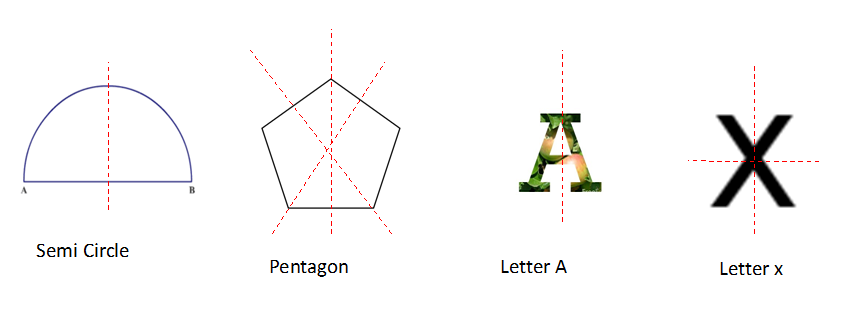
Draw the line or lines of symmetry, if any, of the following shapes:
Answer – the red dotted lines, show the lines of symmetry. For Pentagon there could be more than 3 lines of symmetry. But for the purpose of illustration, we are showing only 3.
Source: Kapdec.com
Find the coordinates of the images of the following points under the reflection in the axes :
( 2,4 ) in the y-axis
( 1,5 ) in the x-axis
( 8,3 ) in the x-axis
( 4,5 ) in the y-axis
Solution: The reflected points:
( 2,4 ) in the y-axis = (- 2,4 )
(1,5) in the x-axis = (1,- 5 )
(8,3) in the x-axis = (8,-3 )
( 4,5 ) in the y-axis = (-4,5 )
