KAPDEC® | Elite STEM Learning Platform | https://kapdec.com
Unit: Number System
Chapter: Decimals – Introduction & Types
Reference: – Introduction to Decimals, Decimal Point and Place Value, Tenths, Hundredths, Thousandths, Like and Unlike Decimals, Terminating Decimals, Recurring (Repeating) Decimals, Non-Terminating Non-Recurring Decimals, Comparison of Decimals
After studying this chapter, you should be able to understand:
- Introduction to Decimals & Their Need
- Decimal Point and Place Value
- Tenths, Hundredths, Thousandths
- Like and Unlike Decimals
- Terminating Decimals
- Recurring (Repeating) Decimals
- Non-Terminating Non-Recurring Decimals
- Comparison and Ordering of Decimals
Introduction to Decimals

Source: Kapdec.com
Decimals are numbers representing special fractions with denominators as 10, 100, 1000, etc.
They are nothing but a way of writing whole number and fractional number together separated by a decimal point (dot).
Decimals are used to represent numbers that are smaller than the unit 1, e.g. 0.47, 0.25, 0.73, etc.
Source: Kapdec.com
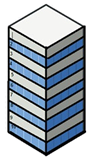
For example, in the following figure, one block is divided into 10 equal parts. In fractional terms, each part represents 1/10 (one-tenth) of a unit. In decimals, it can be denoted as 0.1
The decimal point is represented by the dot and it comes between the units place and the tenths place.
Representing decimals on a number line
We have learnt how to represent fractions and integers on a number line.
A decimal is represented on number line just like fractions.
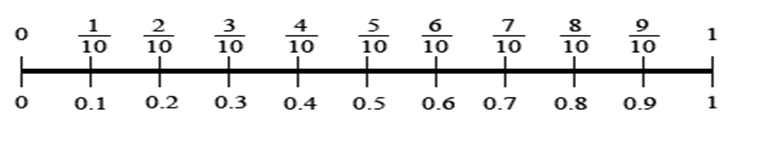
Let us look at decimals on number line up to one decimal point.
- We divide one unit of the number line into ten equal parts such that each part is one-tenth of the whole.
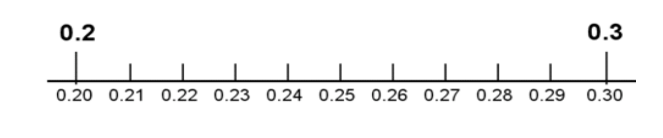
- When we further divide one-tenth part into ten equal parts, we get one-hundredth of the whole.
- This way we can keep on dividing to represent smaller decimal fractions.
Source: Kapdec.com
Source: Kapdec.com
Example- Represent 8.45 on number line
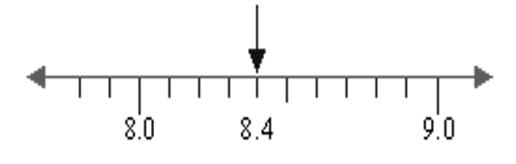
First let us represent the tenths place i.e. 8.4
Source: Kapdec.com
The segment between 8 and 9 is divided into 10 equal parts and the 4th part represents 8.4
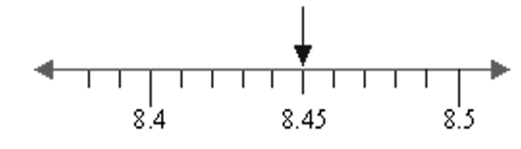
Now, to represent 8.45 on the number line, we further divide the segment between 8.4 and 8.5 into ten equal parts.
Source: Kapdec.com
Here each part represents hundredth place and the arrow which is five parts to the right of 8.4 points at 8.45.
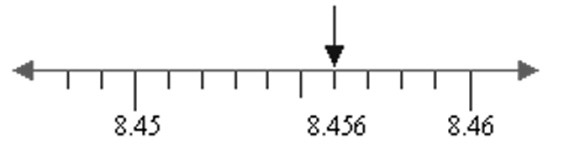
Similarly, we can represent 8.456 on a number line by dividing the segment between 8.45 and 8.46 into ten equal parts.
Source: Kapdec.com
The arrow which is six parts to the right of 8.45 points at 8.456.
Examples–
- Write as decimals: Nine-tenths
Solution:
= 9 × 0.1
= 0.9
- Write as decimals: Four tens and six-tenths
Solution:
= 4 × 10 + 6 × 0.1
= 40 + 0.6
= 40.6
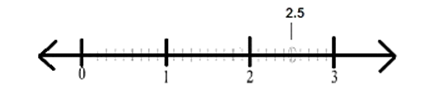
- Locate 2.5 on the number line.
Solution:
- We know that 2.5 is located between 2 and 3.
- So, we divide the block between 2 and 3 into ten equal parts.
- Then we mark 2.5 on the number line.
Source: Kapdec.com
Hundredths
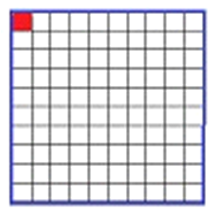
In Hundredth, one block is divided into 100 equal parts and each part comprises 1/100th part of the entire block.
Suppose a square is divided into 100 small parts or squares, then the area of each small square will be 1/100 or one hundredth of the entire square.
Source: Kapdec.com
- The area of the smaller square shaded red is one hundredth of the entire square.
- The decimal notation is 1/100 = 0.01.
Examples–
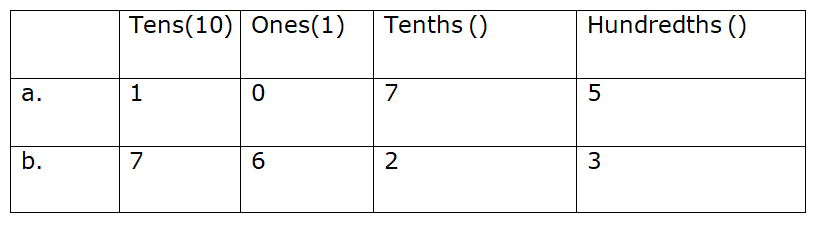
- Write the number given in the following place value table in decimal form.
Source: Kapdec.com
a) The number is 1 × 10 + 0 × 1 + 7 × 0.1 + 5 × 0.01
= 10 + 0 + 0.7 + 0.05
= 10 + 0.7 + 0.05
= 10 + 0.75
= 10.75
b) The number is 7 × 10 + 6 × 1 + 2 × 0.1 + 3 × 0.01
= 70 + 6 +0.2 + 0.03
= 76 + 0.23
= 76.23
- Write each of the following in decimals.
- Five point zero one = 5.01
- One hundred two point five nine = 102.59
