KAPDEC® | Elite STEM Learning Platform | https://kapdec.com
Unit: Number System
Chapter: Whole Numbers
Reference: – Introduction to Whole Numbers, Natural Numbers vs Whole Numbers, The Number Line, Successor and Predecessor, Properties of Whole Numbers (Closure, Commutativity, Associativity, Distributivity, Identity), Addition & Subtraction on the Number Line, Multiplication & Division, Patterns in Whole Numbers
After studying this chapter, you should be able to understand:
- Introduction to Whole Numbers & Their Need
- Natural Numbers vs Whole Numbers
- Representing Whole Numbers on the Number Line
- Successor and Predecessor
- Properties of Whole Numbers (Closure, Commutative, Associative, Distributive, Identity)
- Operations on Whole Numbers & Their Properties
- Patterns in Whole Numbers
Whole Numbers
We use 1, 2, 3, 4,… when we begin to count. They come naturally when we start counting. Hence, mathematicians call the counting numbers as Natural numbers.
- To find the next counting number, we add 1 to the counting number. This new number is also called the successor of the counting number.
- To find the previous counting number, we subtract 1 from the counting number. This new number is also called the predecessor of the counting number.
- The number 4 has 3 as its predecessor and 5 as its successor. Similarly, the successor of 2 is 3 and the predecessor is 1.
But is there any natural number which has no successor? Is there a last natural number?
There exist countable things like number of students in a class or number of red buses on road. There also exists things like number of sugar granules in 1 kg of sugar or number of stars in the sky which cannot be counted. Even if they were countable, a number would exist to state their count. We can always get a new number by adding 1 to it. So, we can say there does not exist any last natural number.
Does 1 have both a successor and a predecessor?
The successor of 1 is 2. But the number 1 has no predecessor in natural numbers. We add zero as the predecessor for 1 to the collection of natural numbers.
BUT – The natural numbers along with zero form the collection of whole numbers.
1. Are all the natural numbers also whole numbers?
2. Are all whole numbers also natural numbers?
3. Which is the greatest whole number?
The Number Line
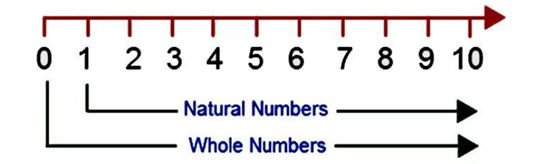
We have seen the number line for natural numbers start from 1.
When we mark a point 0, towards the left of point 1, this becomes a number line for whole numbers.
Source: Kapdec.com
Addition on the Number Line-
Addition of whole numbers can be shown on the number line.
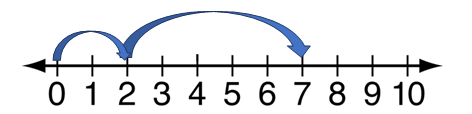
Let us see the addition of 2 and 5.
Source: Kapdec.com
We start from zero. For 2, we make move 2 units towards right. Since we add 5 to this number so we move5units further to the right.
The sum of 2 and 5 is 7, i.e. 2 + 5 = 7.
Subtraction on the Number Line:
The subtraction of two whole numbers can also be shown on the number line.
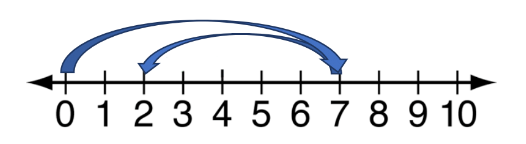
Let us find 7 – 5.
Source: Kapdec.com
We start from zero. For 7, we make move 7 units towards right. Since we subtract5from this number so we move5units to the left from point 7.
The difference of 7 and 5 is 2, i.e. 7-5 = 2.
Multiplication on the Number Line-
We now see the multiplication of whole numbers on the number line.
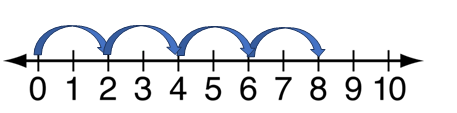
Let us find 2 × 4
Source: Kapdec.com
Multiplying 2 by 4 is same as adding 2 four times. To multiply, we start from zero and make 4 jumps of 2 units each towards right.
The product of 2 and 4 is 8, i.e. 2 × 4 = 8.
Magic or Maths??
1089 trick
Step #1: Write down any three digits number with decreasing digits.
Step #2: Reverse the number you wrote in step #1.
Step #3: Subtract the number obtained in step #2 from the number you wrote in step #1
Step #4: Reverse the number obtained in step #3
Step #5: Add the numbers found in step #3 and step #4
You will find that the result is always 1089
