KAPDEC® | Elite STEM Learning Platform | https://kapdec.com
Algebra: Comparing Quantities
Profit or Loss as a Percentage:
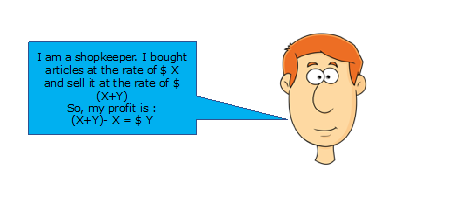
Profit and Loss: In our daily life, we buy goods from the shopkeepers in the market which they buy either directly from manufacturers or through wholesalers.
Source: Kapdec.com
In order to earn money, the shopkeepers sell goods at a rate which is higher than the rate at which they purchased them.
Cost Price: The money paid by the shopkeeper to buy the goods from a manufacturer or a wholesaler is called the cost price of the shopkeeper and denoted by C.P.
Selling Price: The price at which a shopkeeper sells the goods is called the selling price of the shopkeeper, and it is denoted by S.P.
Profit: If the selling price of an article is greater than cost price, then the shopkeeper makes a gain or profit, and the amount of profit is equal to the difference between the selling price and the cost price.
Thus, if S.P. > C.P. Profit = Sell price – Cost price
Loss: If the selling price of an article is less than the cost price then the shopkeeper suffers a loss, and the amount of loss is equal to the difference between the cost price and the selling price.
Thus, if S.P. < C.P., then.
Loss= cost price – sale price
Example: If the cost price of an article is $20 and the selling price is $30, find the profit on the sold article.
Solution:We have,
Cost price= $20
Sell price =$30
Thus, profit= sale price – cost price
Profit= 30- 20 = $10
Example: If the cost price of an article is $65 and the selling price is $50, find the profit or loss on the whole transaction.
We have,
Cost price =$65
Sell price= $50
We say that the cost price is greater than the sale price, so there is a loss on the whole transaction.
Thus, Loss = cost price- sell price
Loss= 65- 50= $15
Profit Percent and Loss Percent:
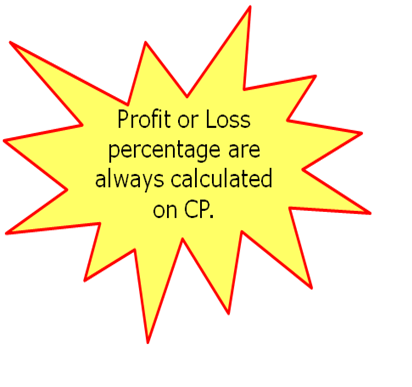
In order to compare the profit or loss on the transaction, we usually express profit and loss as a percent of the cost price.
The profit percentage is the profit that would be obtained for a C.P. of $ 100.
Similarly, the loss percentage is the loss that would be made for a C.P. of $100
Profit %= ProfitsC.P.

Source: Kapdec.com
× 100
Loss% = LossC.P.

Source: Kapdec.com
× 100
Source: Kapdec.com
Example: If cost price =$1120, sale price= $1260
Then profit%=?
We have,cost price =$1120
Sell price= $1260
Profit= 1260-1120= $140
Profit %= ProfitsC.P.

Source: Kapdec.com
× 100
Profit% = 1401120

Source: Kapdec.com
× 100 = 12.5%
Example:
If the sell price = $30 and cost price = $40 then, find loss%:
We have,sell price = $30
Cost price= $40
Loss = 40 -30 = $10
Loss% = LossC.P.

Source: Kapdec.com
× 100
Loss% = 1040

Source: Kapdec.com
× 100 = 25%
Example: If the cost price of 6 apples is equal to the selling price of 5 apples. Find the profit percentage.
Solution:Let the cost price of each apple be $1
Then, CP of 5 apples = $5
SP of 5 apples = CP price of 6 apples = $6
Profit = SP – CP = 6-5 = $1

Source: Kapdec.com
Example: By selling a TV for $240, a seller’s profit is 20%. Find the cost price of the TV.
Solution:Let the CP be$100
Then, SP = $(100+20) = $120
If the SP is $120, then CP = $100

Source: Kapdec.com
Some useful formula:
Some useful formula:
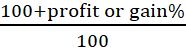
S.P. = 100+profit or gain%100
Source: Kapdec.com
× C.P.
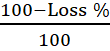
S.P. = 100-Loss %100
Source: Kapdec.com
× C.P.
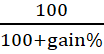
C.P. = 100100+gain%
Source: Kapdec.com
× S.P.
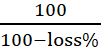
C.P. = 100100-loss%
Source: Kapdec.com
× S.P.
**Students are advised to remember the above formula because it will be helpful in solving various difficult problems of profit and loss.
Key Point:
The profit or loss incurred in a certain transaction can be expressed in terms of percentages
Scan to visit this resource online
https://kapdec.com/resources/conversion-profit-loss-simple-interest
