KAPDEC® | Elite STEM Learning Platform | https://kapdec.com
Unit: Mensuration
Chapter: Area, Perimeter & Volume
Reference: – Introduction to Perimeter, Perimeter of Square, Rectangle, Triangle and Circle, Introduction to Area, Area of Square, Rectangle, Triangle, Parallelogram, Circle, Introduction to Volume, Volume of Cube, Cuboid, Cylinder, Relationship Between Perimeter, Area and Volume, Real-Life Applications
After studying this chapter, you should be able to understand:
- Introduction to Perimeter & Its Meaning
- Perimeter of Square, Rectangle, Triangle and Circle
- Introduction to Area & Its Meaning
- Area of Square, Rectangle, Triangle, Parallelogram and Circle
- Introduction to Volume & Its Meaning
- Volume of Cube, Cuboid and Cylinder
- Relationship Between Perimeter, Area and Volume
- Real-Life Applications of Perimeter, Area and Volume
Volume
Volume refers to the measurement of the material of which an object is made of. Volume is always measured in cubic units.
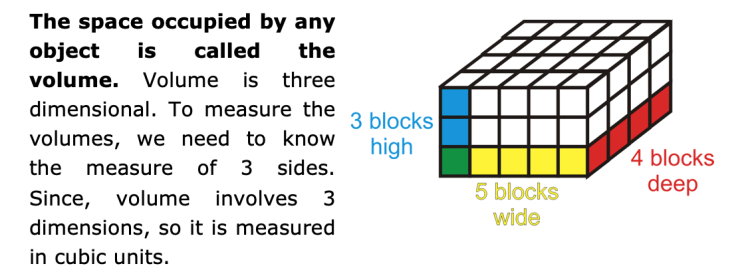
Source: Kapdec.com
Surface like the page of a book, blackboard, etc. are called plane surfaces. They do not have any volume but have only area.
A cube is a solid box whose each surface is a square of same area.
Therefore, cube has:
- 6 surfaces or faces
- 8 vertices
- 12 edges or sides of equal length
Volume of a cube with side length 1 unit is 1 cubic unit. Such cube is called a “unit cube,” and used as unit of volume.
Volume of a cuboid
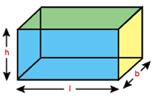
Source: Kapdec.com
Cuboid is a three dimensional figure with length, breadth and height. It has 6 rectangular faces, 8 vertices and 12 edges.
Volume of a cuboid = length x breadth x height = l x b x h cubic units
Or
= area of one surface x height cubic units
(as area =l x b)
Note: In a cuboid, when the length, breadth and height are of different units, convert them to a same unit and solve.
For Example:
1. Find the volume of the cuboid if length, breadth and height are 10cm, 15cm and 20cm respectively.
Solution:
Length of cuboid = 10cm
Breadth of cuboid = 15 cm
Height of cuboid = 20cm
The volume of cuboid = l * b * h = 10 x 15 x 20 = 3000 sq cm
=10 ×15 ×20

Source: Kapdec.com
2. If the volume of the cuboid is 350 cubic cm. The breadth and height of it are 5 cm and 7 cm respectively. Find the length of cuboid.
Solution:
Let the length of cuboid = L
The (B) breadth of cuboid = 5cm
The (H) height of cuboid = 7cm
The volume of cuboid = 350cm3

Source: Kapdec.com
Then, V = L x B x H
à 350 = L x 5 x 7
L = 350/(5×7) = 10 cm
Volume of a Cube
Cube also has three dimensions like cuboid but the length of each side is same. The volume of cube is similar to that of cuboid.
So, Volume of a cube = side × side × side
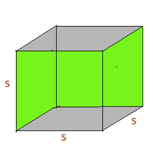
Source: Kapdec.com
= s × s × s cu units
Or
= length × length × length
= l × l × l cu units
Or
= area × side cu units
(And we know that area of square = side × side)
For Example:
1. Calculate the volume of cube. If length of each side is 7cm.
Solution:
The length of each side = 7cm
The volume of cube = a x a x a = 7 x 7 x 7 = 343 cubic cm.
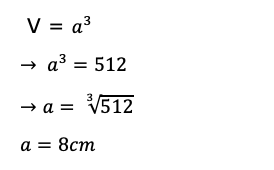
2. If the volume of a cube is 512 cubic cm. Find the length of the cube.
Solution:
Let the length of cube be a cm

Source: Kapdec.com
The volume of cube = 512cm3

Source: Kapdec.com
We know that,
Source: Kapdec.com
Volume by counting cubes
- Find out the number of unit cubes that form the solid or fill up the entire space occupied by the given solid such as cuboid and cube.
Example:
- Take an empty cube shaped box of edge 4 cm with open top. Now fit cubes of edges 1 cm in it.
- How many cubes of 1 cm can be fitted into cube box of edge 4 cm?
- From the observation, it is clear that 64 such cubes will fit into it. So, the volume of the box will be equal to the volume of 64 unit cubes together.
- Therefore, the volume of the cube = 64 cu cm
Note that 64 = 4 × 4 × 4
Let us look at few examples-
Example: Find the number of cubical boxes of cubical side 5 cm, which can be accommodated in carton of dimensions 25 cm x 10 cm x 15 cm.
Solution:
Volume of cubical box = side x side x side = 5 x 5 x 5 = 125 cu cm
Volume of carton = 25 x 10 x 15 = 3750 cu cm
No. of boxes = Volume of carton/Volume of each box = 3750/125 = 30
Source: Kapdec.com
