KAPDEC® | Elite STEM Learning Platform | https://kapdec.com
Unit: Basic Algebra
Chapter: Profit & Loss
Reference: – Introduction to Profit and Loss, Cost Price (CP), Selling Price (SP), Profit and Loss Formulas, Profit Percentage and Loss Percentage, Finding CP or SP When Profit/Loss Percentage is Given, Overhead Expenses, Discount and Marked Price, Real-Life Applications
After studying this chapter, you should be able to understand:
- Introduction to Profit and Loss
- Cost Price (CP) and Selling Price (SP)
- Profit and Loss Formulas
- Profit Percentage and Loss Percentage
- Finding CP or SP When Profit/Loss Percentage is Given
- Overhead Expenses
- Discount and Marked Price
- Real-Life Applications of Profit and Loss
Understanding Averages
The word “average” is used in everyday life to describe what the middle number of a data set is. We often use this term in places like-
- The average height of the students in my class is 132cm
- In the last exam, my average marks were 92.
- The average attendance of class in January was 52 students out of 60.
- Run rate in cricket is the average runs per over that a team scores.
But what exactly does this term mean?
A value which gives us an indication of other values or quantities in a group is called average.
Most of us love watching or playing cricket. So, let us take the example of how average is used in cricket.
- Suppose in 5 cricket test matches, the player, M. S. Dhoni has scored 92, 71, 105, 89 and 108 runs. So, here we can say the average score of M. S. Dhoni in 5 test matches was 93.
- Consider another scenario, that, Zaheer Khan bowled six overs and gave 2, 1, 4, 0, 2 and 6 runs. The average runs he gave per over were 2.5 runs and in cricket we use the term economy for showing average runs while balling. So, here we can say Zaheer Khan has an economy of 2.5 runs.
- In another case, suppose a match between India & New Zealand, is going on and India needs 26 runs in 4 overs to win. So, on average, India needs 6.5 runs in each over in order to win the match.
How do we find average?
To calculate the average of a group of numbers, we-
- Add the numbers together
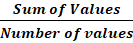
- Divide this sum by the “total number” of values are being added together.
i.e. Average = Sum of ValuesNumber of values
Source: Kapdec.com
Let us look at an example–
Question:
Find the average of first 5 natural numbers.
Solution:
First 5 Natural numbers are 1, 2, 3, 4 and 5
Sum of these natural numbers = 1 + 2 + 3 + 4 + 5 = 15
Average = Sum of 1st 5 natural numbersNumber of natural numbers

Source: Kapdec.com
= 155 =3

Source: Kapdec.com
Thus, the average of first 5 natural numbers is 3.
So, what do we mean by this?
It shows that all the numbers in the group of first five natural numbers lie around 3.
Why not 1? Or 5? If we suppose any other number as the average, like 1 or 5, it would be wrong as they are extreme numbers in the group and are too far off from the other numbers as compared to 3. So, they cannot give an indication of other numbers of the group.
Note-
- The average value lies between the lowest value and the highest value of the group.
- The average value need not necessarily be a value equal to one of the value given in the group of values. It can be a number other than given ones but is indicative of the rest.
- We cannot calculate average of two or more different types of quantities.
Examples-
- The weights (in kgs) of 7 students in a class are 30kg, 42kg, 35kg, 33kg, 40kg, 38kg, 34kg. Find their average weight.
Solution
Sum of their weights = 30kg + 42kg + 35kg + 33kg + 40kg + 38kg + 34kg = 252kg
Average weight of the students = Sum of WeightsNumber of students=2527 =36kg.

Source: Kapdec.com
Thus, the average weight of the students is 36kg.
- Virat scored 64, 81, 59, and 72 runs in four innings while Sachin scored 67, 79 and 82 runs in three innings. Who has the better average?
Solution
Total runs scored by Virat = 63 + 81 + 59 + 72 = 276
Average runs scored by Virat = Total RunsNumber of innings = 2764 = 69

Source: Kapdec.com
runs
Total runs scored by Sachin = 67 + 79 + 82 = 228
Average runs scored by Sachin = Total RunsNumber of innings = 2283 = 76

Source: Kapdec.com
runs
Thus, Sachin has a better average in score.
- The average height of 6 students is 132cm. If height of 5 of the students is 122cm, 140cm, 138cm, 125cm, 130cm. Find the height of the 6th student.
Solution
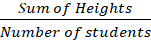
Average height of the students = Sum of HeightsNumber of students
Source: Kapdec.com
So, Sum of the heights of the students = Average height × Number of students
122cm + 140cm + 138cm + 125cm + 130cm + height of the 6th student = 132cm × 6
655cm + height of the 6th student = 792cm
Height of the 6th student = 792cm – 655cm = 127cm
Thus, height of the 6th student is 127cm.
Can you solve this??
If I drive half-way to the city at 30 km/hour, how fast do I have to
go for the rest of the way to make the average speed for the entire
journey of 60 km/hour?
Solution
Infinite Speed!
You are half way there, and want to double your average, so your
speed would have to be infinite.
For example, let’s say it is 120 km to the city.
You get halfway (60 km) at 30 km/h, which takes 2 hours.
To make it all the way (120 km) at 60 km/h would take 2 hours,
but you have already been driving for 2 hours, so your time is up!
