KAPDEC® | Elite STEM Learning Platform | https://kapdec.com
Unit: Number System
Chapter: Prime Factorization, HCF & LCM
Reference: – Prime Factorization (Factor Tree & Division Methods), Highest Common Factor (HCF/GCD), Lowest Common Multiple (LCM), HCF and LCM by Prime Factorization, Relationship Between HCF and LCM, Properties of HCF and LCM, Real-Life Applications
After studying this chapter, you should be able to understand:
- Prime Factorization & Its Methods
- Highest Common Factor (HCF) & How to Find It
- Lowest Common Multiple (LCM) & How to Find It
- Finding HCF and LCM by Prime Factorization
- Relationship Between HCF and LCM
- Properties of HCF and LCM
- Real-Life Applications of HCF and LCM
Prime Factorization
When we express a composite number as a product of prime numbers, it is called prime factorization. The set of prime numbers are called the prime factors of the given number.
Example-Let us take a number 24.
Factors of 24 = 1, 2, 3, 4, 6, 8, 12 and 24.
Out of these factors, the prime factors are 2 and 3.
Now, let us express 24 as a product of its prime factors.
So, 24 = 2 × 2 × 2 × 3
Thus, prime factorization is expressing a number as a product of its prime factors.

Source: Kapdec.com
Method 1: Factor Tree Method
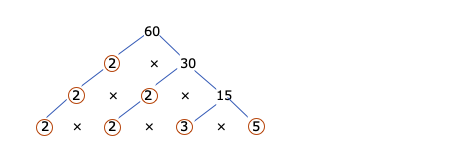
- In this method, we start splitting the given numbers into factors until we cannot split anymore.
- The factor that cannot be split anymore i.e. the prime factor is carried down as it is whereas the composite factor is further split in the next step till it becomes prime.
- Then, all the prime factors of the number are stated in product form to define the actual number.
- The standard way of listing the prime factors is from smallest number to the largest one.
Example – Find the prime factorization of 60.
Source: Kapdec.com
Thus, 60 = 2 × 2 × 3 × 5
#The given number can be treated as a stem while its breakup into prime factors can be treated as its branches.
Method 2: Short Division Method
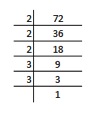
- In this method, first we divide the given number by a smallest prime number which completely divides the given number.
- Then, we divide the quotient again with a smallest prime number or the next smallest prime number which can completely divide the number.
- We repeat the above step again and again, till the quotient becomes 1.
- The product of all the divisors that we got through the above step gives us the number itself and are thereby the prime factors of the number.
Example – Find the prime factorization of 72.
Source: Kapdec.com
Thus, 72 = 2 × 2 × 2 × 3 × 3
