KAPDEC® | Elite STEM Learning Platform | https://kapdec.com
Unit: Number System
Chapter: Multiplication & Division of Large Numbers
Reference: – Multiplication of Large Numbers (Long Multiplication, Regrouping), Division of Large Numbers (Long Division, Dividend, Divisor, Quotient, Remainder), Estimation in Multiplication and Division, Word Problems on Multiplication and Division, Properties of Multiplication and Division, Real-Life Applications
After studying this chapter, you should be able to understand:
- Multiplication of Large Numbers (Long Multiplication & Regrouping)
- Division of Large Numbers (Long Division & Its Components)
- Estimation in Multiplication and Division
- Word Problems on Multiplication and Division
- Properties of Multiplication and Division
- Real-Life Applications of Large Number Operations
Multiplication of Large Numbers
Multiplication of two numbers is nothing but repeated addition. It is equivalent to adding one of the numbers as many times as the value of the other.
Examples-
- 7 X 5 = 7 + 7 + 7 + 7 + 7 = 35
- 9 X 3 = 9 + 9 + 9 = 27
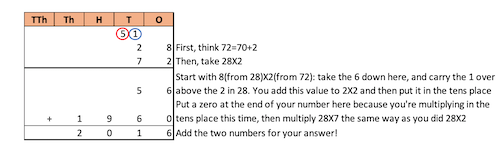
Now, for example there are 72 students in a class and each student buys books and copies worth $28. What was the total spending on books for all students?
In this case, we multiply 28 with 72 to find the total spending. But to find the final answer, we cannot add 72 times, the number 28.
So, similar to addition and subtraction, we have a method to multiply the two numbers.
- We multiply the first digit i.e. the unit digit of the number by each digit of the other number starting left and carrying wherever necessary.
- Then we multiply the second digit from each digit of the other number writing our product from tens place.
- We do the same for third starting writing our product from hundreds place and so on.
- We then add all the products to get the multiplied number.
Let us find the total spending on books using this method-
Source: Kapdec.com
So, from the above table we can say that the total spending on books was $2016.
Let us have a look at a practical problem on multiplication of large numbers-
Example-
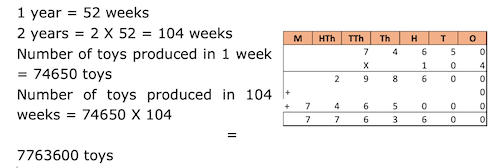
A factory produces 74650 toys in a week. How many toys will it produce in 2 years?
Solution-
Source: Kapdec.com
So, in two years the factory produces 7,763,600 toys.
Properties of Multiplication
It is important to know about the properties because it helps in making our multiplication easier if we know where to use them. Let us look at the properties-
- Multiplicative Property of 0: If a number is multiplied by 0, the product is 0.
Example: 71,542 X 0 = 0
- Multiplicative Property of 1: If a number is multiplied by 1, the product is the number itself.
Example: 149,632 X 1 = 149,632
- Commutative Property of Multiplication: The product of two numbers does not change with a change in the order of the numbers.
Example: 18,257 X 9 = 164,313
9 X 18,257 = 164,313
18,257 X 9 = 9 X 18,257
- Associative Property of Multiplication: Regrouping and changing the order of the numbers does not change the product of the numbers.
Example: 60 X 8 X 100 = (60 X 8) X 100 = 480 X 100 = 48000
60 X 8 X 100 = 60 X (8 X 100) = 600 X 800 = 48000
60 X 8 X 100 = (60 X 100) X 8 = 6000 X 8 = 48000
- Distributive Property of Multiplication: Bigger numbers can be divided into smaller numbers to multiply easily.
Examples:
- 18 X 98 = 18 X (100 – 2)
= (18 X 100) – (18 X 2)
= 1800-36
=1764
- 24 X 125 = 24 X (100 + 20 + 5)
= 24 X 100 + 24 X 20 + 24 X 5
= 2400 + 480 + 120
= 3000
Multiplication of a number by 10, 100, 1000, 10000
- When a number is multiplied by 10, 20, 30, 40, .. , 90; we multiply the number by 1, 2, 3,.., 9 respectivelyand add a zero at the end of the multiplied number.
- When a number is multiplied by 100, 200, 300, 400, .. , 900; we multiply the number by 1, 2, 3,.., 9 respectivelyand add 2 zeroes at the end of the multiplied number.
- When a number is multiplied by 1000, 2000, 3000, 4000, .. , 9000; we multiply the number by 1, 2, 3,.., 9 respectivelyand add 3 zeroes at the end of the multiplied number.
- When a number is multiplied by 10000, 20000, 30000, 40000, .. , 90000; we multiply the number by 1, 2, 3,.., 9 respectivelyand add 4 zeroes at the end of the multiplied number.
Examples-
- 7 X 20 = (7 X 2) X 10 = 14 X 10 = 140
- 12 X 5000 = (12 X 5) X 1000 = 60 X 1000 = 60000
Fun Fact
111,111,111 × 111,111,111 = 12,345,678,987,654,321
It also works for smaller numbers: 111 × 111 = 12321.
Scan to visit this resource online
https://kapdec.com/resources/multiplication-division-of-large-numbers
